THE CLASSIC COLLECTION✦My diaries, being a personal narrative of events 1888-1914, Part 2 (1900-1914)CLASSIC FREE BOOKS
My diaries, being a personal narrative of events 1888-1914, Part 2 (1900-1914)
Wilfrid Scawen Blunt
THE CLASSIC COLLECTION · 1904
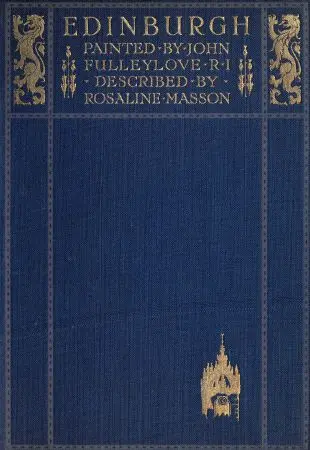
"Edinburgh" by Rosaline Masson is a historical account written in the early 20th century. The text intricately explores the rich history and cultural significance of Edinburgh, focusing on its landmarks, legends, and the impactful figures associated with the city. The work delves into key historical events tied to locations such as Edinburgh Castle and Holyrood Palace, creating a vivid portrait of the city’s past. The opening of the book introduces several historical narratives centered around Edinburgh Castle, emphasizing its legendary status and storied past. Masson recounts tales of royal figures such as Malcolm Canmore and Queen Margaret, illustrating their significance in shaping the castle's history. Throughout this section, the author presents a tapestry of events, from battles and sieges to romantic dramas, showcasing the castle as a symbol of Scottish resilience and heritage. This foundational chapter sets the tone for an exploration of the city's evolution, inviting readers to further discover Edinburgh's rich historical landscape.
Introduction adapted from the source catalogue; source summaries may be automatically generated.
Free to read · English · 47,085 words · No account needed
MAKE TIME FOR A GOOD BOOK
On by default. Untick to stop anonymous reading totals. Each page counts after 10 seconds in view. How this works.
Anonymous counting is on unless you have switched it off.
[19] Diurnal of Occurrents in Scotland, quoted in Mary, Queen of Scots, by Robert S. Rait, pp. 120-121.
[20] R. S. Mylne’s The King’s Master Masons.
[21] Sir Walter Scott.
[22] History of St. Giles’s, Edinburgh, by the Very Rev. James Cameron Lees, D.D. W. and R. Chambers.
[23] Still called “The Albany Aisle.”
[24] Walter Chepman built a chapel of the Crucifixion in the lower part of the churchyard, endowing its chaplain for the welfare of the soul of King James and those who were slain with him at Flodden. This chapel was pulled down during John Knox’s ministry to form the “Outer Tolbooth” for the Lords of Session.
[25] Burgh Records of Edinburgh (1403-1528), p. 144.
[26] At the end of his life, Knox preached within another division, designated “The Tolbooth Kirk.”
[27] Laud’s Service-Book.
[28] Gordon, Hist. of Scots Affairs (Spalding Club), i. 7.
[29] History of Scotland, Professor Hume Brown, ii. 301.
[30] The stream of people pouring out of a church-door is called “the church skaling” in Scotland.
[31] History of St. Giles’s, Edinburgh, by the Very Rev. Dr. Cameron Lees. W. and R. Chambers.
[32] “Edinburgh’s Joy,” etc. Quoted in Dr. Hill Burton’s History,
vii. 387.
[33] History of St. Giles’s, Edinburgh, by the Very Rev. Dr. Cameron Lees. W. and R. Chambers.
[34] Taylor’s Pennyless Pilgrimage.
[35] A “land” is a house of several storeys, usually consisting of
different tenements.
[36] Melville’s Memoirs, p. 181.
[37] The initials G. S. for the wife suggest that the formal “Egidia” was softened, after the homely Scottish fashion, into “Gidy.”
[38] Scandals.
[39] Byers’ Close takes its name from John Byers of Coates, and the carved lintel, “I.B: M.B: 1611 Blissit be God in al his giftis,” now on the old family mansion, Coates House, within the grounds of St. Mary’s Cathedral, was removed from Byers’ Close.
[40] Wilson’s Memorials, ii. footnote to p. 12; and Grant’s Old and New Edinburgh, i. 223.
[41] Sir Alexander Boswell.
[42] This Robert Mylne (F.R.S.) was a great-grandson of the Robert Mylne mentioned on p. 68, and was tenth in the line of Scottish Royal Master Masons of that name. He afterwards settled in London, where he built Blackfriars Bridge over the Thames, was the successor of Wren as Superintendent of St. Paul’s Cathedral, and died in 1811.
[43] Only the entries to these closes have been suffered to remain.
Chambers’s Traditions of Edinburgh, p. 214.
[44] Heroic Love, James Graham, Marquis of Montrose.
[45] Chambers’s Traditions of Edinburgh, pp. 354-356.
[46] This inn must not be confused with Whitehorse Inn in Boyd’s Close (no longer existing), where Dr. Johnson went on his arrival in Edinburgh in 1773.
[47] Poets.
[48] Wilson’s Memorials, ii. 48.
[49] Tells tales.
Your reading position is saved on this browser. Take it to another device with a library code. Reading pages adapt to text, rather than matching a printed edition.
BEHIND THE BOOK
This eBook is for the use of anyone anywhere in the United States and most other parts of the world at no cost and with almost no restrictions whatsoever. You may copy it, give it away or re-use it under the terms of the Project Gutenberg License included with this eBook or online at www.gutenberg.org. If you are not located in the United States, you will have to check the laws of the country where you are located before using this eBook. Read the source licence.
The original source file, including credits and licence, is retained by this library. Request an original-format copy at no charge. Please include the book title and Project Gutenberg identifier #47466.
KEEP YOUR CURIOSITY GOING
Wilfrid Scawen Blunt
Wilfrid Scawen Blunt

E. W. (Edgar Watson) Howe
Cécile Tormay

Moritz Busch
John L. Ransom