Things to be Remembered in Daily Life With Personal Experiences and Recollections
John Timbs
THE CLASSIC COLLECTION · 1869
"Eccentricities of the Animal Creation" by John Timbs is a zoological treatise written in the late 19th century. This work delves into the peculiar characteristics and behaviors of various animals, blending observations from natural history with engaging anecdotes. The book appears to aim at educating readers about fascinating facts surrounding animals, capturing both their whimsical traits and significant historical contexts. The opening of the book introduces the topic of zoological curiosities, highlighting humankind's long-standing interest in animal life across different cultures and eras. It references historical accounts of zoological gardens dating back thousands of years, discussing their origins and the exotic creatures kept within them. Timbs specifically emphasizes the rich history of zoological collections in places like China, Greece, and England, noting earlier examples such as the famous menagerie in the Tower of London. Additionally, the introduction sets the stage for subsequent chapters that promise to explore various eccentricities and remarkable habits of animals, indicating a blend of education and storytelling aimed at both young and adult audiences.
Introduction adapted from the source catalogue; source summaries may be automatically generated.
Free to read · English · 87,626 words · No account needed
MAKE TIME FOR A GOOD BOOK
On by default. Untick to stop anonymous reading totals. Each page counts after 10 seconds in view. How this works.
Anonymous counting is on unless you have switched it off.
The habits of the Great Ant-Bear in captivity have been described scientifically yet popularly, from the Zoological Society's specimen, by Professor Owen, who writes:--"When we were introduced to this, the latest novelty at the noble vivarium in the Regent's-park, we found the animal busy sucking and licking up--for his feeding is a combination of the two actions--the contents of a basin of squashed eggs. The singularly long and slender head, which looks more like a slightly bent proboscis, or some such appendage to a head, was buried in the basin, and the end of the lithe or flexible tongue, like a rat's tail, or a writhing black worm, was ever and anon seen coiling up the sides of the basin, as it was rapidly protruded and withdrawn. The yellow yolk was dripping with the abundant ropy saliva secreted during the feeding process from the exceedingly small terminal mouth; for the jaws are not slit open, as in the ordinary construction of the mouths of quadrupeds, and the head, viewed sideways, seems devoid of mouth; but this important aperture--by some deemed the essential character of an animal--is a small orifice or slit at the end of the tubular muzzle, just being enough, apparently, to let the vermiform tongue slip easily in and out. The tongue, the keeper told us, was sometimes protruded as far as fourteen inches from the mouth."
By the Qjuarani Indians the beast is known by a name which is, in Spanish, "little mouth." The Portuguese and Spanish peons call it by a name equivalent to "Ant-Bear." In the Zoological Catalogue the animal is denominated Myrmocophaga jubata, or the "Maned Ant-eater." This appellation would very well suit the animal if, as most spectators commonly imagine at first sight, its head was where its tail is, for the tail is that part of the animal on which the hair is most developed, after the fashion of a mane; whilst the actual head appears much more like a tail, of a slender, almost naked, stiff, rounded kind. The body is wholly covered by long, coarse hair, resembling hay, rapidly lengthening from the neck backwards to six or eight inches, and extending on the tail from ten to eighteen inches. The colour is greyish brown, with an oblique black band, bordered with white, on each shoulder. The animal measures about four feet from the snout to the root of the tail; and the tail, three feet long, resembles a large screen of coarse hair. When the animal lies down, it bends its head between its fore legs, slides these forward, and crosses them in front of the occiput, sinks its haunches by bending its hind legs and bringing them close to the fore feet; then, leaning against the wall of its den, on one side, it lays the broad tail over the other exposed side of the body, by the side bend of that part, like the movement of a door or screen. Nothing is now visible of the animal but the long coarse hair of its natural and portable blanket. When it is enjoying its siesta, you cannot form any conception of its very peculiar shape and proportions; an oblong heap of a coarse, dry, greyish thatch is all that is visible. When, however, the keeper enters the den with any new dainty, as cockroaches, crickets, maggots, or meal-worms, to tempt the huge insect-devourer, the quick-hearing animal unveils its form by a sweeping movement of the thatch outwards, the tail that supports it rotating, as if joined by a kind of door-hinge to the body; the head is drawn out from between the fore limbs; the limbs are extended, and the entire figure of this most grotesque of quadrupeds stalks forth. The limbs are short; the fore limbs grow rather thicker to their stumpy ends, which look as if the feet had been amputated. The four toes, with their claws, are bent inwards, and are of very unequal length. This is the most singular part of the animal: it is also the most formidable member, and, indeed, bears the sole weapon of defence the beast possesses. The innermost toe, answering to the thumb on the fore limb of the neighbouring chimpanzee, is the shortest. A fifth toe seems to be buried in the outside callosity, on which the animal rests its stumpy feet while walking. At the back part of the sole, or palm, of the fore foot, is a second large callosity, which receives the point of the great claw in its usual state of inward inflection. Against this callosity the animal presses the claw when it seizes any object therewith; and Azara, as we have seen, avers that nothing can make the Ant-Bear relax its grasp of an object so seized.
Your reading position is saved on this browser. Take it to another device with a library code. Reading pages adapt to text, rather than matching a printed edition.
John Timbs
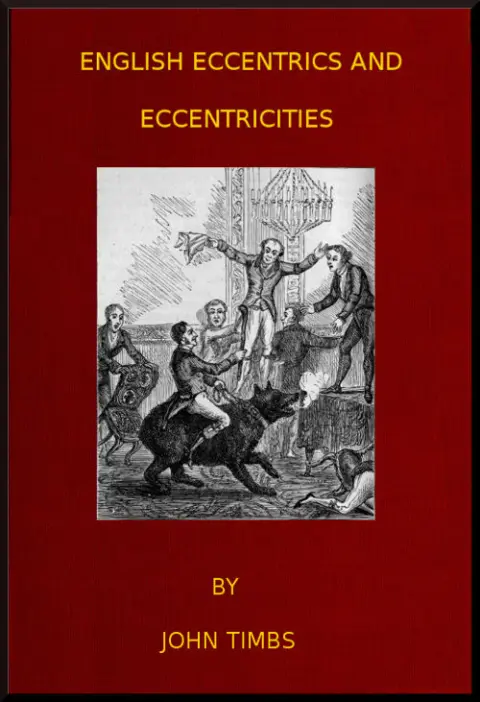
John Timbs
John Timbs
John Timbs
BEHIND THE BOOK
This eBook is for the use of anyone anywhere in the United States and most other parts of the world at no cost and with almost no restrictions whatsoever. You may copy it, give it away or re-use it under the terms of the Project Gutenberg License included with this eBook or online at www.gutenberg.org. If you are not located in the United States, you will have to check the laws of the country where you are located before using this eBook. Read the source licence.
The original source file, including credits and licence, is retained by this library. Request an original-format copy at no charge. Please include the book title and Project Gutenberg identifier #44422.
KEEP YOUR CURIOSITY GOING
Cécile Tormay

Moritz Busch
John L. Ransom
Frances Wright
Cécile Tormay

Mabel Potter Daggett