Things to be Remembered in Daily Life With Personal Experiences and Recollections
John Timbs
THE CLASSIC COLLECTION · 1869
"Eccentricities of the Animal Creation" by John Timbs is a zoological treatise written in the late 19th century. This work delves into the peculiar characteristics and behaviors of various animals, blending observations from natural history with engaging anecdotes. The book appears to aim at educating readers about fascinating facts surrounding animals, capturing both their whimsical traits and significant historical contexts. The opening of the book introduces the topic of zoological curiosities, highlighting humankind's long-standing interest in animal life across different cultures and eras. It references historical accounts of zoological gardens dating back thousands of years, discussing their origins and the exotic creatures kept within them. Timbs specifically emphasizes the rich history of zoological collections in places like China, Greece, and England, noting earlier examples such as the famous menagerie in the Tower of London. Additionally, the introduction sets the stage for subsequent chapters that promise to explore various eccentricities and remarkable habits of animals, indicating a blend of education and storytelling aimed at both young and adult audiences.
Introduction adapted from the source catalogue; source summaries may be automatically generated.
Free to read · English · 87,626 words · No account needed
MAKE TIME FOR A GOOD BOOK
On by default. Untick to stop anonymous reading totals. Each page counts after 10 seconds in view. How this works.
Anonymous counting is on unless you have switched it off.
Mr. E. Ray Lankester notices that the boring of Annelids seems quite unknown; and he mentions two cases, one by a worm called Leucadore, the other by a Sabella. Leucadore is very abundant on some shores, where boulders and pebbles may be found worm-eaten and riddled by them. Only stones composed of carbonate of lime are bored by them. On coasts where such stones are rare, they are selected, and others are left. The worms are quite soft, and armed only with horny bristles. How, then, do they bore? Mr. Lankester maintains that it is by carbonic acid and other acid excretions of their bodies, aided by the mechanical action of their bristles. The selection of a material soluble in these acids is most noticeable, since the softest chalk and the hardest limestone are bored with the same facility. This can only be by chemical action. If, then, we have a case of chemical boring in these worms, is it not probable that many Molluscs are similarly assisted in their excavations?
[27] How Brunel took his construction of the Thames Tunnel from observing the bore of the Teredo navalis in the keel of a ship, in 1814, is well known.
[28] "Athenæum," No. 1640.
[29] See also "Life in the Sea," in "Strange Stories of the Animal World," by the author of the present volume. Second Edition. 1868.
ANCIENT Zoological Gardens, 12
Animals, Rare, of London Zoological Society, 16, 17, 18
Annelids, boring, 348
Annelids and Molluscs, Boring Habits of, 348
Ant-Bear in captivity, 76
Ant-Bear, the Great, 72
Ant-Bear at Madrid, 72
Ant-Bear described, 77
Ant-Bear, Domestic, in Paraguay, 75
Ant-Bear, Economy of, 76
Ant-Bear and its Food, 74
Ant-Bears, Fossil, 80, 81
Ant-Bear, Muscular Force of, 79
Ant-Bear, Wallace's Account of, 73
Ant-Bear, Zoological Society's, 76, 82, 84
Ant-Eater, Porcupine, 84
Ant-Bear, Professor Owen on, 80
Ant-Eaters, scarcity of, 80
Ant-Eater, Tamandua, 82
Ant-Eaters, Von Saek's Account of, 83
Aristotle's History of Animals, 279, 280
BARNACLE GEESE, finding of the, 334
Barnacle Goose, Gerarde on, 332
Barnacle Goose, Giraldus Cambrensis on, 332
Barnacle Goose, Max Müller on, 331
Barnacle Goose, name of, 332
Barnacle Goose, Sir E. Tennent on, 334
Barnacle Goose, Sir Kenelm Digby on, 334
Barnacle Goose, Sir R. Moray on, 331
Barnacle Goose, Stories of the, 331-335
Barnacles breeding upon old ships, 333
Barnacle Geese in the Thames, 331
Bat, altivolans, by Gilbert White, 100
Bat, American, by Lesson, 91
Bat, Aristotle on, 85
Bat, Mr. Bell on, 86
Bats, Curiosities of, 85
Bat, described by Calmet, 87
Bat, Flight and Wing of, 96
Bats, in England, 100
Bat, Heber, Stedman, and Waterton on, 91
Bats in Jamaica, 100
Bat, Kalong, of Java, 98
Bat, Long-Eared, by Sowerby, 92, 93-96
Bat, Nycteris, 97
Bat, Rere-mouse and Flitter-mouse, 86
Bat Skeleton, Sir C. Bell on, 87
Bat in Scripture, 85
Bat, Vampire, from Sumatra, 88
Bat, Vampire, Lines on, by Byron, 89
Bat, vulgar errors respecting, 97
Bat-Fowling or Bat-Folding, 92
Berlin Zoological Gardens and Museum, 16
Bible Natural History, 11
Your reading position is saved on this browser. Take it to another device with a library code. Reading pages adapt to text, rather than matching a printed edition.
John Timbs
John Timbs
John Timbs
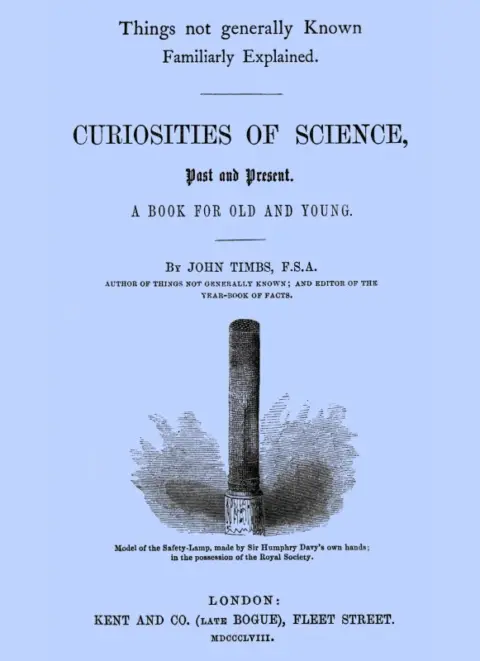
John Timbs
BEHIND THE BOOK
This eBook is for the use of anyone anywhere in the United States and most other parts of the world at no cost and with almost no restrictions whatsoever. You may copy it, give it away or re-use it under the terms of the Project Gutenberg License included with this eBook or online at www.gutenberg.org. If you are not located in the United States, you will have to check the laws of the country where you are located before using this eBook. Read the source licence.
The original source file, including credits and licence, is retained by this library. Request an original-format copy at no charge. Please include the book title and Project Gutenberg identifier #44422.
KEEP YOUR CURIOSITY GOING
Cécile Tormay

Moritz Busch
John L. Ransom
Frances Wright
Cécile Tormay

Mabel Potter Daggett