
Things to be Remembered in Daily Life With Personal Experiences and Recollections
John Timbs
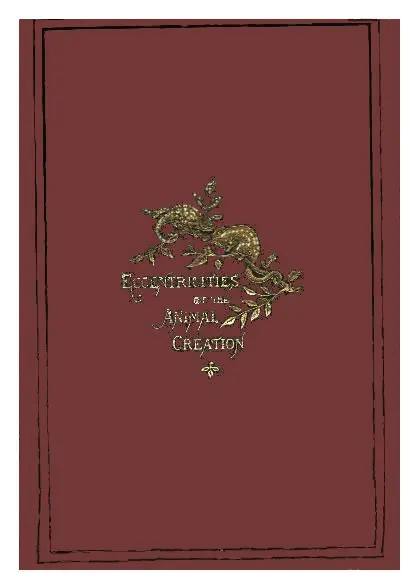
THE CLASSIC COLLECTION · 1869
"Eccentricities of the Animal Creation" by John Timbs is a zoological treatise written in the late 19th century. This work delves into the peculiar characteristics and behaviors of various animals, blending observations from natural history with engaging anecdotes. The book appears to aim at educating readers about fascinating facts surrounding animals, capturing both their whimsical traits and significant historical contexts. The opening of the book introduces the topic of zoological curiosities, highlighting humankind's long-standing interest in animal life across different cultures and eras. It references historical accounts of zoological gardens dating back thousands of years, discussing their origins and the exotic creatures kept within them. Timbs specifically emphasizes the rich history of zoological collections in places like China, Greece, and England, noting earlier examples such as the famous menagerie in the Tower of London. Additionally, the introduction sets the stage for subsequent chapters that promise to explore various eccentricities and remarkable habits of animals, indicating a blend of education and storytelling aimed at both young and adult audiences.
Introduction adapted from the source catalogue; source summaries may be automatically generated.
Free to read · English · 87,626 words · No account needed
MAKE TIME FOR A GOOD BOOK
On by default. Untick to stop anonymous reading totals. Each page counts after 10 seconds in view. How this works.
Anonymous counting is on unless you have switched it off.
"Proud swells her heart! she deems at last
To lure him with her silver tongue,
And, as the shelving rocks she passed,
She raised her voice, and sweetly sung.
"In softer, sweeter strains she sung,
Slow gliding o'er the moonlight bay,
When light to land the chieftain sprung,
To hail the maid of Colonsay.
"O sad the Mermaid's gay notes fell,
And sadly sink remote at sea!
O sadly mourns the writhèd shell
Of Jura's shore, its parent sea
"And ever as the year returns,
The charm-bound sailors know the day;
For sadly still the Mermaid mourns
The lovely chief of Colonsay."
Curious evidences of the existence of Mermaids are to be found in ancient authors. Pliny says that "the ambassadors to Augustine from Gaul declared that sea-women were often seen in their neighbourhood." Solinus and Aulus Gellius also speak of their existence. Some stories are, however, past credence. It is related in the "Histoire d'Angleterre" that, in the year 1187, a Merman was "fished up" off the coast of Suffolk, and kept for six months. It was like a man, but wanted speech, and at length escaped into the sea! In 1430, in the great tempests which destroyed the dykes in Holland, some women at Edam, in West Friesland, saw a Mermaid who had been driven by the waters into the meadows, which were overflowed. "They took it, dressed it in female attire, and taught it to spin!" It was taken to Haarlem, where it lived some years! Then we read of Ceylonese fishermen, in 1560, catching, at one draught, seven Mermen and Mermaids, which were dissected! In 1531, a Mermaid, caught in the Baltic, was sent to Sigismund, King of Poland, with whom she lived three days, and was seen by the whole court!
In Merollo's "Voyage to Congo," in 1682, Mermaids are said to be plentiful all along the river Zaire. In the "Aberdeen Almanack" for 1688, it is predicted that "near the place where the famous Dee payeth his tribute to the German Ocean," on the 1st, 13th, and 29th of May, and other specified times, curious observers may "undoubtedly see a pretty company of Mar Maids," and likewise hear their melodious voices. In another part of Scotland, about the same time, Brand, in his "Description of Orkney and Shetland," tells us that two fishermen drew up with a hook a Mermaid, "having face, arm, breast, shoulders, &c., of a woman, and long hair hanging down the neck, but the nether part, from below the waist, hidden in the water." One of the fishermen stabbed her with a knife, and she was seen no more! The evidence went thus:--Brand was told by a lady and gentleman, who were told by a baillie to whom the fishing-boat belonged, who was told by the fishers! Valentyn describes a Mermaid he saw in 1714, on his voyage from Batavia to Europe, "sitting on the surface of the water," &c. In 1758, a Mermaid is said to have been exhibited at the fair of St. Germain, in France. It was about two feet long, and sported about in a vessel of water. It was fed with bread and fish. It was a female, with negro features.
Your reading position is saved on this browser. Take it to another device with a library code. Reading pages adapt to text, rather than matching a printed edition.
John Timbs
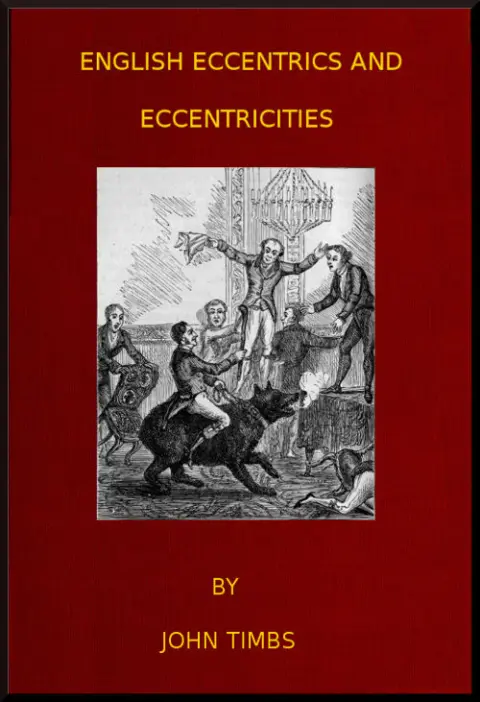
John Timbs
John Timbs
John Timbs
BEHIND THE BOOK
This eBook is for the use of anyone anywhere in the United States and most other parts of the world at no cost and with almost no restrictions whatsoever. You may copy it, give it away or re-use it under the terms of the Project Gutenberg License included with this eBook or online at www.gutenberg.org. If you are not located in the United States, you will have to check the laws of the country where you are located before using this eBook. Read the source licence.
The original source file, including credits and licence, is retained by this library. Request an original-format copy at no charge. Please include the book title and Project Gutenberg identifier #44422.
KEEP YOUR CURIOSITY GOING
Cécile Tormay

Moritz Busch
John L. Ransom
Frances Wright
Cécile Tormay

Mabel Potter Daggett