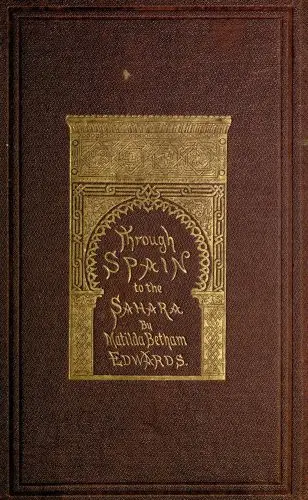
Through Spain to the Sahara
Matilda Betham-Edwards
THE CLASSIC COLLECTION · 1902
"East of Paris: Sketches in the Gâtinais, Bourbonnais, and Champagne" by Miss Betham-Edwards is a travel narrative written during the late 19th century. The book explores various regions of Eastern France, detailing the author's observations of quaint towns, landscapes, and local life. Through her sketches, the author aims to unveil the beauty and charm of lesser-known areas, inviting readers to experience the richness of these French locales alongside her travels. At the start of the narrative, the author expresses her eagerness to share her journeys through areas that have not been covered in her previous works. She reflects on the charm of different towns, including Melun, with its picturesque scenery and rich history. The opening describes the author's desire to engage deeply with the places she visits, offering tantalizing glimpses into the towns that form the backbone of her sketches, such as Moret-sur-Loing and Bourron. As she takes her readers on a leisurely exploration, she paints vivid pictures of her experiences, focusing on the natural beauty, historical relevance, and cultural surroundings of the regions explored.
Introduction adapted from the source catalogue; source summaries may be automatically generated.
Free to read · English · 39,427 words · No account needed
MAKE TIME FOR A GOOD BOOK
On by default. Untick to stop anonymous reading totals. Each page counts after 10 seconds in view. How this works.
Anonymous counting is on unless you have switched it off.
From a view of sky blue waters and smooth brown sands we were transported to a world of emerald green verdure and richest foliage, interpenetrated with golden light. On this 14th of September the warmth and dazzlingness of mid-summer still reigned at Pougues; and the scenery in which we suddenly found ourselves, bosquets, dells, and glades, with all the charm but without the savageness of the forest, recalled the loveliest lines of the laziest poet:--
“Was naught around but images of rest, And flowery beds, that slumberous influence kest[1], Sleep-soothing groves and quiet lawns between, From poppies breathed; and beds of pleasant green.”
[Footnote 1: Cast]
A drive of a few minutes had landed us in the heart of this little Paradise, baths and Casino standing in the midst of park-like grounds. Apparently Pougues, that is to say, the Pougues-les-Eaux of later days, has been cut out of natural woodland, the Casino gardens and its surroundings being rich in forest trees of superb growth and great variety. The wealth of foliage gives this new fashionable little watering-place an enticingly rural appearance, nor is the attraction of water wholly wanting. To quote once more a most quotable, if little read, poet:--
“Meantime, unnumbered glittering streamlets played, And hurled everywhere their water’s sheen, That, as they bickered through the sunny glade, Though restless still, themselves a lulling murmur made.”
A pretty little lake, animated with swans, varies the woodland scenery, and tropical birds in an aviary lend brilliant bits of colour. The usual accessories of a health resort are, of course, here--reading room, concert hall, theatre, and other attractions, rapidly turning the place into a lesser Vichy. The number and magnificence of the hotels, the villas and cottages, that have sprung up on every side, bespeak the popularity of Pougues-les-Eaux, as it is now styled, the surname adding more dignity than harmoniousness. One advantage Pougues possesses over its rivals, is position. At Aix-les-Bains, Plombières, Salins, and how many other inland spas, you are literally wedged in between shelving hills. If you want to enjoy wide horizons, and anything like a breeze, you must get well outside the town. Never in hot, dusty, crowded cities have I felt so half-suffocated as at the two first named places. Pougues, on the contrary, lies in a broad expanse of beautifully varied woodland and champaign, no more appropriate site conceivable for the now popular air-cure. “Pougues-les-Eaux, Cure d’Eau and Cure d’Air,” is now its proud title, folks flocking hither, not only to imbibe its delicious, ice-cold, sparkling waters, but to drink in its highly nourishing air. The iron-gaseous waters resemble in properties those of Spa and Vichy. From one to five tumblers are ordered a day, according to the condition of the drinker, a little stroll between each dose being advisable. With regard to the air-cure, visitors are reminded that at Pougues they find the four kinds of walking exercise recommended by a German specialist, namely, that on quite level ground; secondly, a very gradual climb; thirdly, a somewhat steeper bit of up-hill; and, fourthly, the really arduous ascent of Mont Givre. In order to entice health-seekers, all kinds of gratifications await them on the summit, restaurant, dairy, reading room, tennis court, and croquet ground, to say nothing of a panorama almost unrivalled in eastern France. We have, indeed, climbed the Eiffel Tower, in other words, are on a level with that final stage from which floats the Tricolour. Looking east we behold the sombre Morvan and Nevers rising above the Loire, whilst westward, beyond the plain and the Loire, may be descried the cathedral of Bourges. How many regions visited and revisited by myself now lie before my eyes as on a map--the Berri, Georges Sand’s country, the little Celtic kingdom of the Morvan, on the borders of which, for so many years, that charming writer, Philip Gilbert Hamerton, made his home; the Nivernais, with its souvenirs of Vert-Vert and Mazarin, or, rather, Mazarin and Vert-Vert, the Department of the Allier made from the ancient province of the Bourbonnais.
Your reading position is saved on this browser. Take it to another device with a library code. Reading pages adapt to text, rather than matching a printed edition.
Matilda Betham-Edwards
Matilda Betham-Edwards
Matilda Betham-Edwards
Matilda Betham-Edwards
BEHIND THE BOOK
This eBook is for the use of anyone anywhere in the United States and most other parts of the world at no cost and with almost no restrictions whatsoever. You may copy it, give it away or re-use it under the terms of the Project Gutenberg License included with this eBook or online at www.gutenberg.org. If you are not located in the United States, you will have to check the laws of the country where you are located before using this eBook. Read the source licence.
The original source file, including credits and licence, is retained by this library. Request an original-format copy at no charge. Please include the book title and Project Gutenberg identifier #8734.
KEEP YOUR CURIOSITY GOING
Wilfrid Scawen Blunt
Wilfrid Scawen Blunt

E. W. (Edgar Watson) Howe
Francis Greenleaf Allinson & Anne C. E. (Anne Crosby Emery) Allinson
Cyrenus Cole

John Martineau