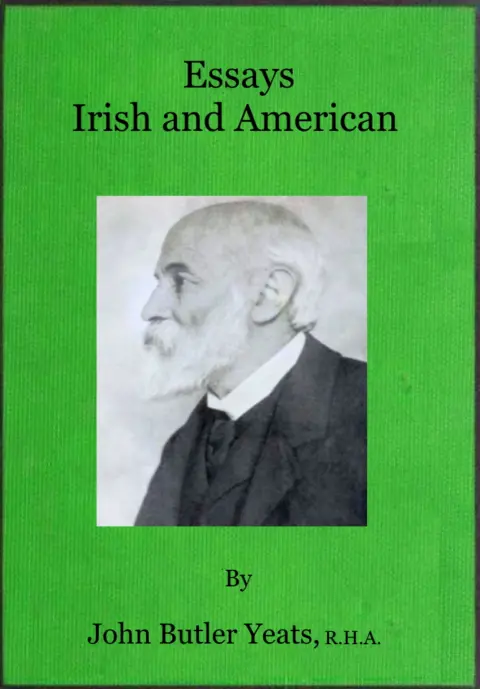
Essays Irish and American
John Butler Yeats
THE CLASSIC COLLECTION · 1923
"Early Memories; Some Chapters of Autobiography" by John Butler Yeats is an autobiographical work written in the early 20th century. The book explores the author's childhood, family life, and the formation of his artistic identity, influenced heavily by his relationships with family, particularly his father. It offers insights into Yeats' upbringing, the challenges he faced in his education, and reflections on his environment in Ireland. The opening of the autobiography begins with a poignant preface detailing the passing of Yeats' father, capturing the depth of familial bonds and how they sparked the author's introspective journey. Yeats recounts his childhood, illustrating the significant role his father played in nurturing his artistic inclinations, despite initially wanting him to pursue law. Through evocative memories, he depicts a blend of familial warmth, the struggles of an artistic temperament, and encounters with characters who shaped his understanding of life and creativity. The narrative also reveals his sense of loneliness during childhood, the influence of his mother, and the profound impact of early education on his artistic development.
Introduction adapted from the source catalogue; source summaries may be automatically generated.
Free to read · English · 24,445 words · No account needed
MAKE TIME FOR A GOOD BOOK
On by default. Untick to stop anonymous reading totals. Each page counts after 10 seconds in view. How this works.
Anonymous counting is on unless you have switched it off.
The next morning between nine o'clock & twelve I saw three boys receive what the master called 'Three capital drubbings.' That night as we lay in our little room we three brothers had become very sober boys.
Among the Beatitudes is one which is not in the Bible, but nevertheless is in every Scotchman's bones: 'Blessed are they who expect not, for they shall not be disappointed.'
Among the boys was one from the County Limerick who saw the grotesque in everything, and my brother who was the leader in all the games and the handsomest and merriest boy in the school, who lived to be the success of the family and who had never known illness until he died when fifty six years of age. Fortune seemed to have showered on him every kind of good luck except that of growing old. Another boy was my dear friend, George Pollexfen, whose sister I afterwards married. Unlike my brother, George was the most melancholy of men. He was melancholy as a boy and as a man. I think it was his melancholy that attracted me, who am a cheerful & perennially hopeful man. It always mortifies me to think how cheerful I am, for I am convinced it is a gift which I share with all the villains: it is their unsinkable buoyancy that enables these unfortunates to go on from disaster to disaster and remain impenitent. My old friend and school-mate always saw the worst side of things. On a summer day he would remember that winter was coming, and if prosperity came to him, as it did all his life, he made elaborate preparations for the arrival of misfortune. He was very tender-hearted and humane, & so out of his prognostications of evil he would extract a kind of sad humour that made him infinitely tender and pitiful. Out of sorrow he would extract mirthfulness as the scaffold echoes with a jest. In the vehemence of good spirits and hopefulness we grow careless of other people's feelings, as do the rich of the poor men at their gates: not so my sad-hearted and much-burdened old friend. He had also great gifts of expression. What he felt and thought and what he smiled at, for he never laughed, he could tell you in long detailed narratives of men and things. Although slow and tedious in all his movements--and in conversation that tedium was delightful--he afterwards became famous as a steeplechase rider. He was exceedingly well made, and of proved nerve and courage. Sometimes both as boy and man he would throw off some of his melancholy and then his gaiety had the charm of the unexpected, like rare sunshine on a gloomy mountain. The head-master disliked him because of his irresponsiveness which is always trying to the autocratic temper. He said that he looked at him with the face of a horse, which indeed was not an inaccurate description. Had it been possible for our head-master to conceal himself for one night in the large dormitory, where George slept with nine or ten other boys, he would have been wiser. Night after night he would keep these boys wide awake & perfectly still while he told them stories, made impromptu as he went along. Silence was commanded in all the bedrooms, therefore these had to be told in smothered whispers. I did all I could--and my father helped me--to persuade him to come to Trinity College. Had he done so, he would doubtless have been a writer of extraordinary spontaneity & force, and I should not be writing now these boyish recollections. My friend was because of his family and their traditions puritanic, but his puritanism was of a peculiar sort; he wasn't in the least aggressive like the Belfast man, nor was he conceited nor inquisitorial as the Scotch are; it was merely that he saw human nature sorrowfully, and with little hope. It only enhanced his tenderness, which was like that of a nurse by the bedside of a sick man, and veritably there were times when thinking about this benighted and lost human nature he was like a tender mother with a fractious child: yet never did he lose his sense of proportion, or his sense of fact, or his mirthfulness. At first in any company he would be a perfect wet blanket, and an embarrassment, so that conversation would flag; presently he would begin to talk and then people would discover that he knew more about the subject than, as it seemed to them, anybody else that had ever existed, and that he knew it all as a man of feeling and imagination. They would also discover that he was a listener, whose attention you would woo as that of a king on his throne. He died possessed of a good deal of money: but as he himself told me, with characteristic veracity, the money was made for him by a clerk whom he kept from drink. It never entered into his head to give any of the money to the clerk; it was his by the law, and by the law he kept it. Why puritans are thus tied up and bound and handcuffed and padlocked in the prisons of the law is not for me to say. I have always distrusted puritanism, in that respect I am a genuine Irish Protestant and believe with Christ that the law was made for man and not man for the law. So did not believe my melancholy friend. At the command of the law he would have given you everything he owned and not harboured a regret. What he was ready to give he would exact of others. His life was a long imprisonment. Yet human nature is never more interesting than when undergoing this kind of ordeal. To meet a man in the pleasant ways of acquaintanceship is interesting and exciting, to visit him in prison may be painful, but it is enthralling; for which reason, though I hate puritanism, I don't think I would like it to be entirely removed from the world, unless it be the Belfast variety, which like the east wind is good for neither man nor beast. There was a phrase sometimes on my father's lips, forced from him by sudden annoyance: 'Nothing can exceed the vulgar assumption of a Belfast man.' The root of my old friend's puritanism was self-immolation, the other sort is the glorification of self-assertion. When I think of my friend and others like him, I say to myself that the prison pallor on a fine face is more interesting than the ruddy cheeks of the warden or turnkey or the Governor of the gaol, who all live in the open air.
Your reading position is saved on this browser. Take it to another device with a library code. Reading pages adapt to text, rather than matching a printed edition.
John Butler Yeats
BEHIND THE BOOK
This eBook is for the use of anyone anywhere in the United States and most other parts of the world at no cost and with almost no restrictions whatsoever. You may copy it, give it away or re-use it under the terms of the Project Gutenberg License included with this eBook or online at www.gutenberg.org. If you are not located in the United States, you will have to check the laws of the country where you are located before using this eBook. Read the source licence.
The original source file, including credits and licence, is retained by this library. Request an original-format copy at no charge. Please include the book title and Project Gutenberg identifier #62893.
KEEP YOUR CURIOSITY GOING
John L. Ransom

Herman W. Mudgett

Harriet Monroe
Daniel Dulany Addison
Charles Lanman

Harold Rosher