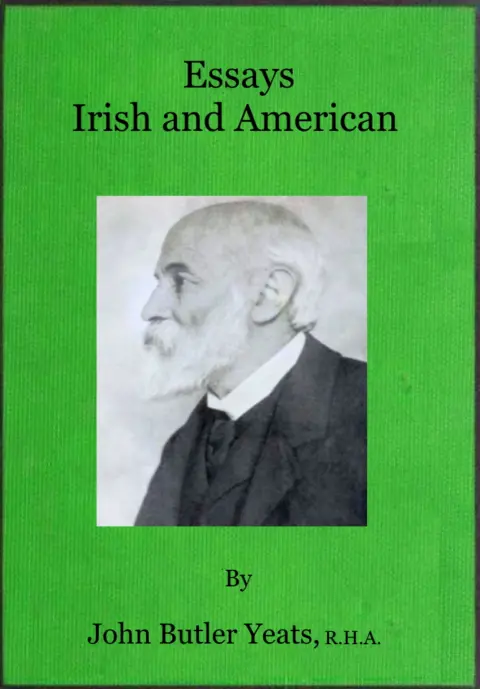
Essays Irish and American
John Butler Yeats
THE CLASSIC COLLECTION · 1923
"Early Memories; Some Chapters of Autobiography" by John Butler Yeats is an autobiographical work written in the early 20th century. The book explores the author's childhood, family life, and the formation of his artistic identity, influenced heavily by his relationships with family, particularly his father. It offers insights into Yeats' upbringing, the challenges he faced in his education, and reflections on his environment in Ireland. The opening of the autobiography begins with a poignant preface detailing the passing of Yeats' father, capturing the depth of familial bonds and how they sparked the author's introspective journey. Yeats recounts his childhood, illustrating the significant role his father played in nurturing his artistic inclinations, despite initially wanting him to pursue law. Through evocative memories, he depicts a blend of familial warmth, the struggles of an artistic temperament, and encounters with characters who shaped his understanding of life and creativity. The narrative also reveals his sense of loneliness during childhood, the influence of his mother, and the profound impact of early education on his artistic development.
Introduction adapted from the source catalogue; source summaries may be automatically generated.
Free to read · English · 24,445 words · No account needed
MAKE TIME FOR A GOOD BOOK
On by default. Untick to stop anonymous reading totals. Each page counts after 10 seconds in view. How this works.
Anonymous counting is on unless you have switched it off.
My old friend George, as full of human nature as an egg is of meat, held the puritan doctrine. He condemned all his neighbours impartially; he had not however like the ordinary man any self-complacent acrimony, no, that was not his way. He was an indulgent and compassionate puritan, because a consistent puritan. If he condemned others he condemned himself also, and he sadly saw himself in those predestined sinners and transgressors and backsliders. Now he was a chief of story tellers. I remember the late York Powell, that Savant who by some strange accident was also a man of genius, praising one of his stories, saying it was the best he had ever listened to. He would tell a story that would take at least two hours in the telling and it would be about nothing at all, yet as it grew and developed, the mere nothing became everything, because he would mass together such richness of significant detail. Long ago at school he slept in a room known as number twelve, and in it slept all the bigger boys of the school. There was a rule that every boy should keep perfectly silent once in bed and the gas turned out. George would keep all that room awake--sleepy schoolboys though they were--telling them in a whisper long stories made in the fashion of Dumas & Fenimore Cooper. All his life he delighted compassionately in the foibles of dandies from the time of Dumas down to our own times, especially if they were military. He had a gift for every kind of indulgence. He never showed capacity for any religions or poetic ecstasy. I could not conceive his reading Shelley with understanding, yet Keats would have pleased him. He was pitiful for men and women and animals and the very plants in the garden. He was as pitiful as St. Francis of Assisi. In this I do not in the least exaggerate. A convinced puritan, holding the doctrine as profoundly as he held all his beliefs, he was naturally a melancholy man. His doctor said of him after his death that he was by no means a delicate man, 'but very low spirited.' The ordinary puritan, in the buoyant strength of high animal spirits, reacts against every kind of depression. He is pessimist as regards other men, as regards himself a confirmed optimist. My old friend, because of his uncheered solitary existence in a small town under a rainy sky beside the sad sea wave, suffered in some degree from what I have called the puritan malady self-exaggeration. He was full of himself and that self all doubt and dreariness, yet among genial friends who loved him it soon passed away. When he came to my house he would invariably dedicate the first evening, or part of it, to this kind of sorrowful personal preoccupation, sighing and shaking his head, complaining aloud of everything, and we who knew him would wait, and be outwardly sympathetic, while inwardly we smiled. At hand grips with hard times we were naturally a little incredulous of the sorrows of an old bachelor who was exceedingly well off and knew how to take care of his money. He had small eyes, very blue, and straight eyebrows and a long skull stretching far back such as I have always found in conjunction with a marked capacity for detail. He was at the same time an exceedingly good listener, and well as he talked I think he preferred listening. Had the destinies permitted he might have become a great student and a recluse and buried himself in a university. His expression was strangely wistful, his eyes seemed to peep at you like stars in the early twilight. Although a successful trader he said that his success and I believe him--was due entirely to his chief clerk and an elder brother's advice. He did not look as if he belonged to the actual world. Indeed he had become the denizen of another world. My stammering uncle tried to comfort his latter years with Bible Christianity and an occasional prayer meeting. George chose better, he studied books on magic and he practised in the ancient science of astrology. It was my son W. B. Yeats who put him on the track of these wonders, and what was in some degree only occasional with my son was to my friend the passion of his life. I think my son looks a poet; I know George looked an astrologer. His eyes were the eyes of second sight. I think indeed he knew the future better than he knew the present and the past. He had a scared look, as if he saw ghosts that no one else could see, & his horoscopes as many can testify were verified. He foresaw and predicted almost to the day, and certainly to the week, when my friend York Powell would die, and he did this more than a year before, when York Powell was in perfect health. When the London 'Times' announced that York Powell was making good recovery, 'No' said George 'the stars are still there.' The last weeks of his life were characteristic. My eldest daughter always spent her summer holidays with him. Arriving one evening she was surprised to find him in bed and he at once said to her, 'Lily I think I am going'. He lived on for six weeks spending his time calmly reading novels for which she searched the country. He would read only what is called serious fiction, and not once again did he speak of death till two days before the end, when he gave her minute directions as to certain things she was to do after his death, how she was to distribute certain small sums of money which she would find in his pockets. He died at day-break while the Banshee, heard by my daughter and two nurses, was wailing around the house. Business men cried when told of his death; they said he had an attractive personality.
Your reading position is saved on this browser. Take it to another device with a library code. Reading pages adapt to text, rather than matching a printed edition.
John Butler Yeats
BEHIND THE BOOK
This eBook is for the use of anyone anywhere in the United States and most other parts of the world at no cost and with almost no restrictions whatsoever. You may copy it, give it away or re-use it under the terms of the Project Gutenberg License included with this eBook or online at www.gutenberg.org. If you are not located in the United States, you will have to check the laws of the country where you are located before using this eBook. Read the source licence.
The original source file, including credits and licence, is retained by this library. Request an original-format copy at no charge. Please include the book title and Project Gutenberg identifier #62893.
KEEP YOUR CURIOSITY GOING
John L. Ransom

Herman W. Mudgett

Harriet Monroe
Daniel Dulany Addison
Charles Lanman

Harold Rosher