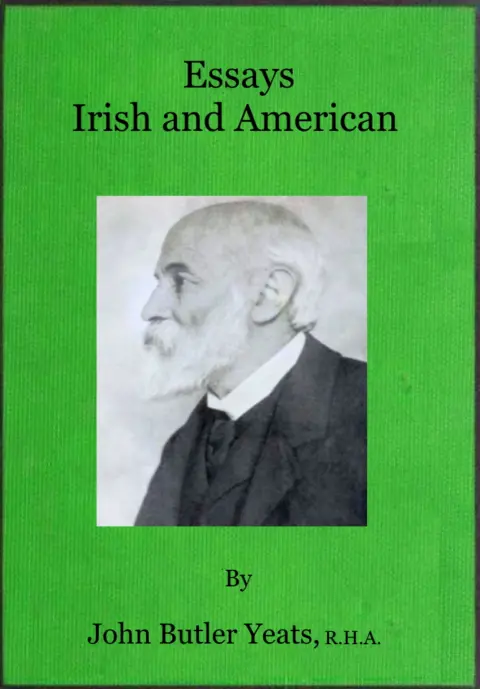
Essays Irish and American
John Butler Yeats
THE CLASSIC COLLECTION · 1923
"Early Memories; Some Chapters of Autobiography" by John Butler Yeats is an autobiographical work written in the early 20th century. The book explores the author's childhood, family life, and the formation of his artistic identity, influenced heavily by his relationships with family, particularly his father. It offers insights into Yeats' upbringing, the challenges he faced in his education, and reflections on his environment in Ireland. The opening of the autobiography begins with a poignant preface detailing the passing of Yeats' father, capturing the depth of familial bonds and how they sparked the author's introspective journey. Yeats recounts his childhood, illustrating the significant role his father played in nurturing his artistic inclinations, despite initially wanting him to pursue law. Through evocative memories, he depicts a blend of familial warmth, the struggles of an artistic temperament, and encounters with characters who shaped his understanding of life and creativity. The narrative also reveals his sense of loneliness during childhood, the influence of his mother, and the profound impact of early education on his artistic development.
Introduction adapted from the source catalogue; source summaries may be automatically generated.
Free to read · English · 24,445 words · No account needed
MAKE TIME FOR A GOOD BOOK
On by default. Untick to stop anonymous reading totals. Each page counts after 10 seconds in view. How this works.
Anonymous counting is on unless you have switched it off.
At last I went to school. It was a boarding-school at Seaforth, Liverpool, and was kept by three maiden ladies: it was a very fashionable school. We were nice little boys with short jackets and wide white collars. Never was any boy so happy as I was in the prospect of that school. My uncle took me to Liverpool; and when he suggested that I stay with him a day longer I would not, I wanted to get into that school. I was not ten minutes inside the walls when I think I was about the most miserable boy in all England, and believed the cloud would never, never lift. I looked at all the other boys and wondered again and again how they could be so cheerful.
My father was evangelical as was then fashionable in the best intellectual circles. He must have said something about hell in my hearing, yet, I did not make any real acquaintance with that dismal and absurd doctrine till I went to Miss Davenport's school. The school was managed upon the highest principles of duty, no prizes were ever given for all must work from sake of duty, and we slept with our Bibles under our pillows with directions to read them as soon as we awoke in the morning; but hell was the driving force. Miss Emma Davenport, who was the chief of the school, often spoke of it.
In the early mornings I read my Bible with assiduity, but only the Old Testament never the New. It was the age of faith; I believed every word to be the word of God, of that mighty God of whom our school-mistress was always speaking. I had always believed also that Robinson Crusoe was an equally veracious history; and when the nurses and servants told me ghost stories and fairy tales, I accepted all they said with an unfaltering credulity. There were certain cabins in our neighbours said to be haunted one in particular covered with ivy which I never passed without a shiver of fear and curiosity. I did not tell my elders, I was too wise: instinctively I knew that they would have robbed me of my ghostly thrills. Now-a-days people are brought up in a world of reason and science: is it any wonder that intricate and delicate and difficult verse should give way to the poetry of rhetoric and a moral uplift? People used to amuse themselves by bracing or relaxing their souls in the vast and shadowy world of solitary fantasy: now we do better--at any rate it is easier--we set about reforming our neighbours. When I first arrived at that English School I was greatly surprised by English mispronunciation. Emma, the Christian name of our headmistress was invariably called 'Emmer,' just as to this day in London clergymen of all denominations pronounce the name of our late Gracious Majesty as 'Victorier,' whereas every Irishman knows that her name is 'Victoria.' Among the trio of ladies governing the school Emma was the ruling spirit, but she had a sister Betsy who if she could do nothing else could apply the cane with sharpness and decision. One day the only other Irish boy in the school and myself climbed for a few feet on one of the trees. There was a sharp tap at the schoolroom window: it was Betsy. She told us to stand in the dining-room until the boys came in for tea. We stood there and waited and would have been dull but for my friend. He produced out of the recesses of his pocket a piece of wax kept for the purpose and diligently applied it to the palm of his hand, & I followed his example. Afterwards we rubbed our hands as hard as we could along the iron top of the fire-screen. Thus we prepared for what was coming. When the boys entered for tea, Betsy came with them and sat down at the head of the table, we standing in the centre of the room. After a moment or two she arose and I still hear her voice as she said, 'Tandy, (Tandy was my friend's name) fetch me the cane.' Tandy had been longer in the school than I and knew all about that cane and found it easily. We received three strokes on each of our hands; it was very painful and I was very much astonished, and when I went home for the holidays I was glad to find that the blood blisters were still there, and I very eagerly showed them to my father who to my surprise only laughed, being neither sympathetic nor impressed. Years afterwards when I saw the portraits of Queen Elizabeth I recognized the resemblance to Betsy. She dressed elaborately with a high collar that reached over her ears and was very tall & meagre, and was, as I remember, like the Queen in that she was a faded beauty. Lonely spinsters sometime suffer from the thought that they've lived wasted lives. It must have soothed Betsy's last moments to remember how she could raise blood blisters on little boys' hands.
Your reading position is saved on this browser. Take it to another device with a library code. Reading pages adapt to text, rather than matching a printed edition.
John Butler Yeats
BEHIND THE BOOK
This eBook is for the use of anyone anywhere in the United States and most other parts of the world at no cost and with almost no restrictions whatsoever. You may copy it, give it away or re-use it under the terms of the Project Gutenberg License included with this eBook or online at www.gutenberg.org. If you are not located in the United States, you will have to check the laws of the country where you are located before using this eBook. Read the source licence.
The original source file, including credits and licence, is retained by this library. Request an original-format copy at no charge. Please include the book title and Project Gutenberg identifier #62893.
KEEP YOUR CURIOSITY GOING
John L. Ransom

Herman W. Mudgett

Harriet Monroe
Daniel Dulany Addison
Charles Lanman

Harold Rosher