The orchestra and its instruments
Esther Singleton
THE CLASSIC COLLECTION · 1907
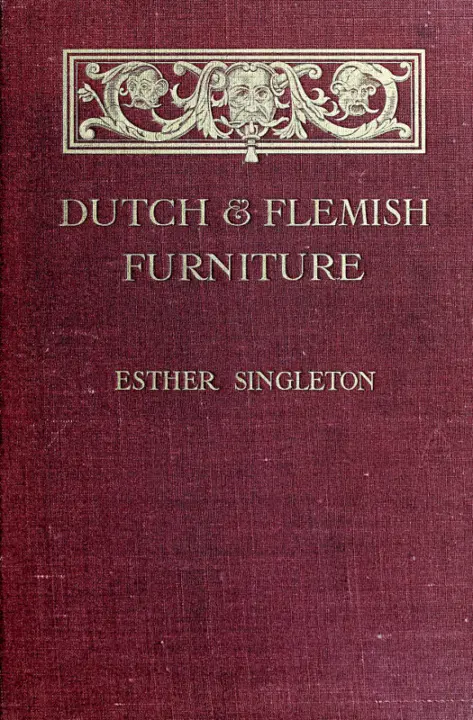
"Dutch and Flemish Furniture" by Esther Singleton is a historical account written in the early 20th century. This work explores the intricate history and craftsmanship of furniture from the Low Countries, focusing on how various artistic styles evolved from the Middle Ages through the Renaissance to the 19th century. The book likely delves into the impact of socio-political developments on furniture design and manufacturing, as well as the cultural exchanges between different European countries. The opening of the text provides background on the artistic and cultural evolution in the Low Countries, emphasizing the significant influence of the English and Flemish artisans on one another throughout history. Singleton highlights the interconnectedness of trade, craftsmanship, and socio-political relationships between England, France, and the Low Countries. This section sets the stage for a detailed exploration of the various furniture styles and artistic movements, indicating that subsequent chapters will draw upon historical events and artistic trends that shaped the distinctive styles found in Dutch and Flemish designs.
Introduction adapted from the source catalogue; source summaries may be automatically generated.
Free to read · English · 90,730 words · No account needed
MAKE TIME FOR A GOOD BOOK
On by default. Untick to stop anonymous reading totals. Each page counts after 10 seconds in view. How this works.
Anonymous counting is on unless you have switched it off.
The inventory of Gertrude van Mierevelt (1639), wife of the painter Van Mierevelt of Delft who died in 1638, gives an excellent idea of a comfortable Dutch home of the early seventeenth century. First should be mentioned six beds with handsome draperies, tapestries, rich furniture covers, and other woollen articles (wollegoet), that prove how much the artist and his wife liked rich textiles. The tinnewerk, consisting of plates, dishes, salt-cellars, etc., shows that the table-service was of pewter, although twenty-eight articles in porcelain and faïence, consisting of plates, bowls and dishes, valued at about twenty-six florins, are also enumerated. The house also contained a great many copper articles and utensils, from tongs and shovels to those fine repoussée dishes so highly prized to-day by collectors; and there was a considerable amount of ironware, including two lanterns. There were some statues in plaster, including a “Suzanne,” ninety-four paintings, chiefly religious, and family portraits, although one representing “Pomona and Flora” is mentioned. The artist also had some violins, a little book of engravings, some wooden panels, and a library of thirty-seven volumes. Many of these were illustrated, and dealt with religious and historical subjects; and as they were all in Dutch it would seem that the artist could read no other language. Especially noticeable is the fine collection of linen, the pride of the mistress. She had no less than twenty-five pairs of sheets, a hundred and eighteen serviettes and fifteen tablecloths, one of which fetched as much as fifteen florins at the sale in 1639, and another of damask (damast taefellaecken), twenty florins.
The most important room of the home of a burgher of moderate means was the hall, or general living-room. This, as so many pictures show, had a great fireplace, at which meals were often cooked. The furniture consisted of tables, chairs, cabinets, and, very frequently, a bed. The chimney-piece is massive, high and often elaborately carved, and above it a landscape, fruit piece, Kermesse, flower-piece or battle-scene by a favourite painter, is hung to form part of the decoration. This chimney-piece is, moreover, filled with porcelain dishes, cups, plates, teapots and curios. Below it hangs an ornamental chimney cloth embroidered with gaily-coloured flowers, red or green silk, white muslin, or figured calico. The hearth is framed in blue and white tiles, furnished with an iron fireback and supplied with brass and irons, racks for the fire-irons, pot-hooks, spits, a crane on which a large brass kettle hangs, and small hooks from which the bellows, hearth brooms, shovel, tongs, etc., hang conveniently for use. A brass or copper warming-pan is not far away. The walls are adorned with pictures, a large looking-glass in an ebony frame, a wall-board with hooks for small cans and jugs and a plate rack or two in which some handsome plates and dishes are formally arranged. A great linen press, or kas, filled with tablecloths and napkins, the head of which is decorated with large Japanese beakers and smaller cups and vases, stands on one side of the room, and a glass case filled with teapots, cups and saucers, dishes, etc., and an East India cabinet on the other. A gaudily-painted Hindeloopen clock ticks on the wall. A large table stands in the centre of the room, covered with a heavy Turkish rug or “carpet,” and several little tables are conveniently disposed. The Russia leather, Turkey work and matted chairs are symmetrically arranged around the walls beneath the many pictures of landscape, interiors or still-life. The windows are curtained, the hangings of red or green striped silk or flowered calico matching those of the bedstead, which can be completely closed like a large box. On the four corners of the cornice of this bed are bunches of feathers or a painted wooden ornament. The casement windows have tiny diamond-shaped or round panes set in lead, and on the outside creepers and roses are carefully trained, forming a beautiful framework. Upon the sills stand flower-pots in which a bright tulip or other favourite flower is blooming.
Your reading position is saved on this browser. Take it to another device with a library code. Reading pages adapt to text, rather than matching a printed edition.
Esther Singleton
Esther Singleton
Esther Singleton
Esther Singleton
BEHIND THE BOOK
This eBook is for the use of anyone anywhere in the United States and most other parts of the world at no cost and with almost no restrictions whatsoever. You may copy it, give it away or re-use it under the terms of the Project Gutenberg License included with this eBook or online at www.gutenberg.org. If you are not located in the United States, you will have to check the laws of the country where you are located before using this eBook. Read the source licence.
The original source file, including credits and licence, is retained by this library. Request an original-format copy at no charge. Please include the book title and Project Gutenberg identifier #54552.
KEEP YOUR CURIOSITY GOING
Cécile Tormay

Moritz Busch
John L. Ransom
Frances Wright
Cécile Tormay

Mabel Potter Daggett