The orchestra and its instruments
Esther Singleton
THE CLASSIC COLLECTION · 1907
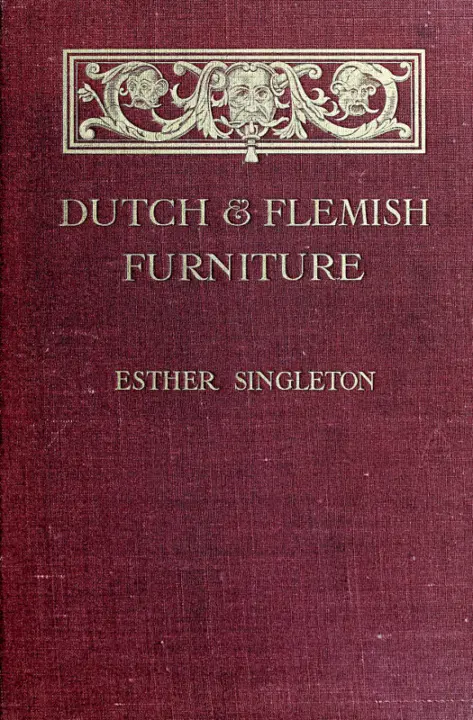
"Dutch and Flemish Furniture" by Esther Singleton is a historical account written in the early 20th century. This work explores the intricate history and craftsmanship of furniture from the Low Countries, focusing on how various artistic styles evolved from the Middle Ages through the Renaissance to the 19th century. The book likely delves into the impact of socio-political developments on furniture design and manufacturing, as well as the cultural exchanges between different European countries. The opening of the text provides background on the artistic and cultural evolution in the Low Countries, emphasizing the significant influence of the English and Flemish artisans on one another throughout history. Singleton highlights the interconnectedness of trade, craftsmanship, and socio-political relationships between England, France, and the Low Countries. This section sets the stage for a detailed exploration of the various furniture styles and artistic movements, indicating that subsequent chapters will draw upon historical events and artistic trends that shaped the distinctive styles found in Dutch and Flemish designs.
Introduction adapted from the source catalogue; source summaries may be automatically generated.
Free to read · English · 90,730 words · No account needed
MAKE TIME FOR A GOOD BOOK
On by default. Untick to stop anonymous reading totals. Each page counts after 10 seconds in view. How this works.
Anonymous counting is on unless you have switched it off.
A third house, belonging to the family Ploos van Amstel, dates from the first half of the eighteenth century, and is supposed to be inhabited by a doctor. It is three storeys high, and has a wide door on the façade with the initials P.V.A. (Ploos Van Amstel) artistically interlaced. Of its twelve rooms, the most remarkable are the parlour and the physician’s study, containing a library, a collection of preparations and a collection of shells and artistic objects in ivory, every item of which is reproduced in miniature.
According to Mr. E. W. Berg, who gives a minute description of this house in De Oude Tyd (1872), it is said that by this doctor is meant Christoffel Ludeman, the well-known “wonder-doctor.”
It was a fad with the wealthy to possess these curious silver toys, which passed from generation to generation. Sometimes the collection consisted of hundreds of pieces. Mrs. van Varick, of New Amsterdam (1696), had no less than eighty-three silver toys to divide among her children.
These silver and gold toys were so artistically made that they attracted the attention of many travellers, who paid large sums for them. Many beautiful and quaint specimens are therefore to be seen in the European Museums and private collections on both sides of the Atlantic.
Sets of dolls’ porcelain were also collected in this century and preserved in show-cases or china-cabinets, with a collection of dolls’ clothes. These cabinets of dolls’ articles were even found in farmhouses, and sometimes jewellery and small articles of value were kept in them.
Many of the poorer houses in the seventeenth century were built of wood or stone, with wooden gables that projected far over the narrow street, so far indeed that the occupants of the one could shake hands across the street with those in the opposite house. Many of these houses were gradually replaced by newer houses of a more regular aspect. As the century wears on they increase in height and solidity. As a rule, the house is of three storeys, with a tiled roof. In the lower floor there is a row of small windows with small panes set in lead and protected by ornamental iron-work. These windows admit light into the small office and entrance-hall, and run along the whole width of the house above the “luifel” (verandah), under which in the daytime wares are offered for sale, and where on fine evenings the burgher sits with his wife and family. Sometimes the thrifty housewife may be seen sitting under the verandah knitting, spinning, sewing, or darning, with her feet on a foot-rest, and the children playing around her. The baby’s cradle is sometimes brought out as well. On Saturdays the children are bathed and washed under the “luifel,” without the public taking the least notice. Gentlemen’s houses, however, have no verandahs, but both sides of the door or gate are flanked by windows with shutters, and this door is on a level with the entrance. The arrangement of the windows on the second floor is like that of the first. Chrysostomus Napolitanus says in 1516, “The dwelling-houses have nearly all the same shape and architecture. The back walls do not rise very high, but end in a point and step-like.” These gable steps were sometimes ornamented with stone vases or images, and the coping was also decorated. In the seventeenth century the houses were built narrower but higher, as also the windows, while the wire screens and the verandahs gradually disappeared. The copings and ornamentations of the cornice were, however, not less richly sculptured; and, under the top windows, stone figures, Caryatides, lions and coats-of-arms were often introduced. In the third storey there were one or two windows, above which the arms of the proprietor were carved. Instead of the armorial device, sometimes a figure, a pair of compasses, or a bell was introduced, from which the house took its name; or again the family name would be carved in gigantic letters. In the course of time the name of the occupant was used less than the name of the house in which he lived. We find mention of the house Blijenburgh, Moesienbroeck, Cruysenborch, Nuysenborch, Blijensteyn, Kleyn Jerusalem, ’t Huys Beaumont, Groot en Kleyn Rosendaeal, etc. Behind the houses were gardens with summer-houses, surrounded with fences of trellis-work. In the common houses a stone-paved hallway leads through the house to an open back yard, where there is a grass plot to bleach the clothes on, and where a room is built with a fireplace and kitchen. From the vestibule a stairway leads to the second floor, which communicates with a smaller stairway and often with a ladder to the floor above.
Your reading position is saved on this browser. Take it to another device with a library code. Reading pages adapt to text, rather than matching a printed edition.
Esther Singleton
Esther Singleton
Esther Singleton
Esther Singleton
BEHIND THE BOOK
This eBook is for the use of anyone anywhere in the United States and most other parts of the world at no cost and with almost no restrictions whatsoever. You may copy it, give it away or re-use it under the terms of the Project Gutenberg License included with this eBook or online at www.gutenberg.org. If you are not located in the United States, you will have to check the laws of the country where you are located before using this eBook. Read the source licence.
The original source file, including credits and licence, is retained by this library. Request an original-format copy at no charge. Please include the book title and Project Gutenberg identifier #54552.
KEEP YOUR CURIOSITY GOING
Cécile Tormay

Moritz Busch
John L. Ransom
Frances Wright
Cécile Tormay

Mabel Potter Daggett