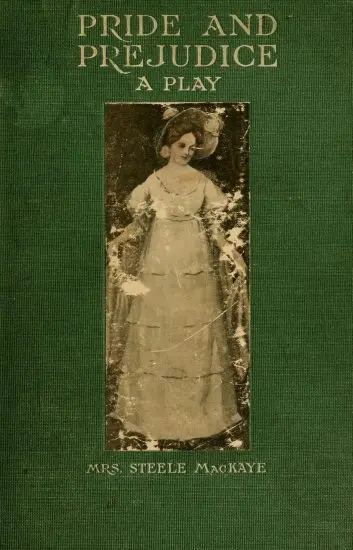
Pride and Prejudice, a play founded on Jane Austen’s novel
Steele, Mrs. MacKaye & Jane Austen
THE CLASSIC COLLECTION · 1895
"Duologues and scenes from the novels of Jane Austen" by Filippi and Austen is a collection of theatrical adaptations written in the late 19th century. It selects and reshapes key moments from Austen’s fiction into short duologues and brief scenes for drawing-room performance, with minimal staging but strict period costume. Aimed at cultivated amateurs, it offers practical stage directions, light narrative links, and pen-and-ink costume notes to bring beloved characters from Northanger Abbey, Sense and Sensibility, Emma, and Pride and Prejudice to life.
The opening of this collection presents a lively preface arguing that Austen is inherently dramatic and best played without scenery, while insisting on accurate 1790s–1800s dress and offering guidance for amateur staging. It then launches into fully scripted scenes: Catherine Morland and Isabella Thorpe in the Bath Pump Room giddily bond over “horrid” novels and flirtations; Mr and Mrs John Dashwood coolly whittle down a promised settlement for their widowed relations; Miss Bates chatters through Jane Fairfax’s letter as Emma looks for escape; Mrs Elton tries to commandeer Mr Knightley’s planned strawberry party and is politely checked; and Emma’s domestic scenes with Harriet show Harriet burning her Elton “relics,” confessing a new attachment to Knightley, and throwing Emma into turmoil. The section closes with Knightley’s unexpected return and an intense exchange with Emma about Frank Churchill and Jane Fairfax, breaking off mid-conversation.
Introduction adapted from the source catalogue; source summaries may be automatically generated.
Free to read · English · 24,007 words · No account needed
MAKE TIME FOR A GOOD BOOK
On by default. Untick to stop anonymous reading totals. Each page counts after 10 seconds in view. How this works.
Anonymous counting is on unless you have switched it off.
In order to make the plots clear and the duologues intelligible to those of the audience who are unacquainted with the novels themselves, a few words in monologue form have sometimes been added to the text—the greatest care being taken, however, to keep as much as possible to the spirit of the original—while for dramatic effect and finish, the time or place of action has often been changed from a garden or street scene to that of an interior, lest the absence of scenery should be felt by actors or audience.
The idea of compiling this small book arose from the dearth of good duologues and one-act plays suitable for amateur performance. The acting rights of the best pieces being reserved, it is difficult for the uninitiated to obtain them; moreover, it is expensive, and so the orange-covered book is sought, and a play neither clever nor interesting selected, simply because it is found to contain the requisite number of characters, and has no elaborate scenery.
How refreshing, then, must these seven scenes be to both artists and audience—they play themselves—the language, sentiments, and personalities are within the reach of every cultivated amateur; and I am convinced that Jane Austen as a play-wright will fascinate her audiences as much as she has her readers as a novelist.
VII. LADY CATHERINE’S VISIT 123 DUOLOGUE BETWEEN LADY CATHERINE AND ELIZABETH BENNET “Pride and Prejudice”
COSTUMES Frontispiece ISABELLA THORPE AND CATHERINE MORLAND Page 3 MR AND MRS JOHN DASHWOOD 17 MISS BATES AND EMMA 33 MRS ELTON AND MR KNIGHTLEY 53 EMMA AND HARRIET 67 ELIZABETH BENNET AND MR COLLINS 103 LADY CATHERINE AND ELIZABETH BENNET 125
The prevailing materials for the morning dresses of this period were cambrics, India muslins, clear muslins, usually white, and often spotted and sprigged with clear colours. The bodices were usually cut low with short sleeves, the neck being covered with an embroidered habit shirt or chemisette, often cut with very high collars coming up to the ears. The arms were covered with sleeves of rucked muslin or net. The walking dresses were worn to the ankle only, but the more graceful house dress was worn long. “Spencers,” or short bodices, with sleeves made of silk or cloth, were often worn over the muslin dress out of doors; these were sometimes buttoned down the centre, sometimes double-breasted, sometimes left open. “Spanish vests,” a sort of Spencer, with long-pointed ends in front, were often seen. Shawls, and long scarfs with embroidered ends, were almost invariable accompaniments of out-door dress, and were carried over the arm or worn draped over one shoulder, or round the neck, with long ends hanging in front like a boa. The use of muslins, furs, China silks, sarsnets, satins, etc., indiscriminately, was characteristic of the period. A dress of India muslin and a fur muff and boa was not considered incongruous. Small hats and turban-shaped caps were as much worn as large; ostrich and herons’ feathers, satins, velvets, velvet flowers, and even jewels were used for these. Gloves were usually of York tan or French kid, but sometimes were of net. Shoes were made of varying materials—coloured kid, often velvet or silk. The colours most in vogue were pinks, lilacs, violets, lavender, pale primrose, pale greens—scarlets often for pelisses—and all clear colours. Browns are described as “cinamon,” chocolate, nut, “la boue de Paris,” Egyptian brown, etc. All muslin dresses were worn over “slips” of silk or cambric. In making the bodices, it should be borne in mind that of the many ways of cutting them, the least graceful is to have a straight line round the waist. The line should curve upwards from beneath the bosom in front and reach the highest point between the shoulder-blades at the back, as seen in the back view of Emma. A double curve, which rises slightly in front as well, as seen in one of the distant figures in the frontispiece, is very becoming.
Your reading position is saved on this browser. Take it to another device with a library code. Reading pages adapt to text, rather than matching a printed edition.
Steele, Mrs. MacKaye & Jane Austen
Jane Austen
Jane Austen
Jane Austen
BEHIND THE BOOK
This eBook is for the use of anyone anywhere in the United States and most other parts of the world at no cost and with almost no restrictions whatsoever. You may copy it, give it away or re-use it under the terms of the Project Gutenberg License included with this eBook or online at www.gutenberg.org. If you are not located in the United States, you will have to check the laws of the country where you are located before using this eBook. Read the source licence.
The original source file, including credits and licence, is retained by this library. Request an original-format copy at no charge. Please include the book title and Project Gutenberg identifier #78656.
KEEP YOUR CURIOSITY GOING
Maurice Baring
W. B. (William Butler) Yeats
Edward Martyn

John Brougham & Charlotte Brontë
Marguerite Merington
Leonid Andreyev