THE CLASSIC COLLECTION✦Exiles: A Play in Three ActsCLASSIC FREE BOOKS
Exiles: A Play in Three Acts
James Joyce
THE CLASSIC COLLECTION · 1914
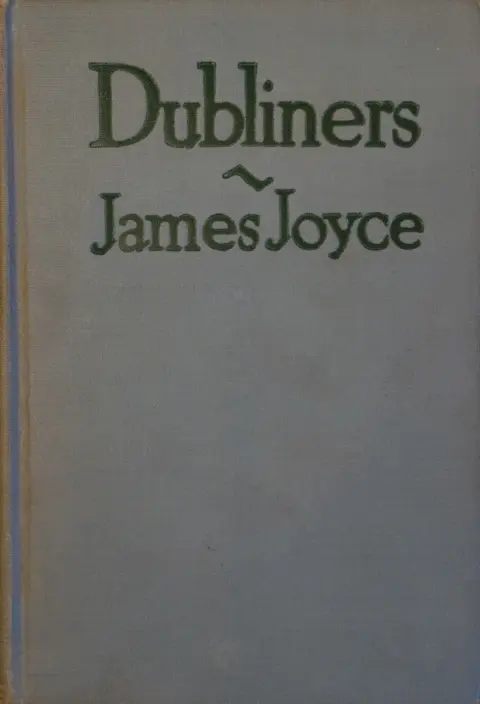
"Dubliners" by James Joyce is a collection of fifteen short stories written from 1904 to 1907 and published in 1914. Set in early twentieth-century Dublin, these stories portray Irish middle-class life through a lens of paralysis and disillusionment. Joyce holds up a mirror to his countrymen, exploring themes of nationalism, Catholicism, and British rule. The collection progresses chronologically from childhood through public life, with characters experiencing moments of sudden self-understanding. Each story captures lives marked by stagnation, failed dreams, and the struggle for spiritual liberation in a city caught at history's crossroads.
Introduction adapted from the source catalogue; source summaries may be automatically generated.
Free to read · English · 68,856 words · No account needed
MAKE TIME FOR A GOOD BOOK
On by default. Untick to stop anonymous reading totals. Each page counts after 10 seconds in view. How this works.
Anonymous counting is on unless you have switched it off.
“O no, Aunt Kate,” said Mary Jane. “Bartell D’Arcy and Miss O’Callaghan aren’t gone yet.”
“Someone is fooling at the piano anyhow,” said Gabriel.
Mary Jane glanced at Gabriel and Mr Browne and said with a shiver:
“It makes me feel cold to look at you two gentlemen muffled up like that. I wouldn’t like to face your journey home at this hour.”
“I’d like nothing better this minute,” said Mr Browne stoutly, “than a rattling fine walk in the country or a fast drive with a good spanking goer between the shafts.”
“We used to have a very good horse and trap at home,” said Aunt Julia
sadly.
“The never-to-be-forgotten Johnny,” said Mary Jane, laughing.
Aunt Kate and Gabriel laughed too.
“Why, what was wonderful about Johnny?” asked Mr Browne.
“The late lamented Patrick Morkan, our grandfather, that is,” explained Gabriel, “commonly known in his later years as the old gentleman, was a glue-boiler.”
“O now, Gabriel,” said Aunt Kate, laughing, “he had a starch mill.”
“Well, glue or starch,” said Gabriel, “the old gentleman had a horse by the name of Johnny. And Johnny used to work in the old gentleman’s mill, walking round and round in order to drive the mill. That was all very well; but now comes the tragic part about Johnny. One fine day the old gentleman thought he’d like to drive out with the quality to a military review in the park.”
“The Lord have mercy on his soul,” said Aunt Kate compassionately.
“Amen,” said Gabriel. “So the old gentleman, as I said, harnessed Johnny and put on his very best tall hat and his very best stock collar and drove out in grand style from his ancestral mansion somewhere near Back Lane, I think.”
Everyone laughed, even Mrs Malins, at Gabriel’s manner and Aunt Kate
said:
“O now, Gabriel, he didn’t live in Back Lane, really. Only the mill was
there.”
“Out from the mansion of his forefathers,” continued Gabriel, “he drove with Johnny. And everything went on beautifully until Johnny came in sight of King Billy’s statue: and whether he fell in love with the horse King Billy sits on or whether he thought he was back again in the mill, anyhow he began to walk round the statue.”
Gabriel paced in a circle round the hall in his goloshes amid the
laughter of the others.
“Round and round he went,” said Gabriel, “and the old gentleman, who was a very pompous old gentleman, was highly indignant. ‘Go on, sir! What do you mean, sir? Johnny! Johnny! Most extraordinary conduct! Can’t understand the horse!’”
Your reading position is saved on this browser. Take it to another device with a library code. Reading pages adapt to text, rather than matching a printed edition.
BEHIND THE BOOK
This eBook is for the use of anyone anywhere in the United States and most other parts of the world at no cost and with almost no restrictions whatsoever. You may copy it, give it away or re-use it under the terms of the Project Gutenberg License included with this eBook or online at www.gutenberg.org. If you are not located in the United States, you will have to check the laws of the country where you are located before using this eBook. Read the source licence.
The original source file, including credits and licence, is retained by this library. Request an original-format copy at no charge. Please include the book title and Project Gutenberg identifier #2814.
KEEP YOUR CURIOSITY GOING
Coulson Kernahan

Maurice Baring
Frances Wright
Cécile Tormay

Frederic Jesup Stimson

W. H. P. (William Henry Pope) Jarvis