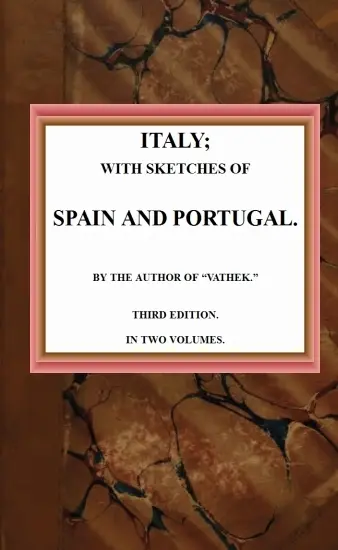
Italy; with sketches of Spain and Portugal
William Beckford
THE CLASSIC COLLECTION · 1783
"Dreams, Waking Thoughts, and Incidents" by William Beckford is a collection of letters and reflections written during the late 18th century. Through these letters, the author documents his travels across various parts of Europe, sharing his whimsical musings, vivid dreams, and observations of the landscapes and cultures he encounters along the way. The introspective nature of the writing reveals Beckford's profound imagination and nostalgia, as well as his struggles with the contrast between reality and his dreamy ideals. The opening of the book introduces us to Beckford's character as a deeply imaginative traveler, who often finds himself lost in reveries and longing for the familiar comforts of home. He begins his journey on June 19, 1780, reminiscing about his idyllic past while taking in the misty landscapes of Kent. Through a series of lively and humorous descriptions, he conveys his feelings of melancholy as he transitions from the serene beauty of England to the alien atmosphere of Flanders, further contemplating the quieter moments in places like Antwerp. As he navigates through bustling towns and historical landmarks, his reflections reveal not just observations of the surrounding world, but also the inner workings of a mind caught between reality and fantasy, often intertwining vivid descriptions of dreams with the observations of his travels.
Introduction adapted from the source catalogue; source summaries may be automatically generated.
Free to read · English · 78,879 words · No account needed
MAKE TIME FOR A GOOD BOOK
On by default. Untick to stop anonymous reading totals. Each page counts after 10 seconds in view. How this works.
Anonymous counting is on unless you have switched it off.
The residence of Petrarch at Arqua is said to have drawn thither from Padua the society of its more enlightened citizens. This city, whilst Petrarch lived in its neighbourhood, was engaged in rebellion against the Venetians; and Francis de Carrara, the head of it, went often to Arqua, to consult Petrarch; when he found himself obliged to sue to Venice for peace. The poet was indeed deputed, upon this occasion, his ambassador to the state; as being a person whose character and credit were most likely to appease its wrath. His success in this embassy might, perhaps, have been some recompense for an employment he accepted with much regret, as it forced him from his beloved retirement. In a letter to one of his friends, written about this period of his life, he says: “I pass the greatest part of the year in the country, which I have always preferred to cities: I read; I write; I think: thus, my life and my pleasures are like those of youth. I take pains to hide myself; but I cannot escape visits: it is an honour which displeases and wearies me. In my little house on the Euganean hills, I hope to pass my few remaining days in tranquillity, and to have always before my eyes my dead, or my absent, friends.” I was musing on these circumstances as I walked along the village, till a venerable old woman, seated at her door with her distaff in her hand, observing me, soon guessed the cause of my excursion; and offered to guide me to Petrarch’s house. The remainder of my way was short, and well amused by my guide’s enthusiastic expressions of veneration for the poet’s memory; which, she assured me, she felt but in common with the other inhabitants of the village. When we came to the door of the house, we met the peasant, its present possessor. The old woman, recommending the stranger and his curiosity to her neighbour’s good offices, departed. I entered immediately, and ran over every room, which the peasant assured me, in confirmation of what I before learnt from better authority, were preserved, as nearly as they could be, in the state Petrarch had left them. The house and premises, having unfortunately been transmitted from one enthusiast of his name to another, no tenants have been admitted, but under the strictest prohibition of making any change in the form of the apartments, or in the memorial relics belonging to the place: and, to say the truth, everything I saw in it, save a few articles of the peasant’s furniture in the kitchen, has an authentic appearance. Three of the rooms below stairs are particularly shown, and they have nothing in them but what once belonged to the poet. In one, which I think they call his parlour, is a very antique cupboard; where, it is supposed, he deposited some precious part of his literary treasure. The ceiling is painted in a grotesque manner. A niche in the wall contains the skeleton of his favourite cat, with a Latin epigram beneath, of Petrarch’s composition. It is good enough to deserve being copied; but the lateness of the hour did not allow me time. A little room, beyond this, is said to have been his study: the walls of it, from top to bottom, are scribbled over with sonnets, and poetical eulogies on Petrarch, ancient and modern: many of which are subscribed by persons, of distinguished rank and talents, Italians as well as strangers. Here, too, is the bard’s old chair, and on it is displayed a great deal of heavy, ornamental carpentry; which required no stretch of faith to be believed the manufacture of the fourteenth century. You may be sure, I placed myself in it, with much veneration, and the most resigned assent to Mrs. Dobson’s relation: that Petrarch, sitting in this same chair, was found dead in his library, with one arm leaning on a book. Who could sit in Petrarch’s chair, void of some effect? I rose not from it without a train of pensive sentiments and soft impressions; which I ever love to indulge. I was now led into a larger room, behind that I first saw; where, it is likely enough, the poet, according to the peasant’s information, received the visits of his friends. Its walls were adorned with landscapes and pastoral scenes, in such painting as Petrarch himself might, and is supposed to have executed. Void of taste and elegance, either in the design or colouring, they bear some characteristic marks of the age to which they are, with no improbability, assigned; and, separate from the merit of exhibiting repeatedly the portraits of Petrarch and Laura, are a valuable sketch of the rude infancy of the art, where it rose with such hasty vigour to perfection. Having seen all that was left unchanged in this consecrated mansion, I passed through a room, said to have been the bard’s bed-room, and stepped into the garden, situated on a green slope, descending directly from the house. It is now rather an orchard than a garden; a spot of small extent, and without much else to recommend it, but that it once was the property of Petrarch. It is not pretended to have retained the form in which he left it. An agreeably wild and melancholy kind of view, which it commands over the Euganean hills, and which I beheld under the calm glow of approaching sunset, must often, at the same moment, have soothed the poet’s anxious feelings, and hushed his active imagination, as it did my own, into a delicious repose. Having lingered here till the sun was sunk beneath the horizon, I was led a little way farther in the village, to see Petrarch’s fountain. Hippocrene itself could not have been more esteemed by the poet, than this, his gift, by all the inhabitants of Arqua. The spring is copious, clear, and of excellent water; I need not say with what relish I drank of it. The last religious act in my little pilgrimage was a visit to the church-yard; where I strewed a few flowers, the fairest of the season, on the poet’s tomb; and departed for Padua by the light of the moon.
Your reading position is saved on this browser. Take it to another device with a library code. Reading pages adapt to text, rather than matching a printed edition.
William Beckford
Samuel Johnson & William Beckford & Horace Walpole
BEHIND THE BOOK
This eBook is for the use of anyone anywhere in the United States and most other parts of the world at no cost and with almost no restrictions whatsoever. You may copy it, give it away or re-use it under the terms of the Project Gutenberg License included with this eBook or online at www.gutenberg.org. If you are not located in the United States, you will have to check the laws of the country where you are located before using this eBook. Read the source licence.
The original source file, including credits and licence, is retained by this library. Request an original-format copy at no charge. Please include the book title and Project Gutenberg identifier #7258.
KEEP YOUR CURIOSITY GOING
Wilfrid Scawen Blunt
Wilfrid Scawen Blunt

E. W. (Edgar Watson) Howe

David Patterson (Spirit) Hatch

David Patterson (Spirit) Hatch

David Patterson (Spirit) Hatch