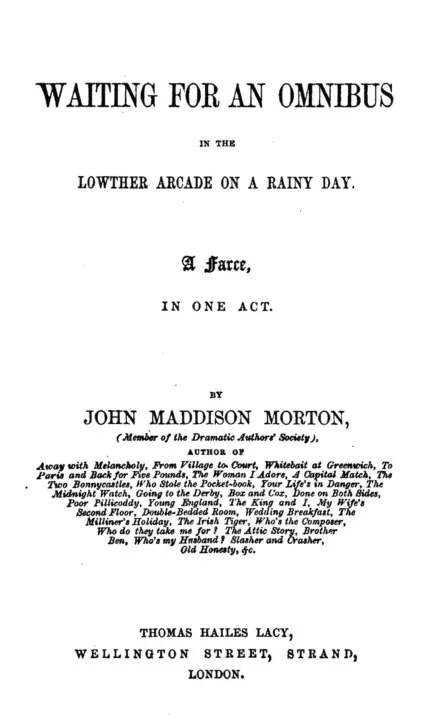
Waiting for an Omnibus in the Lowther Arcade on a Rainy Day: A Farce, in One Act
John Maddison Morton
THE CLASSIC COLLECTION · 1860
"Drawing Rooms, Second Floor, and Attics: A Farce, in One Act" by John Maddison Morton is a comedic play written in the mid-19th century, reflecting the Victorian era's theatrical style. This farce features a lively narrative centered around misunderstandings and mistaken identities, typical of the era’s entertainment that aimed to amuse its audience through humor and clever dialogue. The play is likely concerned with the social dynamics and romantic entanglements among various characters, showcasing the quirks and complexities of interpersonal relationships. The storyline revolves around Triptolemus Brown, a young chemist and druggist, who arrives in London only to face absurd predicaments involving his uncle and prospective brides. Triptolemus, amidst mistaken identities and comical situations, finds himself fleeing from a menacing sailor, trying on dresses to escape detection, and ultimately engaging in a chaotic ball where he must evade his disgruntled relatives and impress the woman he loves, Phoebe Furbelow. Characters like Mr. Bunny and Captain Hardaport contribute to the playful conflict, resulting in a slapstick conclusion as Triptolemus's true identity is revealed amidst a flurry of humorous mishaps. Overall, the play captures the essence of farce through its witty exchanges and absurd situations, appealing to audiences looking for light-hearted entertainment.
Introduction adapted from the source catalogue; source summaries may be automatically generated.
Free to read · English · 9,101 words · No account needed
MAKE TIME FOR A GOOD BOOK
On by default. Untick to stop anonymous reading totals. Each page counts after 10 seconds in view. How this works.
Anonymous counting is on unless you have switched it off.
CAPT. H. (looking cautiously about--then mysteriously to TRIPTOLEMUS, who, in order to appear collected is pulling on a pair of gloves of different colours) Hark ye, messmate: you can do me a good turn! I'm looking out for a young chap here--a rival! (in a voice of thunder--TRIPTOLEMUS gives a violent start) whose brains, if he's got any, I mean to blow out--all fair and above board, of course! Now, what d'ye think I'd better do, to put his monkey up--pull his nose or kick him round the room?
Enter BUNNY, COCKLETOP, CAROLINE, ARABELLA, and other GUESTS, C.--the music ceases--some of the GUESTS seat themselves at card tables and begin to play, others take refreshments, handed about by JONATHAN, R. and L.
TRIPTOLE. The monkey?
CAPT. H. Pshaw!--hush! (TRIPTOLEMUS attempts to escape)
COCKLE. (in a maudlin pathetic tone to CAROLINE) He's very poorly indeed, miss. (TRIPTOLEMUS seems struck by the voice)
CARO. (with indifference) Who, sir?
COCKLE. My nephew, Triptolemus.
TRIPTOLE. (aside) Uncle Cockletop! if he recognizes me, up goes the donkey--I mean the monkey! (pulling his wig more over his eyes)
COCKLE. (to HARDAPORT) Very hard, ain't it, sir, after coming up all the way from Cambridge on the wings of love.
TRIPTOLE. (aside, in an agony) There are circumstances under which a nephew ought to be allowed to strangle his uncle.
COCKLE. I repeat, very hard; ain't it, sir?
CAPT. H. (sharply) Very indeed!
COCKLE. Bless you! (making an ineffectual attempt to grasp the CAPTAIN'S hand) Bless you again!
BUNNY. (to COCKLETOP) Be quiet, do! Sit down and have a quiet game of cards--that gentleman will play with you, I'm sure! (meaning TRIPTOLEMUS--pushes COCKLETOP into other chair of card table)
COCKLE. (shuffling the cards and addressing TRIPTOLEMUS, who pulls his wig still more over his eyes) What shall we play at, sir?
TRIPTOLE. (bewildered) Sir! (finding a red worsted comforter in the paletot wipes his face with it)
COCKLE. What say you to picquet? I'm rather partial to casino!
TRIPTOLE. Well, I went to one once; but I didn't much like it.
CAPT. H. Ha, ha, ha! (laughing) Not bad. (TRIPTOLEMUS rises from his chair, and makes him a low bow)
COCKLE. (to TRIPTOLEMUS) Once more, sir, what shall it be?
TRIPTOLE. Don't you think "Beat my neighbour out of doors," rather a
pretty game?
COCKLE. No, no; perhaps you won't object to say cribbage?
TRIPTOLE. Certainly not, sir, if it will gratify you. Cribbage--I'll
say it again--cribbage!
CAPT. H. Ha, ha, ha! good again! (TRIPTOLEMUS rises and makes another
bow to the CAPTAIN)
COCKLE. Now, then, to see who deals. (cuts the cards) I wish you'd
cut, sir.
TRIPTOLE. (aside) I wish I could.
Your reading position is saved on this browser. Take it to another device with a library code. Reading pages adapt to text, rather than matching a printed edition.
John Maddison Morton
John Maddison Morton
John Maddison Morton
John Maddison Morton
BEHIND THE BOOK
This eBook is for the use of anyone anywhere in the United States and most other parts of the world at no cost and with almost no restrictions whatsoever. You may copy it, give it away or re-use it under the terms of the Project Gutenberg License included with this eBook or online at www.gutenberg.org. If you are not located in the United States, you will have to check the laws of the country where you are located before using this eBook. Read the source licence.
The original source file, including credits and licence, is retained by this library. Request an original-format copy at no charge. Please include the book title and Project Gutenberg identifier #49665.
KEEP YOUR CURIOSITY GOING
Maurice Baring
W. B. (William Butler) Yeats
Edward Martyn

John Brougham & Charlotte Brontë
Marguerite Merington
Leonid Andreyev