THE CLASSIC COLLECTION✦Lost DiariesCLASSIC FREE BOOKS
Lost Diaries
Maurice Baring
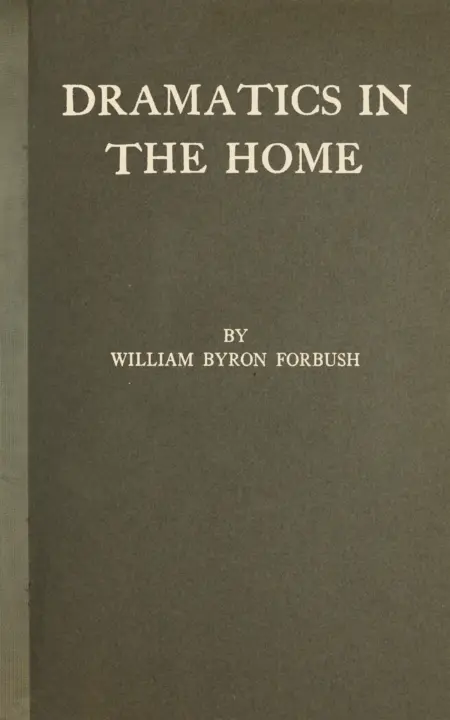
THE CLASSIC COLLECTION · 1914
"Dramatics in the Home" by William Byron Forbush is a guidebook focused on the role and development of dramatic play within the family setting, written in the early 20th century. It explores the inherent dramatic instincts in children, emphasizing the importance of creativity and expression in their development. The book serves as a practical resource for parents seeking to cultivate their children's imaginative abilities through various forms of play and performance. In "Dramatics in the Home," Forbush outlines numerous strategies for parents to engage their children in dramatic activities that enhance creativity, social skills, and emotional expression. The book delves into different types of dramatic play, including folk dancing, pantomime, storytelling, and performance, all aimed at fostering a child's natural instincts. Through detailed descriptions of games, activities, and the significance of imaginative play, Forbush demonstrates how these practices can create richer family interactions and strengthen the parent-child bond, encouraging children to find their place and role within both the home and the larger community.
Introduction adapted from the source catalogue; source summaries may be automatically generated.
Free to read · English · 8,920 words · No account needed
MAKE TIME FOR A GOOD BOOK
On by default. Untick to stop anonymous reading totals. Each page counts after 10 seconds in view. How this works.
Anonymous counting is on unless you have switched it off.
The parent should crave, and the social worker plan, so that every child will have the opportunity during the “gang” period of belonging to some social club whose scheme is based upon imaginative play. In such organizations, young people live out together actual revivals of pioneer activities and virtues and of the days and deeds of chivalry. A similar opportunity is possible in the schools, through dramatic self-government.
The parent ought to be interested in the tendency that is manifest in the church to recognize and revive the sacred drama. Both through liturgy and the church festivals it is possible to make the strongest spiritual impression upon children.
THE DRAMATIC FESTIVAL, by Annie A. T. Craig. (Containing plays and festivals for successive school periods.)
FOLK FESTIVALS, by Mary Master Needham. (Very practical and
suggestive.)
PAGEANTS AND PAGEANTRY, by Bates and Orr. (Helpful introduction and
five pageants.)
FESTIVALS AND PLAYS, by Percival Chubb. (For schools and other
institutions. Valuable suggestions on the use of music in
festival work.)
THE CELEBRATION OF THE FOURTH OF JULY BY MEANS OF PAGEANTRY, by
William Chauncy Langdon.
EDUCATION THROUGH RECREATION, by George E. Johnson.
* EDUCATION BY PLAYS AND GAMES, by George E. Johnson.
* PLAY IN EDUCATION, by Joseph Lee.
EDUCATION THROUGH PLAY, by Henry S. Curtis.
* THE KINGDOM OF THE CHILD, by Heinige.
* THE PLAY WAY, by H. Caldwell Cock.
* PLAY LIFE IN THE FIRST EIGHT YEARS, by Luella Palmer.
* THE NEW KINDERGARTEN CURRICULUM, Bulletin No. 16, United States Bureau of Education, Chapter on Games.
HOW TO TEACH, by Norsworthy and Strayer. Chapter 9, on The Meaning
of Play in Education.
GAMES FOR THE PLAYGROUND, HOME, SCHOOL AND GYMNASIUM, by Jessie H. Bancroft. (Gives graded descriptions of many active dramatic games for all ages.)
EASY GAMES FOR LITTLE PLAYERS, by Margaret Boughton. (An English publication, showing how to turn the nursery rhymes into dramatic form. This would be excellent for a children’s party or for any little circle that chances to be meeting in the home. The suggested dialogue does not need to be memorized.)
FUNDAMENTALS OF CHILD STUDY, by E. A. Kirkpatrick. Chapter 9, on
Play.
THE DRAMATIC ARTS, by Caroline Crawford. Article in the Teacher’s College Record, September, 1915.
CHILDREN’S PLAY AND ITS PLACE IN EDUCATION, by Walter Wood.
MANUAL OF PLAY, by William Byron Forbush.
THE RHYTHMS OF CHILDHOOD, by Caroline Crawford.
DRAMATIC GAMES AND DANCES FOR LITTLE CHILDREN, by Caroline Crawford.
TIMELY GAMES AND SONGS, by Clara Sawyer Reed.
GAMES FOR THE SCHOOL, GYMNASIUM AND HOME, by Jessie Bancroft.
FESTIVALS AND PAGEANTS, by Percival Chubb.
PAGEANTRY AND DRAMATICS IN RELIGIOUS EDUCATION, by W. V. Meredith.
Your reading position is saved on this browser. Take it to another device with a library code. Reading pages adapt to text, rather than matching a printed edition.
BEHIND THE BOOK
This eBook is for the use of anyone anywhere in the United States and most other parts of the world at no cost and with almost no restrictions whatsoever. You may copy it, give it away or re-use it under the terms of the Project Gutenberg License included with this eBook or online at www.gutenberg.org. If you are not located in the United States, you will have to check the laws of the country where you are located before using this eBook. Read the source licence.
The original source file, including credits and licence, is retained by this library. Request an original-format copy at no charge. Please include the book title and Project Gutenberg identifier #70738.
KEEP YOUR CURIOSITY GOING
Maurice Baring
W. B. (William Butler) Yeats
Edward Martyn

John Brougham & Charlotte Brontë
Marguerite Merington
Leonid Andreyev