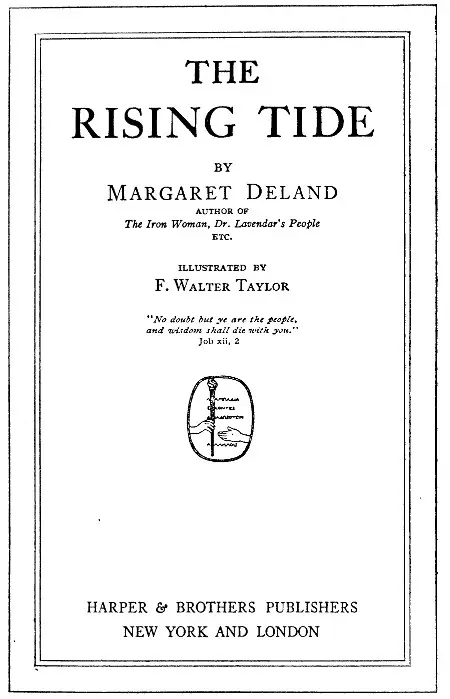
The Rising Tide
Margaret Wade Campbell Deland
THE CLASSIC COLLECTION · 1903
"Dr. Lavendar's People" by Margaret Wade Campbell Deland is a novel written in the early 20th century. Set in the quaint town of Old Chester, the book revolves around the lives of its residents, particularly focusing on the intertwined relationships and societal expectations. The narrative primarily follows the lives of Miss Ellen Baily, her delicate brother David, and their interactions with Dr. Lavendar and the Reverend Mr. Spangler, hinting at themes of love, duty, and sacrifice. At the start of the novel, we are introduced to Miss Ellen Baily, who runs a small school from her home while supporting her melancholic brother, David. David, haunted by a past love, struggles with finding purpose in life, having failed in various careers. The arrival of Mr. Spangler, the new clergyman, disrupts the delicate balance of their lives, leading to unexpected developments. As the characters navigate their emotions and societal roles, Miss Ellen must confront her responsibilities towards her brother and her budding feelings towards Mr. Spangler, all while the town observes with a curious eye. The opening sets up a rich, character-driven narrative that promises deeper explorations of human relationships and moral dilemmas as the story unfolds.
Introduction adapted from the source catalogue; source summaries may be automatically generated.
Free to read · English · 68,299 words · No account needed
MAKE TIME FOR A GOOD BOOK
On by default. Untick to stop anonymous reading totals. Each page counts after 10 seconds in view. How this works.
Anonymous counting is on unless you have switched it off.
"Did you ever reflect," said Mr. Barkley, "that should that power be used after the death of the donor, to carry out a wish of said donor, expressed an hour, nay, a moment, before the instant of dissolution--such act would be an offence in the eye of the law?"
"I've always thought the law ought to put on spectacles, Ezra," said Dr. Lavendar; "it has mighty poor eyesight once in a while."
Mr. Barkley was shocked. "The law, Lavendar, is the deepest expression of the human sense of justice!"
"But, Ezra," Dr. Lavendar said, suddenly attentive, "that is very interesting. I remember you referred to the lapsing of the power of attorney when you made out that paper for me; but I didn't quite understand. Do you mean that carrying out, now, directions given before the death of my old friend would be against the law? Suppose he had asked me--last week, perhaps, to destroy--well, say that old account-book there on the table, couldn't I do it to-day?"
"Dr. Lavendar, you do not, I fear, apprehend the majesty of the law!
Why," said Mr. Ezra, standing up, very straight and solemn, "such a
deed--"
"But suppose I didn't want--suppose Johnny didn't want, for reasons of his own, to have anybody--say, even his executor--see that account-book; suppose it might be put to some bad purpose--used to injure some third person (of course that is an absurd supposition, but it will do for an illustration); if he had asked me last week to destroy it, do you mean to say, Ezra, I couldn't destroy it to-day?--just because he happened to die this morning!"
"My dear sir," said Mr. Ezra, "such conduct on your part would be perilously near a criminal offence."
Dr. Lavendar whistled. "Well, Ezra, I won't destroy it."
"I hope not, sir--I hope not, indeed," cried Mr. Ezra.
Dr. Lavendar laughed; he had the impulse to turn round and wink at Johnny, to take him into the joke. But it was only for an instant, and his face fell quickly into puzzled lines.
"A moment's reflection," Mr. Ezra continued, "will convince you, Dr. Lavendar, that the aforesaid account-book is now the property, not of the deceased, but of the estate. Its destruction would be the destruction of property belonging to the heirs. Furthermore, your belief that the herein before mentioned account-book might be put to an improper use, for the injury of a third person--such belief would no more justify you in destroying it than would your belief in its unfairness towards said third person justify you in destroying a will."
Your reading position is saved on this browser. Take it to another device with a library code. Reading pages adapt to text, rather than matching a printed edition.
Margaret Wade Campbell Deland
Margaret Wade Campbell Deland
Margaret Wade Campbell Deland
Margaret Wade Campbell Deland
BEHIND THE BOOK
This eBook is for the use of anyone anywhere in the United States and most other parts of the world at no cost and with almost no restrictions whatsoever. You may copy it, give it away or re-use it under the terms of the Project Gutenberg License included with this eBook or online at www.gutenberg.org. If you are not located in the United States, you will have to check the laws of the country where you are located before using this eBook. Read the source licence.
The original source file, including credits and licence, is retained by this library. Request an original-format copy at no charge. Please include the book title and Project Gutenberg identifier #34427.
KEEP YOUR CURIOSITY GOING
Coulson Kernahan

Maurice Baring
Frances Wright
Cécile Tormay

Frederic Jesup Stimson

W. H. P. (William Henry Pope) Jarvis