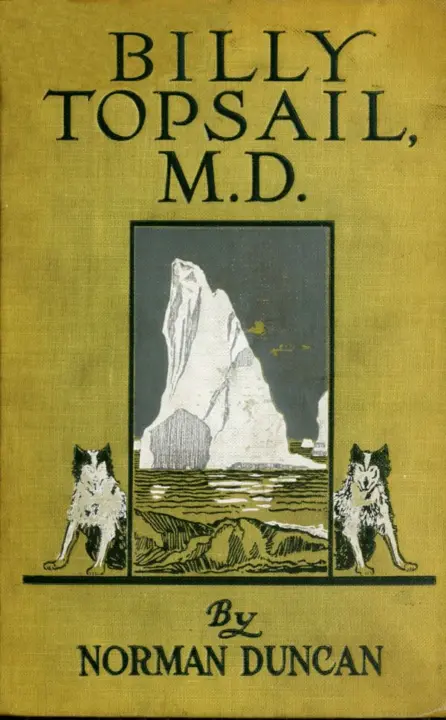
Billy Topsail, M.D.: A Tale of Adventure With Doctor Luke of the Labrador
Norman Duncan
THE CLASSIC COLLECTION · 1905
"Dr. Grenfell's Parish: The Deep Sea Fisherman" by Norman Duncan is an account written in the early 20th century. The book sheds light on the work of Dr. Wilfred T. Grenfell, a dedicated physician on the Newfoundland and Labrador coasts, as he provides much-needed medical care to the isolated fishermen and their families living in harsh conditions. Through Grenfell's experiences, the narrative explores themes of sacrifice, devotion, and the tumultuous life of the fishing communities. The opening of the narrative introduces Dr. Grenfell's mission with a poignant encounter between a stranger and an old fisherman, reflecting the dire need for medical assistance in the coastal communities. The fisherman hopes to find help for his ailing daughter but is met by disappointment when the stranger admits he is not a doctor. This interaction sets the tone for the account of Grenfell’s compassionate work, as it becomes evident that he is a beacon of hope for the residents who often suffer without medical aid. The reader is drawn into the grim realities of life along the Labrador coasts and the challenges faced by not only Grenfell but also the community he serves.
Introduction adapted from the source catalogue; source summaries may be automatically generated.
Free to read · English · 24,608 words · No account needed
MAKE TIME FOR A GOOD BOOK
On by default. Untick to stop anonymous reading totals. Each page counts after 10 seconds in view. How this works.
Anonymous counting is on unless you have switched it off.
When, at last, word comes south that the ice is clearing from the coast, the vessels spread their little wings to the first favouring winds; and in a week--two weeks or three--the last of the Labradormen have gone "down north."
Dr. Grenfell and his workers find much to do among these men and women
and children.
At Indian Harbour where the Strathcona lay at anchor, I went aboard the schooner Jolly Crew. It was a raw, foggy day, with a fresh northeast gale blowing, and a high sea running outside the harbour. They were splitting fish on deck; the skiff was just in from the trap--she was still wet with spray.
"I sails with me sons an' gran'sons, zur," said the skipper, smiling. "Sure, I be a old feller t' be down the Labrador, isn't I, zur?"
He did not mean that. He was proud of his age and strength--glad that he was still able "t' be at the fishin'."
"'Tis a wonder you've lived through it all," said I.
He laughed. "An' why, zur?" he asked.
"Many's the ship wrecked on this coast," I answered.
"Oh no, zur," said he; "not so many, zur, as you might think. Down this way, zur, we knows how t' sail!"
That was a succinct explanation of very much that had puzzled me.
"Ah, well," said I, "'tis a hard life."
"Hard?" he asked, doubtfully.
"Yes," I answered; "'tis a hard life--the fishin'."
"Oh no, zur," said he, quietly, looking up from his work. "'Tis
just--just life!"
They do, indeed, know how "t' sail." The Newfoundland government, niggardly and utterly independable when the good of the fisherfolk is concerned, of whatever complexion the government may chance to be, but prodigal to an extraordinary degree when individual self-interests are at stake--this is a delicate way of putting an unpleasant truth,--keeps no light burning beyond the Strait of Belle Isle; the best it does, I believe, is to give wrecked seamen free passage home. Under these difficult circumstances, no seamen save Newfoundlanders, who are the most skillful and courageous of all, could sail that coast: and they only because they are born to follow the sea--there is no escape for them--and are bred to sailing from their earliest years.
"What you going to be when you grow up?" I once asked a lad on the far
northeast coast.
He looked at me in vast astonishment.
"What you going to be, what you going to do," I repeated, "when
you grow up?"
Still he did not comprehend. "Eh?" he said.
"What you going to work at," said I, in desperation, "when you're a
man?"
Your reading position is saved on this browser. Take it to another device with a library code. Reading pages adapt to text, rather than matching a printed edition.
Norman Duncan
Norman Duncan
Norman Duncan
Norman Duncan
BEHIND THE BOOK
This eBook is for the use of anyone anywhere in the United States and most other parts of the world at no cost and with almost no restrictions whatsoever. You may copy it, give it away or re-use it under the terms of the Project Gutenberg License included with this eBook or online at www.gutenberg.org. If you are not located in the United States, you will have to check the laws of the country where you are located before using this eBook. Read the source licence.
The original source file, including credits and licence, is retained by this library. Request an original-format copy at no charge. Please include the book title and Project Gutenberg identifier #39130.
KEEP YOUR CURIOSITY GOING
Wilfrid Scawen Blunt
Wilfrid Scawen Blunt

E. W. (Edgar Watson) Howe
Cécile Tormay

Moritz Busch
John L. Ransom