THE CLASSIC COLLECTION✦An outlaw’s diary: the CommuneCLASSIC FREE BOOKS
An outlaw’s diary: the Commune
Cécile Tormay
THE CLASSIC COLLECTION · 1912
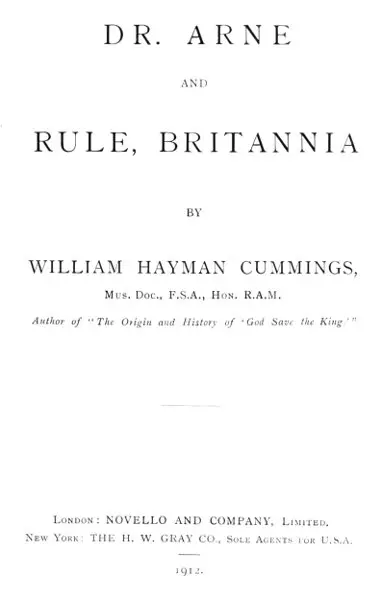
"Dr. Arne and Rule, Britannia" by William Hayman Cummings is a historical account written in the early 20th century. This work chronicles the life and influential career of Thomas Augustine Arne, a prominent composer of the 18th century, most notably known for the national song "Rule, Britannia." Cummings explores not only Arne's compositions but also the personal and sociocultural circumstances that shaped his musical legacy, providing insight into his struggles and triumphs. The opening of the book establishes the context for Arne's life by detailing his lineage, sociopolitical environment, and initial musical education. It describes his family background and the early indicators of his musical talent, including his secretive practice of music while adhering to his father’s wishes for him to pursue a legal career. The author sets the stage for a more comprehensive exploration of Arne’s career development, challenges, and the eventual recognition he gained within the British musical scene. This section hints at a narrative that is both educational for music students and enchanting for readers interested in the history behind one of Britain’s cherished national songs.
Introduction adapted from the source catalogue; source summaries may be automatically generated.
Free to read · English · 37,165 words · No account needed
MAKE TIME FOR A GOOD BOOK
On by default. Untick to stop anonymous reading totals. Each page counts after 10 seconds in view. How this works.
Anonymous counting is on unless you have switched it off.
The popularity of "Comus" induced Arne to publish a score of the music in 1740. The title-page of the volume reads: "The Music in the Masque of Comus. Written by Milton. As it was Perform'd at the Theatre-Royal in Drury-Lane. Composed by Thomas Augustine Arne. Opera Prima. London. Printed by William Smith, at the musick shop in Middle Row, near Holborn Bars, and sold by the Author." The copies were signed by the composer; we may therefore presume that the publication was his own venture, which may account for his calling it Opera Prima. It certainly was not the first work of his, either composed or printed. He afterwards sold the plates, and the score was published with a new title-page bearing the imprint "London. Printed for and sold by J. Simpson in Sweetings Alley Royal Exchange." "Comus" became so popular that the songs were sung all over the Kingdom, and gave rise to numerous convivial and musical associations which were convened under the title Comus's Court.
In 1739, a number of eminent musicians residing in London united in establishing a charitable society for the relief of indigent musicians and their families. The first steps were taken by Festing, Handel, Green, Weideman, and nine others; it was then called "The Society of Musicians," and since has become by Charter "The Royal Society of Musicians." Among the first to join the Association and to sign the "Declaration of Trust" were Thomas Arne and Handel. The former, after some years, neglected to pay his subscription, and ceased to be a member; but the latter retained his membership to the end of his life, and by his Will bequeathed one thousand pounds to its funds.
1740 was a very busy and prosperous year for Arne. His composition of the "Masque of Alfred" for the Prince of Wales will be found fully discussed in connection with "Rule, Britannia"; the other Masque, which was performed at the same celebration, was "The Judgment of Paris," written by William Congreve. This author died in 1728, and it is not known who arranged the book as set by Arne; it contained much more music than "Alfred," and, with the exception of "Rule, Britannia," of greater importance. The Overture, composed on the conventional pattern of the day, beginning with a Largo, followed by a spirited fugue, concludes with a Minuet Andante and a Giga con spirito; the only instruments employed are strings and oboes. The Recitative, "O ravishing delight," sung by Mr. Beard in the character of Paris, it would be difficult to surpass. Accompanied by the string quartett, it is full of variety and charm, and leads into an Allegro, with bravura passages well written for the voice. If revived to-day by a good tenor singer it would prove a great success. There is a remarkable Air for Venus, "Gentle Swain," which was sung by Mrs. Arne. In the printed score the composer appends the note, "This Air is composed for a Violoncello solo, and a double Bass to play with the Harpsichord."[7] The violoncello had quite recently been introduced into England by Cervetto (Giacobbe Bassevi), who joined the Drury Lane Theatre orchestra in 1738; by his skill he soon made the instrument popular. Both Arne and Handel wrote special obbligato parts for him. His personality and manners were very marked, and he became a pet of the gods in the gallery of the theatre, who, when he appeared in the orchestra, would call out "play up, Nosey." He became manager of Drury Lane Theatre, and died on the 14th of January, 1783, over one hundred years of age, leaving his son a fortune of £20,000. He signed the admission book of the "Society of Musicians" on the 14th of April, 1742. An amusing story is told of an encounter Cervetto had with Garrick; the latter had been absent from Drury Lane Theatre for two years, and on his return he prepared an address to speak previous to the play. When the applause which greeted him had subsided, the house became silent in expectation of the speech. At this crucial moment, Cervetto anticipated the first word by a tremendous yawn, which caused the audience to burst into convulsive laughter, and several minutes elapsed before quiet was restored. When the curtain dropped, Garrick rushed to the music-room and seized Cervetto by the shoulders, calling him a scoundrel, and a base-viol, and demanded what he meant by his conduct. The poor man could only reply that "when he had a great rapture" he always did "yawn that way."
Your reading position is saved on this browser. Take it to another device with a library code. Reading pages adapt to text, rather than matching a printed edition.
BEHIND THE BOOK
This eBook is for the use of anyone anywhere in the United States and most other parts of the world at no cost and with almost no restrictions whatsoever. You may copy it, give it away or re-use it under the terms of the Project Gutenberg License included with this eBook or online at www.gutenberg.org. If you are not located in the United States, you will have to check the laws of the country where you are located before using this eBook. Read the source licence.
The original source file, including credits and licence, is retained by this library. Request an original-format copy at no charge. Please include the book title and Project Gutenberg identifier #43214.
KEEP YOUR CURIOSITY GOING
Cécile Tormay

Moritz Busch
John L. Ransom
Frances Wright
Cécile Tormay

Mabel Potter Daggett