THE CLASSIC COLLECTION✦An outlaw’s diary: the CommuneCLASSIC FREE BOOKS
An outlaw’s diary: the Commune
Cécile Tormay
THE CLASSIC COLLECTION · 1912
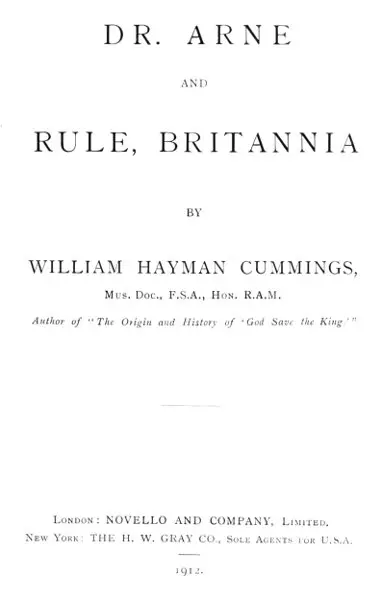
"Dr. Arne and Rule, Britannia" by William Hayman Cummings is a historical account written in the early 20th century. This work chronicles the life and influential career of Thomas Augustine Arne, a prominent composer of the 18th century, most notably known for the national song "Rule, Britannia." Cummings explores not only Arne's compositions but also the personal and sociocultural circumstances that shaped his musical legacy, providing insight into his struggles and triumphs. The opening of the book establishes the context for Arne's life by detailing his lineage, sociopolitical environment, and initial musical education. It describes his family background and the early indicators of his musical talent, including his secretive practice of music while adhering to his father’s wishes for him to pursue a legal career. The author sets the stage for a more comprehensive exploration of Arne’s career development, challenges, and the eventual recognition he gained within the British musical scene. This section hints at a narrative that is both educational for music students and enchanting for readers interested in the history behind one of Britain’s cherished national songs.
Introduction adapted from the source catalogue; source summaries may be automatically generated.
Free to read · English · 37,165 words · No account needed
MAKE TIME FOR A GOOD BOOK
On by default. Untick to stop anonymous reading totals. Each page counts after 10 seconds in view. How this works.
Anonymous counting is on unless you have switched it off.
The next air is sung by Eltruda, the Queen, represented by Mrs. Horton. It was sung off the stage, and according to Arne's score was accompanied by harpsichord and flute, the latter instrument echoing the voice-part. The libretto has two verses, but only the following was performed:
Sweet valley, say, where, pensive lying,
For me, our children, England, sighing,
The best of mortals leans his head.
Ye fountains, dimpled by my sorrow,
Ye brooks that my complainings borrow,
O lead me to his lonely bed:
Or if my lover,
Deep woods, you cover,
Ah, whisper where your shadows o'er him spread!
In the third scene, second Act, after a dialogue between Alfred, Eltruda and the Hermit, the latter summons the "Genius of England." Then the stage direction is "Music grand and awful. The Genius descending sings the following song":
From these eternal regions bright,
Where suns, that never set in night,
Diffuse the golden day:
Where spring unfading pours around,
O'er all the dew-impearled ground,
Her thousand colors gay:
O whether on the fountain's flowery side,
Whence living waters glide,
Or in the fragrant grove
Whose shade embosoms peace and love,
New pleasures all your hours employ,
And rapture every sense with every joy!
Great heirs of empire! yet unborn,
Who shall this island late adorn;
A monarch's drooping thought to chear,
Appear! Appear! Appear!
Possibly this song may have been omitted at the performance. Music for it cannot be found. The spirits of Edward the Third, Philipa his Queen, and their son the Black Prince, arise together; afterwards Queen Elizabeth, succeeded by William the Third--all are described by the Hermit. The next scene opens with a "Symphony of Martial music." The last scene affords an opportunity for Emma, the Shepherd's wife, represented by Kitty Clive, to sing a bright and sprightly melody, accompanied by the string orchestra in gavotte time to the following words:
If those, who live in Shepherd's bower,
Press not the rich and stately bed:
The new-mown hay and breathing flower
A softer couch beneath them spread.
If those, who sit at Shepherd's board,
Soothe not their taste by wanton art:
They take what Nature's gifts afford,
And take it with a chearful heart.
If those, who drain the Shepherd's bowl,
No high and sparkling wines can boast,
With wholesome cups they chear the soul,
And crown them with the village toast.
If those who join in Shepherd's sport,
Gay-dancing on the daizy'd ground.
Have not the splendor of a court;
Yet Love adorns the merry round.
A short dialogue between Alfred and Eltruda follows, and then the Hermit speaks, "Behold, my Lord, our venerable Bard,
Your reading position is saved on this browser. Take it to another device with a library code. Reading pages adapt to text, rather than matching a printed edition.
BEHIND THE BOOK
This eBook is for the use of anyone anywhere in the United States and most other parts of the world at no cost and with almost no restrictions whatsoever. You may copy it, give it away or re-use it under the terms of the Project Gutenberg License included with this eBook or online at www.gutenberg.org. If you are not located in the United States, you will have to check the laws of the country where you are located before using this eBook. Read the source licence.
The original source file, including credits and licence, is retained by this library. Request an original-format copy at no charge. Please include the book title and Project Gutenberg identifier #43214.
KEEP YOUR CURIOSITY GOING
Cécile Tormay

Moritz Busch
John L. Ransom
Frances Wright
Cécile Tormay

Mabel Potter Daggett