THE CLASSIC COLLECTION✦An outlaw’s diary: the CommuneCLASSIC FREE BOOKS
An outlaw’s diary: the Commune
Cécile Tormay
THE CLASSIC COLLECTION · 1912
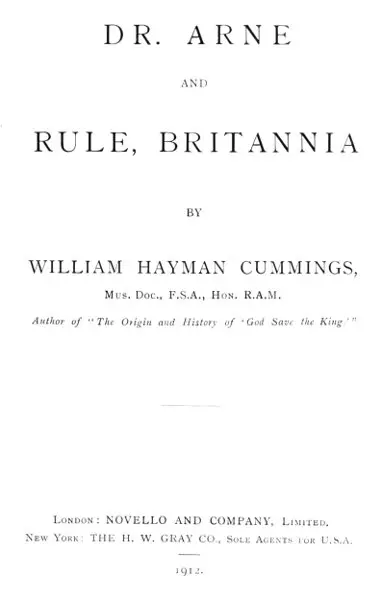
"Dr. Arne and Rule, Britannia" by William Hayman Cummings is a historical account written in the early 20th century. This work chronicles the life and influential career of Thomas Augustine Arne, a prominent composer of the 18th century, most notably known for the national song "Rule, Britannia." Cummings explores not only Arne's compositions but also the personal and sociocultural circumstances that shaped his musical legacy, providing insight into his struggles and triumphs. The opening of the book establishes the context for Arne's life by detailing his lineage, sociopolitical environment, and initial musical education. It describes his family background and the early indicators of his musical talent, including his secretive practice of music while adhering to his father’s wishes for him to pursue a legal career. The author sets the stage for a more comprehensive exploration of Arne’s career development, challenges, and the eventual recognition he gained within the British musical scene. This section hints at a narrative that is both educational for music students and enchanting for readers interested in the history behind one of Britain’s cherished national songs.
Introduction adapted from the source catalogue; source summaries may be automatically generated.
Free to read · English · 37,165 words · No account needed
MAKE TIME FOR A GOOD BOOK
On by default. Untick to stop anonymous reading totals. Each page counts after 10 seconds in view. How this works.
Anonymous counting is on unless you have switched it off.
The grand-niece previously quoted says: "Dr. Arne died a sincere penitent, and a firm Catholic. His confessor buried him according to the ceremony of his Church. A cross was put on his coffin, and he was interred in the burial ground of St. Paul's, Covent Garden, on the right hand side going in." There are two contemporary printed accounts of the last moments of the distinguished composer; one from his intimate friend, the popular tenor singer, Vernon, who, at that time engaged in the neighbouring Drury Lane Theatre, was in the habit of visiting Arne daily at his residence in Bow Street. The morning after Arne's decease he told the company assembled in the music-room at the theatre that he "was talking on the subject of music with the Doctor, who suffered much from exhaustion, when, in attempting to illustrate what he had advanced, he in a very feeble and tremulous voice sung part of an air, during which he became progressively more faint, until he breathed his last, making as our immortal Shakespeare expresses it, a swan-like end fading in music."
The other account says Arne "died of a spasm on his lungs, retaining his faculties to the last moment of his existence. He had originally been instructed in the principles of the Romish Church: these however he had for many years wholly neglected, as inconsistent with a life of ease and gallantry, in which he indulged to the fullest extent of his purse and constitution. In his last stage, the dormant seeds of early maxims and prejudices, as is usually the case, revived in his bosom, too strong to be checked, or perhaps discriminated by sound reason. The complicated train of doubts, hopes, and fears, operated so forcibly on the Doctor's feelings at this awful period, that a priest was sent for, by whom he was awed into a state of most submissive repentance. In thus renewing the duties of a Christian, those of his professional line were not forgotten; for about an hour before his death he sung an harmonious Halleluja, a flight of fancy, calculated as it were to usher him into the other world." These narratives, though not precisely similar in detail, leave no doubt in the mind of the reader that Arne died repentant, doubtless the happier for having been reconciled to his wife. "Notwithstanding the number and excellence of his publications, Dr. Arne left little or no property behind him; a circumstance which will not appear extraordinary to those who consider his real character and life. He was naturally fond of vicious pleasure, to which he sacrificed every other consideration." The Will he made is at Somerset House, and recites as follows:--"In the Name of God Amen--I Thomas Augustine Arne of Bow Street Covent Garden in the County of Middlesex doctor in Music being of sound mind memory and understanding hereby make and pronounce this to be my last Will and Testament revoking all former Wills made or pretended to be made whatever Whereas I am possessed of a small Personal Estate consisting of goods Chattels and Effects most of them now standing lying or being in the House I rent of Mrs. Woodeville in Bow Street aforesaid and particularized in the Schedule hereto annexed I leave give and bequeath them in manner and form following First to my beloved wife Cecilia and only son Michael I give and bequeath the sad remains of my once excellent Organ mangled trod to pieces and ruined by and through the Villainy of wicked Servants that they may dispose of the same to the best advantage and share the profits equally between them Secondly I give and bequeath to the said Cecilia and Michael all my Worldly Goods Chattels Estate Personal whatever and wherever to be found (except as hereafter excepted) Books musical and for reading Plate and every other thing now situate standing or lying in my house in Bow Street aforesaid or in any other place to be found As to all books Musical or Literary and all Manuscripts in either branch written or composed by me or other Persons My Will is that such as may by performance at any time or in any place produce any profit or Benefit to the said Cecilia and Michael The expenses attending such Performances being first paid and defrayed equally between them The Profits or Benefits arising from the Sale or Public Performance thereof shall be equally divided between them share and share alike And the said Property being liable to an exception before limited I shall make it here viz. That the share and proportion of the said Michael is only circumscribed or limited in this particular viz. that when by sale of the Goods or part of them or by Public Performance or Performances of any of my Works, have received to his share the sum of seventy Pounds that he shall pay or cause to be paid to his Daughter Jemima the sum of ten Guineas as a present from me to his said Daughter for her Love and Kindness to me It is therefore my last will that all my works in particular Shall be and remain in the Possession of my said wife Cecilia subject to their being called forth used and employed for the mutual benefit profit and emolument of my said son as well as my wife, for Security of which to the said Cecilia she has and shall have by virtue hereof (before the delivery of any work) an unquestionable right to be satisfied As to the Probability of Success in the undertaking and an equal right to elect a Trustee or Treasurer to sit in the Treasurers Office on all and every Night whereon any of my works are performed And after all the charges attending such performance or performances shall be duly deducted to take and receive for and to the use of the said Cecilia one clear half or Moiety of the Monies or Profits arising therefrom and then take the Score and Parts of such Work or Works and reconvey it or them in Safety to the said Cecilia And this same just method of Proceeding shall duly be observed for the said Cecilia's equal Security in Case that either of the said dramatic Productions shall by their mutual consent be disposed of for their mutual Profits or Advantage to either of the Patent Theatres And in case that the said Cecilia shall depart this Life before the Death of the said Michael in such case the whole Personal Estate and Property above mentioned shall devolve or come down in right to the said Michael as sole Successor by this my last Will and Testament And lastly I hereby nominate and appoint the said Cecilia and Michael my joint and sole Executors of this my last will and Testament hereby impowering them to sue for and recover all debts and Demands whatever due to me on any account whatever whether in Law or Equity As Witness my hand and Seal this sixth of December in the seventeenth year of the Reign of Our Sovereign Lord George the third and in the year of our Lord One thousand seven hundred and seventy-seven.
Your reading position is saved on this browser. Take it to another device with a library code. Reading pages adapt to text, rather than matching a printed edition.
BEHIND THE BOOK
This eBook is for the use of anyone anywhere in the United States and most other parts of the world at no cost and with almost no restrictions whatsoever. You may copy it, give it away or re-use it under the terms of the Project Gutenberg License included with this eBook or online at www.gutenberg.org. If you are not located in the United States, you will have to check the laws of the country where you are located before using this eBook. Read the source licence.
The original source file, including credits and licence, is retained by this library. Request an original-format copy at no charge. Please include the book title and Project Gutenberg identifier #43214.
KEEP YOUR CURIOSITY GOING
Cécile Tormay

Moritz Busch
John L. Ransom
Frances Wright
Cécile Tormay

Mabel Potter Daggett