THE CLASSIC COLLECTION✦An outlaw’s diary: the CommuneCLASSIC FREE BOOKS
An outlaw’s diary: the Commune
Cécile Tormay
THE CLASSIC COLLECTION · 1912
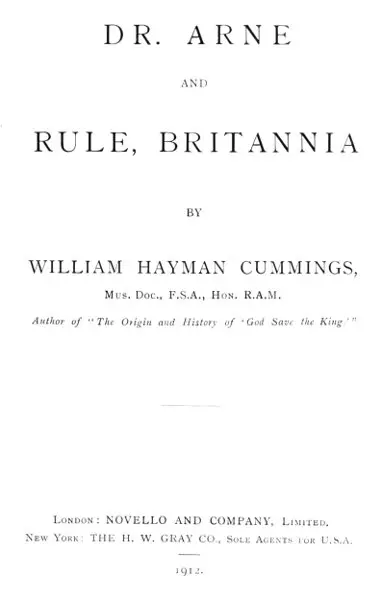
"Dr. Arne and Rule, Britannia" by William Hayman Cummings is a historical account written in the early 20th century. This work chronicles the life and influential career of Thomas Augustine Arne, a prominent composer of the 18th century, most notably known for the national song "Rule, Britannia." Cummings explores not only Arne's compositions but also the personal and sociocultural circumstances that shaped his musical legacy, providing insight into his struggles and triumphs. The opening of the book establishes the context for Arne's life by detailing his lineage, sociopolitical environment, and initial musical education. It describes his family background and the early indicators of his musical talent, including his secretive practice of music while adhering to his father’s wishes for him to pursue a legal career. The author sets the stage for a more comprehensive exploration of Arne’s career development, challenges, and the eventual recognition he gained within the British musical scene. This section hints at a narrative that is both educational for music students and enchanting for readers interested in the history behind one of Britain’s cherished national songs.
Introduction adapted from the source catalogue; source summaries may be automatically generated.
Free to read · English · 37,165 words · No account needed
MAKE TIME FOR A GOOD BOOK
On by default. Untick to stop anonymous reading totals. Each page counts after 10 seconds in view. How this works.
Anonymous counting is on unless you have switched it off.
"DEAR SIR,--I was never so conceited of any abilities, as non cedere majoribus; but then I ever was above servility, and could not pay a compliment to the opinion of Socrates or Seneca, at the expense of my reason. Humanum est errare, therefore the main study of every wise man is to arrive at rectitude, which cannot possibly be accomplished by giving an implicit concession to our first determinations. But shall Arne, a musician, have the hardiesse to dispute with Garrick, in his own way?--Yes, if Garrick, not giving himself time to debate on the natural effects arising from their causes, peremptorily gives his ego dixi to what does not (to Arne) appear natural. But where Garrick is pleased to exercise his judgment, as in his own parts, by a fair trial of his opinion pro and con? No, Arne would as soon dispute with Sir Isaac Newton (if living) on his doctrine of colours, sed ad propositum.
"When Miss Weller rehearsed part of Polly's character in the green-room, I knew it would be in vain to attempt a justification of her manner, at that juncture, and therefore reserved my sentiments for this occasion. I shall only particularize the soliloquy, 'Now I'm a wretch indeed,' which, in all the Polly's I ever saw, had no effect on the audience, except when Mrs. Cibber played the character, who spoke and acted in the same manner as Miss Weller does; and Mr. Barry had the same idea of it. In you this position is glaringly illustrated. Now, in regard to Polly's situation, it is this. She has been soliciting her husband's life with her parents, which, instead of moving their obdurate hearts, has had no other effect, than her father's leaving her mother with a determination to prepare matters at the Old Bailey for his death. Polly, overhearing this, comes on in an agony of grief, says, 'Now I'm a wretch indeed!'--thinks she sees him already in the cast--that she hears vollies of sighs from the windows in Holborn--then abruptly breaks out--'I see him at the tree--the whole circle are in tears--even butchers weep.' Can it be natural that the sight of a beloved husband at the gallows should excite fainter emotions in a doting wife, than arise in butchers exercised in offices of cruelty? Would not an apple-woman, who should see so fine a youth, merely in the cast, naturally clap her hands together, through depth of concern, and exclaim 'Ah, poor soul! God bless him and take him to his mercy!'--perhaps shed tears? Certainly; then Polly's emotion on figuring him at the fatal tree, where the whole circle, through mere humanity, are in tears, can be nothing short of distraction, and any action, short of the force she gave it, must appear trifling, faint, and unfeeling. You are far from having seen the best of her in that character, which appears in her scenes of love, fondness, fears, and strokes of tenderness with Mackheath. But I was not willing to give you too much trouble, and besides, I plainly saw that you could not divest yourself of prepossession; else, how was it possible that a fine voice both for speaking and singing; action open, easy, and graceful; an unexceptionable person and figure, with a countenance free from the least distortion, could be productive of such faint approbation? You have often said you regarded me--but, as in the case of Miss Brent, were I to produce an angel, her being ushered by me would create coolness and indifference. This observation, which I could more forcibly illustrate, I plainly see has put you out of humour. Give me leave to say, so it has me, who am not without my feeling on so mortifying an occasion. You are possessed both of fortune and merit; the one considerable, the other supreme. I pay you no particular respect, on account of the former; but the highest imaginable on account of the latter. Providence, by placing you in this beneficial situation, meant you as the sun and rain, to cheer and water plants of genius. Your own talents, and the just encouragement they have met with, demand, as a debt, those beneficent offices from you. The pay given to three nothings would be a suitable reward to a rising, promising genius, whose industry and advancement could never fail of repaying you ten fold in return. Having faithfully kept my promise to take no material step, without first acquainting you with my design, and therefore given you a fair offer of Miss Weller, I will trouble you with no more letters, or applications on her account; so shall only add, that if you are inclined to encourage and cherish her, as you have done by many others, with much lesser talents and requisites, I am desirous, and immediately ready to give you the preference; but if otherwise, as I have only my small merit and hard labour to subsist on, let it never be a matter of the least difference between us, that I have acted like a man of honour, and you----overlooked a jewel. I am, Sir, as I ever was, your sincere friend, and most obedient servant,
Your reading position is saved on this browser. Take it to another device with a library code. Reading pages adapt to text, rather than matching a printed edition.
BEHIND THE BOOK
This eBook is for the use of anyone anywhere in the United States and most other parts of the world at no cost and with almost no restrictions whatsoever. You may copy it, give it away or re-use it under the terms of the Project Gutenberg License included with this eBook or online at www.gutenberg.org. If you are not located in the United States, you will have to check the laws of the country where you are located before using this eBook. Read the source licence.
The original source file, including credits and licence, is retained by this library. Request an original-format copy at no charge. Please include the book title and Project Gutenberg identifier #43214.
KEEP YOUR CURIOSITY GOING
Cécile Tormay

Moritz Busch
John L. Ransom
Frances Wright
Cécile Tormay

Mabel Potter Daggett