THE CLASSIC COLLECTION✦An outlaw’s diary: the CommuneCLASSIC FREE BOOKS
An outlaw’s diary: the Commune
Cécile Tormay
THE CLASSIC COLLECTION · 1912
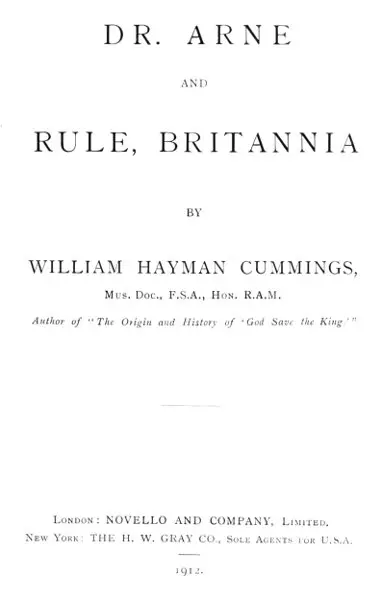
"Dr. Arne and Rule, Britannia" by William Hayman Cummings is a historical account written in the early 20th century. This work chronicles the life and influential career of Thomas Augustine Arne, a prominent composer of the 18th century, most notably known for the national song "Rule, Britannia." Cummings explores not only Arne's compositions but also the personal and sociocultural circumstances that shaped his musical legacy, providing insight into his struggles and triumphs. The opening of the book establishes the context for Arne's life by detailing his lineage, sociopolitical environment, and initial musical education. It describes his family background and the early indicators of his musical talent, including his secretive practice of music while adhering to his father’s wishes for him to pursue a legal career. The author sets the stage for a more comprehensive exploration of Arne’s career development, challenges, and the eventual recognition he gained within the British musical scene. This section hints at a narrative that is both educational for music students and enchanting for readers interested in the history behind one of Britain’s cherished national songs.
Introduction adapted from the source catalogue; source summaries may be automatically generated.
Free to read · English · 37,165 words · No account needed
MAKE TIME FOR A GOOD BOOK
On by default. Untick to stop anonymous reading totals. Each page counts after 10 seconds in view. How this works.
Anonymous counting is on unless you have switched it off.
To this conciliatory epistle Dr. Arne replied in the following month: "Sept. 3rd 1775. DEAR SIR.--I received the favour of your reply to my letter, which I could not doubt of, you never being deficient in politeness. You are certainly in the right to suppose that, if I wrote the word apathy, I meant antipathy. Did I make the blunder or is it a joke, like Mrs. Cibber's asking you how you could possibly spell King with a Q? I must beg your permission to assure you that you are greatly mistaken in two points. First, when you imagine that I have the least partiality either in favour of the other theatre or its patentees: next in saying that the music in 'Elfrida' is much superior to the music I composed for you in 'King Arthur.' The principal songs, which for air and mastership I have never excelled, have not been performed. They were written for the late Mrs. Arne,[23] and fashioned to her sweet voice, and glaring abilities. Mr. Arne expected, from the music and her performances of it, that they would be productive of the highest pleasure, that a judicious audience ever received from either of our endeavours, and several eminent masters thought as he did: but when those coups de maître came out of the mouths of persons who could neither sing in time nor tune, nor turn out one jeu de la voix in them, the result was much the same as if an approved author had written a fine part for ----. I was near hurting your delicacy, in nominating a gentleman, with whose acquaintance I am honoured, and this part, through an unfortunate event, should be acted by Jemmy Raftor, or Dagger Marr. Champness's songs, the chorus in the first scene of Mr. Vernon's 'Come, if you dare,' and several other things that employed my utmost efforts, were laid aside, in favour of Purcell's music, which (though excellent in its kind) was Cathedral, and not to the taste of a modern theatrical audience. But never was my surprise greater than when I perceived that a drama so fertile of invention and elegant in poetry, which brought so much to Harry Gifford, and lately in Dublin should (though strongly performed at a vast expense at Drury-lane) fail in making that impression on the public, which the managers had an undoubted right to expect. You frankly say that you have not engaged any of my pupils, because you have not the same opinion of them that I have. Be pleased to remember that I did not recommend Miss Weller as an accomplished singer; but as a young girl, with a good person, who would be useful in musical pieces; but whose talents in speaking and acting, might, with your friendly encouragement, in a little time bring so pretty a figure to be a shining object. Had you seen her play Mrs. Cadwallader in Foote's farce at Covent Garden, your candour would induce you to think with that company, who all declared that no young actress ever did better. When I offered you this girl, you wanted an accomplished singer. When I recommended Miss Jameson as such, I was to whistle an angel from Heaven, or you were full; though you brought out a raw nothing last year, and have taken Mrs. Jewell and a Jewess[24] this season. I hope you will, as you have kindly done, excuse this frankness in me, and give me leave to add that I will positively bet a hundred pounds upon Miss Jameson, against any singer you can name in either theatre--I might safely a hundred to one. I wish you would ponder on the contents--not now, because your cast is rather overloaded--but hereafter, when it may not be so. And now, Sir, to the last matter I shall at present trouble you with. Bickerstaff added songs to the Oracle, and brought it out by the title of 'Daphne and Amintor,' at Drury Lane, which succeeded very well. I remember a piece of Mr. Lloyd's, called the 'Capricious Lovers,' when performed in Clive's time. Every body liked the Burletta, but none were pleased with the music--which has induced me to reset it. Now, Sir, if you think it will (with the addition of my new music) fill up a vacancy, till the town fills, the vocal, instrumental, and speaking parts, are ready drawn out: the title may, and should be altered to 'The Country Girl at Court,' being the original one, viz.: 'La Contadina in Cort,' and (for a sixth night) I will attend the getting up of the musical part, and deliver up the composition to your use. If you don't want it, make no ceremony in saying so; for it will be of use to me, with my catches and glees. Have I been studying the longitude? Perhaps so; but if I have tired you, it is more than you could do by me, were you to fill a ream of paper.
Your reading position is saved on this browser. Take it to another device with a library code. Reading pages adapt to text, rather than matching a printed edition.
BEHIND THE BOOK
This eBook is for the use of anyone anywhere in the United States and most other parts of the world at no cost and with almost no restrictions whatsoever. You may copy it, give it away or re-use it under the terms of the Project Gutenberg License included with this eBook or online at www.gutenberg.org. If you are not located in the United States, you will have to check the laws of the country where you are located before using this eBook. Read the source licence.
The original source file, including credits and licence, is retained by this library. Request an original-format copy at no charge. Please include the book title and Project Gutenberg identifier #43214.
KEEP YOUR CURIOSITY GOING
Cécile Tormay

Moritz Busch
John L. Ransom
Frances Wright
Cécile Tormay

Mabel Potter Daggett