
Last letters from the living dead man
David Patterson (Spirit) Hatch
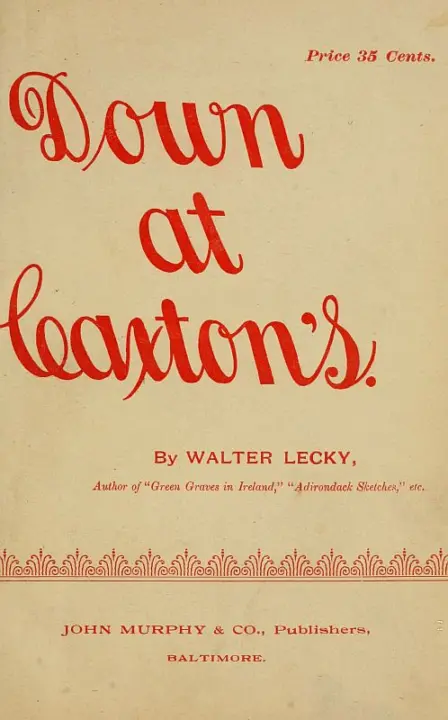
THE CLASSIC COLLECTION · 1895
"Down at Caxton's" by William A. McDermott is a collection of sketches written in the late 19th century. The work captures the essence of various influential figures in American literature and features thoughtful explorations of their contributions and character. Although the author initially focuses on notable literary figures, it seems to set the stage for a wider discussion about the intersections of literature, art, and culture, particularly in relation to the Catholic Church. At the start of the collection, the author dedicates his series of sketches to a dear friend and acknowledges the influence of several prominent writers. The opening section discusses Richard Malcolm Johnston, emphasizing his contributions to dialect fiction and a portrayal of Georgia life before the Civil War. McDermott highlights Johnston's authenticity and ability to represent the local flavor through dialect, arguing for the literary significance that was often overlooked by critics of the time. This introductory exploration serves to establish the cultural and artistic milieu that will be examined throughout the book.
Introduction adapted from the source catalogue; source summaries may be automatically generated.
Free to read · English · 30,137 words · No account needed
MAKE TIME FOR A GOOD BOOK
On by default. Untick to stop anonymous reading totals. Each page counts after 10 seconds in view. How this works.
Anonymous counting is on unless you have switched it off.
“Of the female characters that I have created, Miss Doolana Lines was my favorite, while Mr. Bill Williams is my favorite among the male characters. I started Doolana to make her mean and stingy like her father, but I hadn’t written a page before she wrenched herself out of my hands. She said to me, ‘I am a woman, and you shall not make me mean.’ These stories are all of Georgia as it was before the war. In the hill country the institution of slavery was very different from what it was in the rice region or near the coast. Do you know the Georgia negro has five times the sense of the South Carolina negro? Why? Because he has always been near his master, and their relations are closer. My father’s negroes loved him, and he loved them, and if a negro child died upon the place my mother wept for it. Some time ago I went to the old place, and an old negro came eight miles, walked all the way, to see me.
“He got to the house before five o’clock in the morning, and opened the shutters while I was asleep. With a cry he rushed into the room. ‘Oh, Massa Dick.’ We cried in each other’s arms. We had been boys together. One of my slaves is now a bishop—Bishop Lucius Holsey, one of the most eloquent men in Georgia.”
These charming bits of autobiography show us the sterling nature of Malcolm Johnston, a nature at once cheerful, kind and loving. It is the object of such natures, in the pessimistic wayfares of life, to make friends, illuminating them with sunshine and tickling them with laughter.
In front of the Ara Coeli I stood. A swarthy Italian was telling of the dramatic death of Cola di Rienzi. His English was lightly worn, but it seemed to please his audience, and it was for that purpose they had paid their lire. The crazy-quilt language of the cicerone and his audacious way of handling history, made him cut an attractive figure in the eyes of most tourists, whose desires are amusement rather than study. As a type, to use a phrase borrowed from the school of psychological novelism, he was a study. To the student Rome is a city of absorbing interest, to the ordinary American bird of passage a dull place. It all depends on your point of view. If you are a scholar, a collector of old lace, or a vandal, Rome is your happy hunting ground. If these pursuits do not interest you, Roman beggars with all sorts and conditions of diseases, sometimes by nature, mostly by art, Roman fleas, and the gaunt ghosts of the Campagna quickly drive you from the capital of the Cæsars and Popes. A few other annoyances might be added, such as sour wine, whose mist fumes are not to be shriven by your bottle-let of eau de Cologne, garlic on the fringe of decay, and the provoking smell of salt fish in the last stage of decomposition. But you have come to Rome; it is a name to conjure with, and despite the drawbacks, you must have a glimpse, an ordinary bowing acquaintance, with the famed old dame. At the office, an English office, in the Piazza di Spagna, you have asked for a “droll guide.” Who could listen to a scholarly one amid such active drawbacks as wine, fleas and fish? Michael Angelo Orazio Pantacci is your man. What do you care for good English? Did you not leave New York to leave it behind? What do you care for Roman history? Pantacci is your man, and his lecture on Cola di Rienzi is a masterpiece. A stranger joined our little crowd. Pantacci at that moment had attained his descriptive high-water mark. His pose and voice were touchingly dramatic. Cola was, as he expressed it, “to perish.” The stranger smiled and passed on. His smile was a composite affair. It was easy to see in it Michael Angelo’s historical duplicity and our ignorant simplicity. The stranger was tall, with the shoulders slightly stooping, a nose as near an approach to the Grecian as an American may come, a heavy black mustache, ruddy cheeks, that whispered of English food mellowed with the glowing Chianti. Who is that man? I said to my companion, whose eyes had followed the stranger rather than Pantacci. “That,” said he, “is Marion Crawford, the author of the Saracenesca books. You remember reading them at Albano.” Tell me something about him. He is a very clever man. Cola has perished; let us leave Pantacci. On the way to Cordietti’s tell me something of his life. He knows how to tell a story, an art hardly to be met with in contemporary fiction. Fiction has abrogated to herself the whole domain of life, and thus the art of telling a story for the story’s sake is lost. Fiction has a mission. She freights herself with all isms. Scott, Manzoni, even the great wizard of Spanish fiction, could they live again, were failures. Introspection is the cult, and, happily for their fame, they knew nothing of it. These great masters told us how scenes of life were enacted. Why, they left to the inquisitive and later-day brood of commentators. Since then the all absorbing scientific spirit prevails, and we moderns brush away the delightful humor of Dickens for the analytical puzzles of Henry James; the keen satire of Thackeray for the coxcomberies of George Meredith. Fairy cult interests none, modern children are ancient men. Scepticism is rampant, and the cause of it is, in a great manner, due to the modern novelist. This product of the 19th century world-spirit coolly tells us that romance lies dead. Realism has taken her place. If we are to believe the theories of its votaries, it is without an ideal—a mere anatomical transcript of man. What this theory leads to is well illustrated by the gutter filth of Zola and Catulle Mendes. It makes novel writing a trade. One ceases to be astonished at the output, if he thoroughly grasps the difference between a tradesman and an artist. Trade is a word much used by realists. Grant Allen, writing of that realistic necromancer, Guy de Maupassant, has nothing apter to define his position than the phrase “he knows his trade.” In point of fact, Grant Allen enunciates a truth in this phrase, one that might be carried still further, by saying that his whole school are journeymen laborers, tradesmen, if you prefer, turning out work, tasteless and crude, at the bidding of the erubescent young person of the period. It is readily assumed that work of this kind is not, despite the word-jugglery of their school, realism. It does not deal with the true man, but with a phrase, and that abnormal. A better phrase in use in speaking of the works of this school is, “literature of disease.” The artist who lives must have a model, and that we call the ideal. The nearer he approaches this the more lasting his work. All the great artists had ideals. Workmen may be guided by the rule of thumb. The first lesson a great artist learns is, “The art that merely imitates can only produce a corpse; it lacks the vital spark, the soul, which is the ideal, and which is necessary in order to create a living organic reality that will quicken genius and arouse enthusiasm throughout the ages.” The gulf between the trade-novelist and the artist-novelist is of vital importance. The former believes that art is simply imitation, the latter, that art is interpretation. One is a stone-cutter, the other a sculptor.
Your reading position is saved on this browser. Take it to another device with a library code. Reading pages adapt to text, rather than matching a printed edition.
BEHIND THE BOOK
This eBook is for the use of anyone anywhere in the United States and most other parts of the world at no cost and with almost no restrictions whatsoever. You may copy it, give it away or re-use it under the terms of the Project Gutenberg License included with this eBook or online at www.gutenberg.org. If you are not located in the United States, you will have to check the laws of the country where you are located before using this eBook. Read the source licence.
The original source file, including credits and licence, is retained by this library. Request an original-format copy at no charge. Please include the book title and Project Gutenberg identifier #51886.
KEEP YOUR CURIOSITY GOING
David Patterson (Spirit) Hatch

David Patterson (Spirit) Hatch

David Patterson (Spirit) Hatch
Cécile Tormay

Moritz Busch
John L. Ransom