
Last letters from the living dead man
David Patterson (Spirit) Hatch
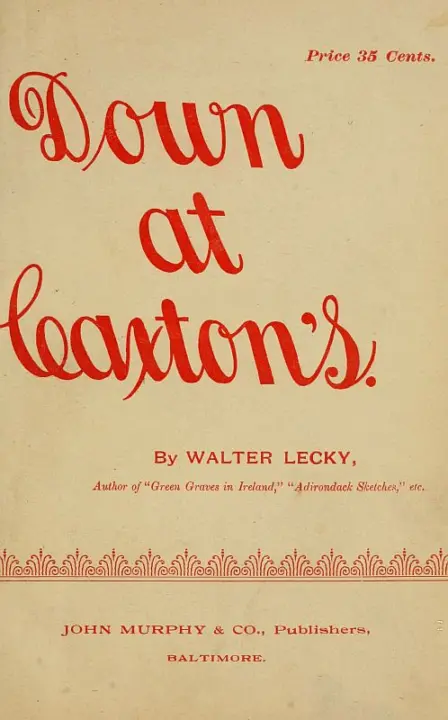
THE CLASSIC COLLECTION · 1895
"Down at Caxton's" by William A. McDermott is a collection of sketches written in the late 19th century. The work captures the essence of various influential figures in American literature and features thoughtful explorations of their contributions and character. Although the author initially focuses on notable literary figures, it seems to set the stage for a wider discussion about the intersections of literature, art, and culture, particularly in relation to the Catholic Church. At the start of the collection, the author dedicates his series of sketches to a dear friend and acknowledges the influence of several prominent writers. The opening section discusses Richard Malcolm Johnston, emphasizing his contributions to dialect fiction and a portrayal of Georgia life before the Civil War. McDermott highlights Johnston's authenticity and ability to represent the local flavor through dialect, arguing for the literary significance that was often overlooked by critics of the time. This introductory exploration serves to establish the cultural and artistic milieu that will be examined throughout the book.
Introduction adapted from the source catalogue; source summaries may be automatically generated.
Free to read · English · 30,137 words · No account needed
MAKE TIME FOR A GOOD BOOK
On by default. Untick to stop anonymous reading totals. Each page counts after 10 seconds in view. How this works.
Anonymous counting is on unless you have switched it off.
“Large heart and brave! Tried soul and true!
How thickly in thy life’s short span,
All strong sweet virtues throve and grew,
As friend, as hero, and as man.
Unmoved by thought of blame or praise,
Unbought by gifts of power and pride,
Thy feet still trod Time’s devious ways
With Duty as thy law and guide.”
Good blood, you will say, from whence our poet came, and blood counts even in poetry. I have no anecdotes to relate of Miss Guiney’s early years. I am not sure that there were any. Anecdotes are usually manufactured in later life, if the subject happens to become famous. Her education was carefully planned, and intelligently carried out. She was not held in the dull routine of the school-room, but was allowed to emancipate herself in the works of the poets. What joy must have been her’s, scampering home after the study of de omni scibili, the ordinary curriculum of any American school, to a quiet nook and the dream of her poets. Amid these dreams came the siren whisperings of the muse, telling her of the poet within struggling for life and expression. These struggles begot a tiny little volume happily named “Songs at the Start.” The great American reviewer, who, ordinarily,
“Bolts every book that comes out of the press, Without the least question of larger or less,”
on this occasion, by some untoward event, stumbled on a truth when he informed us, with the air of one who rarely touches earth, that the book bore signs of promise. The people, by all means a better critic, were more apt in their judgment of the young singer. A few years later they asked her to write the memorial poem for the services in commemoration of General Grant. Thus honored by her native city, in an easy way she was led to climb the ladder of fame. In 1885 appeared her first volume of essays, “Goose Quill Papers;” in 1887 a volume of poems bearing the fanciful name of “White-Sail;” in 1888 a pretty book for children; in 1892 “Monsieur Henri, a Foot-note to French History.” It us something to be noted in regard to a “Foot-note to French history,” that the novelist Stevenson, in his far-off home in Samoa, was publishing at the same time a work which bore a decided likeness to her title. Stevenson’s book was published as “A Foot-Note to History.” In 1893 appeared her latest volume of verse, being a selection of poems previously published in American magazines. This selection (the poet has a genuine knack for tacking taking names to her volumes) is quaintly named “A Wayside Harp,” and dedicated to a brace of Irish poets, the Sigerson sisters. The graceful dedication as well as many of its strongest and most artistic poems, were the outcome of a trip to Great Britain and Ireland. The author travelled with open eyes, and brought back many a dainty picture of the scenes she had so lovingly witnessed. This volume fulfils the early promise, and what is more, gives indubitable signs that the poet possesses a reserve force. Not a few women poets write themselves out in their first volume. Not so with Miss Guiney, every additional volume shows greater strength and more complete mastery of technique. After the surfeit of twaddle passing current as poetry, such a book as “A Wayside Harp” should find a waiting audience, Miss Guiney has the essentials of a poet, which I take to be color, music, perfume and passion. In their use she is an artist. In her first book an excess of these everywhere prevailed; it was from this excess, however, that the prudent critic would have hazarded a doubt as to her fitness to join the company of the bards. Since then she has been an ardent student. This study has not only taught her limitations, a thing that saves so much after pruning, but that other lesson, forgotten by so many bardlets, that the greatest poetic effects are the result of the masterful mixing of a few simple colors. It is well that she has learned these lessons at the outset of her career. Let not the fads and fancies of this fin de siècle and the senseless worship of those poetasters who scorn sense while they hug sound lead her from the true road of song. No amount of meaningless words airily strung together, no amount of gymnastic rhyming feats can produce a poet. They are the badges of those wondrous little dunces that pass nature with a frown, alleging in the language of the witty Bangs that “Nature is not art.” Guiney’s friend and faithful mentor, O’Reilly, had taught her to abhor all those who spent their waking hours chiselling cherry stones. To him it was a poet’s duty to aim high, attune his lyre, not to the petty, but the manly and hopeful; never to debase the lyre by an utterance of selfishness, but to consecrate it with the strains of liberty and humanity. If Guiney follows the teachings of her early friend—teachings which are substantially sound, she will yet produce poems that the world will not willingly let die. That Rosetti fad of hiding a mystic meaning in a poem, now occupying the brains of our teeming songsters, is now and then to be met with in our poet. It is a trade-trick. Poetry is sense—common-sense at that, and you cannot rim common-sense things with mystical hues. Abjuring these trade-tricks, and shaking off the trammels of her curious and extensive reading and evolving from herself solely, she has, says Douglas Sladen, a great promise before her. As an instance of this promise let us quote that fine poem, “The Wild Ride,” which is full of genuine inspiration, and which may be the means of introducing to some the most thoroughly gifted Catholic woman writer of our country.
Your reading position is saved on this browser. Take it to another device with a library code. Reading pages adapt to text, rather than matching a printed edition.
BEHIND THE BOOK
This eBook is for the use of anyone anywhere in the United States and most other parts of the world at no cost and with almost no restrictions whatsoever. You may copy it, give it away or re-use it under the terms of the Project Gutenberg License included with this eBook or online at www.gutenberg.org. If you are not located in the United States, you will have to check the laws of the country where you are located before using this eBook. Read the source licence.
The original source file, including credits and licence, is retained by this library. Request an original-format copy at no charge. Please include the book title and Project Gutenberg identifier #51886.
KEEP YOUR CURIOSITY GOING
David Patterson (Spirit) Hatch

David Patterson (Spirit) Hatch

David Patterson (Spirit) Hatch
Cécile Tormay

Moritz Busch
John L. Ransom