READ · DISCOVER · ENJOYClassic literature · Always free
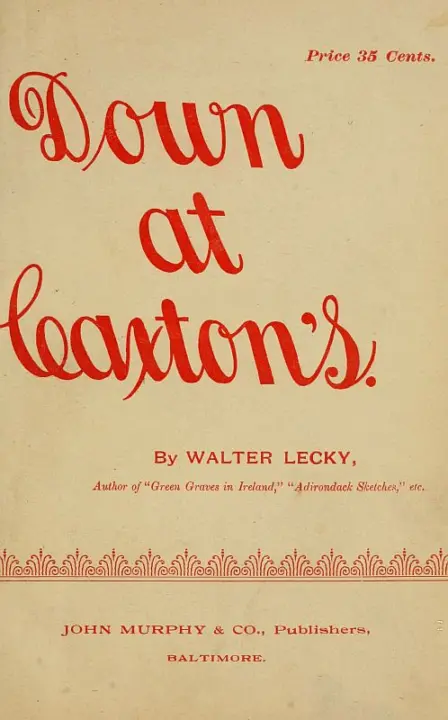
Down at Caxton’s — digital edition cover

THE CLASSIC COLLECTION · 1895

Down at Caxton’s

"Down at Caxton's" by William A. McDermott is a collection of sketches written in the late 19th century. The work captures the essence of various influential figures in American literature and features thoughtful explorations of their contributions and character. Although the author initially focuses on notable literary figures, it seems to set the stage for a wider discussion about the intersections of literature, art, and culture, particularly in relation to the Catholic Church. At the start of the collection, the author dedicates his series of sketches to a dear friend and acknowledges the influence of several prominent writers. The opening section discusses Richard Malcolm Johnston, emphasizing his contributions to dialect fiction and a portrayal of Georgia life before the Civil War. McDermott highlights Johnston's authenticity and ability to represent the local flavor through dialect, arguing for the literary significance that was often overlooked by critics of the time. This introductory exploration serves to establish the cultural and artistic milieu that will be examined throughout the book.

Introduction adapted from the source catalogue; source summaries may be automatically generated.

Start reading ↓

Free to read · English · 30,137 words · No account needed

MAKE TIME FOR A GOOD BOOK

Down at Caxton’s

On by default. Untick to stop anonymous reading totals. Each page counts after 10 seconds in view. How this works.

Anonymous counting is on unless you have switched it off.

Down at Caxton’s

Patrick Francis Mullaney, better known as Brother Azarias, was born in Killenaule County, Tipperary, Ireland, June 29th, 1847. Like the majority of eminent men that his country has given birth to, he came of its noble peasantry. The old tale was here enacted. The parents left the land of their birth in search of a home in our better land. This found, Azarias joined them. At the age of fifteen he joined the Christian Brothers. That great Order gave free scope to his fine abilities. In 1866 he was chosen professor of mathematics and English literature at Rock Hill College, Maryland. He continued in this position for ten years. At the expiration of his professorship he travelled a year through Europe, collecting materials and writing his “Development of Old English Thought.” On his return he became president of Rock Hill College, holding that position until recalled to Paris by his Superior in 1866. After an absence of three years Brother Azarias returned to the States as professor of English literature at the De La Salle Institute, New York. This is not only an important position, but it gives leisure, and that ready access to the great libraries, so prized by literary men.

WOMEN.

KATHERINE ELEANOR CONWAY.

“Next room to that of Roche’s,” said the dear O’Reilly, showing me his nest of poets, “is a gentle poetess.”

The door was wide open. It is a question with my mind if the room ever knew a door. Be this as it may, there sat, with her chair close drawn to her desk, a frail, delicate-looking woman. The ordinary eye might see nothing in a face that was winsome, if not handsome; yet, let the dainty mouth curve in speech, and at once a subtle attraction, lit up by lustrous eyes, permeated the face. One characteristic that made itself felt, in the most sparse conversation with this woman, was her humility, a rare virtue among American literary women. I have known not a few among that irritable class who, no sooner had they sipped the most meagre draught of fame, than they became intoxicated with their own importance, and for the balance of life wooed that meretricious goddess, Notoriety. In fiery prose and tuneful song they told of the dire misfortunes that had been heaped upon their sex by that obstinate vulgar biped, man. Their literature—for that is the name given to the crudest offspring of the press in these days—is noisy, and, says a witty writer, a noisy author is as bad as a barrel organ,—a quiet one is as refreshing as a long pause in a foolish sermon. Clergymen, who have listened to a brother divine on grace, will be the first to see the point. Our authoress—(a female filled with the vanity that troubled Solomon says I should write female author)—is a quiet and unobtrusive writer. Of the tricks that catch and the ways that are crooked in literature, she knows nothing, and what is better, no amount of tawdry fame could induce her to swerve a jot from the hard stony road that leads to enduring success, the only goal worth striving for in the domain of letters. I am well aware that in the popular list of women-writers mouthed by the growing herd of flippant readers that have no other use for a book than as a time-killer,—a herd to whom ideas are as unpalatable as disestablishment to an English parson—you will fail to find the name of Katherine Conway. The reason is simple. She has no fads to air in ungrammatical English, no fallacies to adduce in halting metre. It was a Boston critic who echoed the dictum of the French critic—that grammar has no place in the world of letters. Only have ideas, that is, write meaningless platitudes, grandiose nothings, something that neither man, the angels above nor the demons down under the sea, may decipher, and this illusive verbiage will make you famous. A school of critics will herald your work with such adjectives as “noble, lofty, absorbing, soul-inspiring;” nay, more, a pious missionary friend may be found to to translate the verbiage into Syriac, as a present for converts. Borne on the tide of such criticism, not a few women writers have mistaken the plaudits of notoriety, that passing show, for fame. It was a saying of De Musset’s that fame was a tardy plant, a lover of the soil. Be this as it may, it is safe to assert that its coming is not proclaimed by far-fetched similes, frantic metaphors, sensuous images, ranting style, ignorance of metre, want of grammar; the dishes are not of the voluptuous, morbid or the monstrous kind. Its thirst is not slaked at sewers of dulness spiced with immorality. These symptoms savor of one disease known to all pathologists as notoriety. In an age of this dreaded disease it is surely refreshing to meet with works that breathe gentleness and repose,—a beautiful trust in religion, and a warm, natural heart for humanity. These traits will the reader find in abundance in the pages of Katherine Conway. “What kills a poet,” says Aldrich, “is self-conceit.” Of all the forms self-conceit may assume none is more foolish or detrimental, especially to a woman-poet, than the pluming of oneself as the harbinger of some renovating gospel, some panacea for human infirmities. What is the burden of your message? says the critic to the young poet. Straightway the poet evolves a message, and as messages of this kind ought to be mysterious, the poet wraps them in a jargon as unintelligible as Garner’s monkey dialect. Thus in America has risen a school of woman poetry, deluded by false criticism, calling itself a message to humanity, dubbed rightly the school of passion, and one might add, of pain. This school may ask, “Am I to be debarred from treating of the passions on the score of sex.” By no means; the passions are legitimate subjects. Love, one of them, is your most attractive theme, but as Lilly has it, love is not to you what it is to the physiologist, a mere animal impulse which man has in common with moths and molluscs. Your task is to extract from human life, even in its commonest aspects, its most vulgar realities, what it contains of secret beauty; to lift it the level of art, not to degrade art to its level. Few American writers more fully realized these great artistic truths than the master under whose fatherly tuition Miss Conway had long been placed. Boyle O’Reilly was a Grecian in his love for nature. As such it was his aim to seek the beautiful in its commonest aspects, its most vulgar realities. No amount of claptrap or fine writing could make him mistake a daub for a Turner. In the bottom of his soul he detested the little bardlings who had passed nature by, without knowing her, who wove into the warp and woof of their dulness the putridity of Zola and morbidity of Marie Bashkirtseff. Under such a guide, the poetic ideal set before Miss Conway has been of the highest, and the highest is only worth working for. This ideal must be held unswervingly, even if one sees that books that are originally vicious are “placarded in the booksellers’ windows; sold on the street corners; hawked through the railroad trains; yea, given away, with packages of tea or toilet soap, in place of the chromo, mercifully put on the superannuated list.” These books are but foam upon the current of time, flecking its surface for a moment, and passing away into oblivion, while what Miss Conway happily calls the literature of moral loveliness, or what might as aptly be called the literature of all time, remains our contribution to posterity. Its foundations, to follow the thought of Azarias, are deeply laid in human nature, and its structure withstands the storms of adversity and the eddies of events. For such a literature O’Reilly made a life struggle; his pupil has closely followed his footsteps in the charming, simple, melodious volume that lies before me, “A Dream of Lilies.” Rarely has a Catholic book had a more artistic setting, and one might add, rarely has a volume of Catholic verse deserved it more. Here the poetess touches her highest point, and proves that years of silence have been years of study and conscientious workmanship. In her poem “Success” may be found the key to this volume;

Your reading position is saved on this browser. Take it to another device with a library code. Reading pages adapt to text, rather than matching a printed edition.

BEHIND THE WORDS

About William A. McDermott

William A. McDermott (1863–1913). Explore Down at Caxton’s in this collection. These books span essays & ideas, history.

Explore this author’s books →

THE READERS’ VERDICT

How did this story stay with you?

Not rated yet
Your rating for Down at Caxton’s

Be the first to share your verdict.

One rating per browser, which you can change or remove. A necessary browser identifier remembers your vote. How ratings work

A GOOD STORY DESERVES COMPANY

Pass this book along.

A great read is even better when it’s shared.

SEND A LITTLE INSPIRATION

Share this book

BEHIND THE BOOK

Edition & source details.

Title
Down at Caxton’s
Author
William A. McDermott
Publication year
1895
Digital edition publisher
Project Gutenberg
Gutenberg release date
2016-04-29
Language
English
Source edition imprint
Not stated in source catalogue
Source identifier
Project Gutenberg #51886
Contributors
No additional named contributors in source metadata

Public-domain source & licence

This eBook is for the use of anyone anywhere in the United States and most other parts of the world at no cost and with almost no restrictions whatsoever. You may copy it, give it away or re-use it under the terms of the Project Gutenberg License included with this eBook or online at www.gutenberg.org. If you are not located in the United States, you will have to check the laws of the country where you are located before using this eBook. Read the source licence.

Full source licence and obtaining an original copy

The original source file, including credits and licence, is retained by this library. Request an original-format copy at no charge. Please include the book title and Project Gutenberg identifier #51886.

the full Project Gutenberg License must appear
prominently whenever any copy of a Project Gutenberg work (any work
on which the phrase “Project Gutenberg” appears, or with which the
phrase “Project Gutenberg” is associated) is accessed, displayed,
performed, viewed, copied or distributed:

This eBook is for the use of anyone anywhere in the United States and most
other parts of the world at no cost and with almost no restrictions
whatsoever. You may copy it, give it away or re-use it under the terms
of the Project Gutenberg™ License included with this eBook or online
at www.gutenberg.org. If you
are not located in the United States, you will have to check the laws
of the country where you are located before using this eBook.

1.E.2. If an individual Project Gutenberg electronic work is
derived from texts not protected by U.S. copyright law (does not
contain a notice indicating that it is posted with permission of the
copyright holder), the work can be copied and distributed to anyone in
the United States without paying any fees or charges. If you are
redistributing or providing access to a work with the phrase “Project
Gutenberg” associated with or appearing on the work, you must comply
either with the requirements of paragraphs 1.E.1 through 1.E.7 or
obtain permission for the use of the work and the Project Gutenberg
trademark as set forth in paragraphs 1.E.8 or 1.E.9.

1.E.3. If an individual Project Gutenberg electronic work is posted
with the permission of the copyright holder, your use and distribution
must comply with both paragraphs 1.E.1 through 1.E.7 and any
additional terms imposed by the copyright holder. Additional terms
will be linked to the Project Gutenberg License for all works
posted with the permission of the copyright holder found at the
beginning of this work.

1.E.4. Do not unlink or detach or remove the full Project Gutenberg
License terms from this work, or any files containing a part of this
work or any other work associated with Project Gutenberg.

1.E.5. Do not copy, display, perform, distribute or redistribute this
electronic work, or any part of this electronic work, without
prominently displaying the sentence set forth in paragraph 1.E.1 with
active links or immediate access to the full terms of the Project
Gutenberg License.

1.E.6. You may convert to and distribute this work in any binary,
compressed, marked up, nonproprietary or proprietary form, including
any word processing or hypertext form. However, if you provide access
to or distribute copies of a Project Gutenberg work in a format
other than “Plain Vanilla ASCII” or other format used in the official
version posted on the official Project Gutenberg website
(www.gutenberg.org), you must, at no additional cost, fee or expense
to the user, provide a copy, a means of exporting a copy, or a means
of obtaining a copy upon request, of the work in its original “Plain
Vanilla ASCII” or other form. Any alternate format must include the
full Project Gutenberg License as specified in paragraph 1.E.1.

1.E.7. Do not charge a fee for access to, viewing, displaying,
performing, copying or distributing any Project Gutenberg works
unless you comply with paragraph 1.E.8 or 1.E.9.

1.E.8. You may charge a reasonable fee for copies of or providing
access to or distributing Project Gutenberg electronic works
provided that:

• You pay a royalty fee of 20% of the gross profits you derive from
the use of Project Gutenberg works calculated using the method
you already use to calculate your applicable taxes. The fee is owed
to the owner of the Project Gutenberg trademark, but he has
agreed to donate royalties under this paragraph to the Project
Gutenberg Literary Archive Foundation. Royalty payments must be paid
within 60 days following each date on which you prepare (or are
legally required to prepare) your periodic tax returns. Royalty
payments should be clearly marked as such and sent to the Project
Gutenberg Literary Archive Foundation at the address specified in
Section 4, “Information about donations to the Project Gutenberg
Literary Archive Foundation.”

• You provide a full refund of any money paid by a user who notifies
you in writing (or by e-mail) within 30 days of receipt that s/he
does not agree to the terms of the full Project Gutenberg™
License. You must require such a user to return or destroy all
copies of the works possessed in a physical medium and discontinue
all use of and all access to other copies of Project Gutenberg™
works.

• You provide, in accordance with paragraph 1.F.3, a full refund of
any money paid for a work or a replacement copy, if a defect in the
electronic work is discovered and reported to you within 90 days of
receipt of the work.

• You comply with all other terms of this agreement for free
distribution of Project Gutenberg™ works.


1.E.9. If you wish to charge a fee or distribute a Project
Gutenberg™ electronic work or group of works on different terms than
are set forth in this agreement, you must obtain permission in writing
from the Project Gutenberg Literary Archive Foundation, the manager of
the Project Gutenberg™ trademark. Contact the Foundation as set
forth in Section 3 below.

1.F.

1.F.1. Project Gutenberg volunteers and employees expend considerable
effort to identify, do copyright research on, transcribe and proofread
works not protected by U.S. copyright law in creating the Project
Gutenberg™ collection. Despite these efforts, Project Gutenberg™
electronic works, and the medium on which they may be stored, may
contain “Defects,” such as, but not limited to, incomplete, inaccurate
or corrupt data, transcription errors, a copyright or other
intellectual property infringement, a defective or damaged disk or
other medium, a computer virus, or computer codes that damage or
cannot be read by your equipment.

1.F.2. LIMITED WARRANTY, DISCLAIMER OF DAMAGES - Except for the “Right
of Replacement or Refund” described in paragraph 1.F.3, the Project
Gutenberg Literary Archive Foundation, the owner of the Project
Gutenberg™ trademark, and any other party distributing a Project
Gutenberg™ electronic work under this agreement, disclaim all
liability to you for damages, costs and expenses, including legal
fees. YOU AGREE THAT YOU HAVE NO REMEDIES FOR NEGLIGENCE, STRICT
LIABILITY, BREACH OF WARRANTY OR BREACH OF CONTRACT EXCEPT THOSE
PROVIDED IN PARAGRAPH 1.F.3. YOU AGREE THAT THE FOUNDATION, THE
TRADEMARK OWNER, AND ANY DISTRIBUTOR UNDER THIS AGREEMENT WILL NOT BE
LIABLE TO YOU FOR ACTUAL, DIRECT, INDIRECT, CONSEQUENTIAL, PUNITIVE OR
INCIDENTAL DAMAGES EVEN IF YOU GIVE NOTICE OF THE POSSIBILITY OF SUCH
DAMAGE.

1.F.3. LIMITED RIGHT OF REPLACEMENT OR REFUND - If you discover a
defect in this electronic work within 90 days of receiving it, you can
receive a refund of the money (if any) you paid for it by sending a
written explanation to the person you received the work from. If you
received the work on a physical medium, you must return the medium
with your written explanation. The person or entity that provided you
with the defective work may elect to provide a replacement copy in
lieu of a refund. If you received the work electronically, the person
or entity providing it to you may choose to give you a second
opportunity to receive the work electronically in lieu of a refund. If
the second copy is also defective, you may demand a refund in writing
without further opportunities to fix the problem.

1.F.4. Except for the limited right of replacement or refund set forth
in paragraph 1.F.3, this work is provided to you ‘AS-IS’, WITH NO
OTHER WARRANTIES OF ANY KIND, EXPRESS OR IMPLIED, INCLUDING BUT NOT
LIMITED TO WARRANTIES OF MERCHANTABILITY OR FITNESS FOR ANY PURPOSE.

1.F.5. Some states do not allow disclaimers of certain implied
warranties or the exclusion or limitation of certain types of
damages. If any disclaimer or limitation set forth in this agreement
violates the law of the state applicable to this agreement, the
agreement shall be interpreted to make the maximum disclaimer or
limitation permitted by the applicable state law. The invalidity or
unenforceability of any provision of this agreement shall not void the
remaining provisions.

1.F.6. INDEMNITY - You agree to indemnify and hold the Foundation, the
trademark owner, any agent or employee of the Foundation, anyone
providing copies of Project Gutenberg™ electronic works in
accordance with this agreement, and any volunteers associated with the
production, promotion and distribution of Project Gutenberg™
electronic works, harmless from all liability, costs and expenses,
including legal fees, that arise directly or indirectly from any of
the following which you do or cause to occur: (a) distribution of this
or any Project Gutenberg work, (b) alteration, modification, or
additions or deletions to any Project Gutenberg work, and (c) any
Defect you cause.

Section 2. Information about the Mission of Project Gutenberg

Project Gutenberg is synonymous with the free distribution of
electronic works in formats readable by the widest variety of
computers including obsolete, old, middle-aged and new computers. It
exists because of the efforts of hundreds of volunteers and donations
from people in all walks of life.

Volunteers and financial support to provide volunteers with the
assistance they need are critical to reaching Project Gutenberg’s
goals and ensuring that the Project Gutenberg collection will
remain freely available for generations to come. In 2001, the Project
Gutenberg Literary Archive Foundation was created to provide a secure
and permanent future for Project Gutenberg and future
generations. To learn more about the Project Gutenberg Literary
Archive Foundation and how your efforts and donations can help, see
Sections 3 and 4 and the Foundation information page at www.gutenberg.org.

Section 3. Information about the Project Gutenberg Literary Archive Foundation

The Project Gutenberg Literary Archive Foundation is a non-profit
501(c)(3) educational corporation organized under the laws of the
state of Mississippi and granted tax exempt status by the Internal
Revenue Service. The Foundation’s EIN or federal tax identification
number is 64-6221541. Contributions to the Project Gutenberg Literary
Archive Foundation are tax deductible to the full extent permitted by
U.S. federal laws and your state’s laws.

The Foundation’s business office is located at 41 Watchung Plaza #516,
Montclair NJ 07042, USA, +1 (862) 621-9288. Email contact links and up
to date contact information can be found at the Foundation’s website
and official page at www.gutenberg.org/contact

Section 4. Information about Donations to the Project Gutenberg
Literary Archive Foundation

Project Gutenberg™ depends upon and cannot survive without widespread
public support and donations to carry out its mission of
increasing the number of public domain and licensed works that can be
freely distributed in machine-readable form accessible by the widest
array of equipment including outdated equipment. Many small donations
($1 to $5,000) are particularly important to maintaining tax exempt
status with the IRS.

The Foundation is committed to complying with the laws regulating
charities and charitable donations in all 50 states of the United
States. Compliance requirements are not uniform and it takes a
considerable effort, much paperwork and many fees to meet and keep up
with these requirements. We do not solicit donations in locations
where we have not received written confirmation of compliance. To SEND
DONATIONS or determine the status of compliance for any particular state
visit www.gutenberg.org/donate.

While we cannot and do not solicit contributions from states where we
have not met the solicitation requirements, we know of no prohibition
against accepting unsolicited donations from donors in such states who
approach us with offers to donate.

International donations are gratefully accepted, but we cannot make
any statements concerning tax treatment of donations received from
outside the United States. U.S. laws alone swamp our small staff.

Please check the Project Gutenberg web pages for current donation
methods and addresses. Donations are accepted in a number of other
ways including checks, online payments and credit card donations. To
donate, please visit: www.gutenberg.org/donate.

Section 5. General Information About Project Gutenberg electronic works

Professor Michael S. Hart was the originator of the Project
Gutenberg concept of a library of electronic works that could be
freely shared with anyone. For forty years, he produced and
distributed Project Gutenberg eBooks with only a loose network of
volunteer support.

Project Gutenberg eBooks are often created from several printed
editions, all of which are confirmed as not protected by copyright in
the U.S. unless a copyright notice is included. Thus, we do not
necessarily keep eBooks in compliance with any particular paper
edition.

Most people start at our website which has the main PG search
facility: www.gutenberg.org.

This website includes information about Project Gutenberg,
including how to make donations to the Project Gutenberg Literary
Archive Foundation, how to help produce our new eBooks, and how to
subscribe to our email newsletter to hear about new eBooks.


KEEP YOUR CURIOSITY GOING

Your next chapter awaits.