
Last letters from the living dead man
David Patterson (Spirit) Hatch
THE CLASSIC COLLECTION · 1895
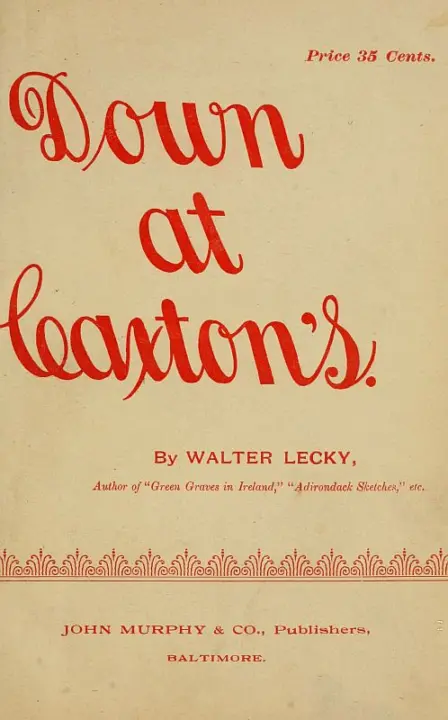
"Down at Caxton's" by William A. McDermott is a collection of sketches written in the late 19th century. The work captures the essence of various influential figures in American literature and features thoughtful explorations of their contributions and character. Although the author initially focuses on notable literary figures, it seems to set the stage for a wider discussion about the intersections of literature, art, and culture, particularly in relation to the Catholic Church. At the start of the collection, the author dedicates his series of sketches to a dear friend and acknowledges the influence of several prominent writers. The opening section discusses Richard Malcolm Johnston, emphasizing his contributions to dialect fiction and a portrayal of Georgia life before the Civil War. McDermott highlights Johnston's authenticity and ability to represent the local flavor through dialect, arguing for the literary significance that was often overlooked by critics of the time. This introductory exploration serves to establish the cultural and artistic milieu that will be examined throughout the book.
Introduction adapted from the source catalogue; source summaries may be automatically generated.
Free to read · English · 30,137 words · No account needed
MAKE TIME FOR A GOOD BOOK
On by default. Untick to stop anonymous reading totals. Each page counts after 10 seconds in view. How this works.
Anonymous counting is on unless you have switched it off.
Maurice Francis Egan, poet, essayist, novelist, journalist, and all-round literary man, was born in Philadelphia, Pa., May 24, 1852. His first instructors were the Christian Brothers, at their well-known La Salle College in that city. From La Salle he went to Georgetown College, as a professor of English. After leaving Georgetown he edited a short-lived venture, McGee’s Weekly. In 1881 he became assistant editor of the Freeman’s Journal, and remained virtually at the head of that paper until the death of its founder and the passing of the property to other hands. The founding of the Catholic University, and the acceptance of its English professorship by Warren Stoddard, made a vacancy in the faculty of Notre Dame University. This vacancy was offered to and accepted by Mr. Egan.
There are few places better fitted as a poet’s home than Notre Dame. Beautiful scenery to fill the eye, brilliant society to spur the mind, and a spacious library freighted with the riches of the past. In comparison with the majority of the Catholic writers, the poet’s journey in life has been comparatively smooth, though far from what it should have been. He has published the following volumes:—“That Girl of Mine,” 1879; “Preludes,” 1880; “Song Sonnets,” London, 1885; “Theatre,” 1885; “Stories of Duty,” 1885; “Garden of Roses,” 1886; “Life Around Us,” 1886; “Novels and Novelists,” 1888; “Patrick Desmond,” 1893; “Poems,” 1893. To this list must be added innumerable articles in magazines and weekly journals. Judged by the signed output, it is safe to write that the English professor of Notre Dame is a very busy man. The wonder is that a mind so occupied by so many diverse things can write entertainingly of each.
The poet’s first book, a few sonnets and poems, was for “sweet charity’s sake,” and had but a limited circulation. It is safe to say that every first book of a genuine poet, despite its crudities, will show the seeker signs of things to come. Egan’s book was not without promises, but in truth these promises are only partly fulfilled in his latest volume of verse. There may be many reasons adduced for this disparity between promise and fulfilment. One of them is the haste with which poetry is published. Horace’s dictum of using the file has been long since forgotten. The rabble calls for poetry, and, like the Italian and his lentils, care little for the quality. If the poet harkens to the calls (and who among the contemporary bards has laughed it to scorn?) he exchanges perpetuity for the present, notoriety for fame. Nor will the rabble leave the poet freedom in choosing his material. He is simply a tradesman, and must use what is placed at his disposal. Things great and grand must be left unto that day when the poet, untrammelled by worldly care, shall write his heart’s dream. If the time ever comes, the poet learns in sorrow that his dreams will never float into human speech, for the hand has lost its cunning. So the days of youth and manhood pass, blowing bubbles or decorating platitudes. Death snatches the poetling, and oblivion is his coverlid. The songs he sang died with the rabble. The new generation asked for a poet that could drill into the human heart and bring forth its secrets—a listener to nature, her interpreter to man. To such a one the vocabulary of a minor bard is useless. Another reason, more applicable to our author, is that he has been unfortunate to be a pioneer in Catholic American literature. His poems, appealing, as they do, to a distinct class, and that far from being a book-buying one, will fail to attract the lynx-eyed critic who cares only for the general literary purveyor. From such a source, the poet’s chance of corrective criticism has been slight. The class to which Mr. Egan belongs has no criticism to offer its literary food givers. If an author’s book sells, his name is blazoned forth in half a hundred headless petty journals. His most glaring defects become through their glasses mystic beauty spots. He is invited to lecture on all kinds of subjects. A clique grows around him, whose duty it is to puff the master. The reasons, frankly adduced, have limited the scope and dwarfed the really fine genius of Maurice Egan. His latest volume, while containing many poems that reveal hidden powers, has much of the crudity and faults of earlier work. These poems speak of better things that will be fulfilled by the poet if he will consecrate himself wholly to his art, shutting his mind to the rabble shout and eulogious criticism. Then may he hear the rhythms and cadences of that music whose orchestra comprises all things from the shells to the stars, all beings from the worm to man, all sounds from the voice of the little bird to the voice of the great ocean. To these translations men will cling to the last, and in their clinging is the poet’s fame. In his shorter poems, and notably in his sonnets, Mr. Egan is at his best. Here his scope is broader, his touch is firmer. The mastery of musical expression, lacking in his longer poems, is here to be met with in the fulness of its beauty. As a writer of sonnets, Mr. Egan has had great success. In this line of writing he is easily at the head of the younger American school of poets. “A Night in June” is a charming piece of word painting, full of beauty and power. The reader of this exquisite sonnet will feel how deftly the poet has put in words the silent magic of such a night, when air and earth have songs to sing. In the sonnet to the old lyric master Theocritus, the poet’s graceful interpretative touch is equally felt.
Your reading position is saved on this browser. Take it to another device with a library code. Reading pages adapt to text, rather than matching a printed edition.
BEHIND THE BOOK
This eBook is for the use of anyone anywhere in the United States and most other parts of the world at no cost and with almost no restrictions whatsoever. You may copy it, give it away or re-use it under the terms of the Project Gutenberg License included with this eBook or online at www.gutenberg.org. If you are not located in the United States, you will have to check the laws of the country where you are located before using this eBook. Read the source licence.
The original source file, including credits and licence, is retained by this library. Request an original-format copy at no charge. Please include the book title and Project Gutenberg identifier #51886.
KEEP YOUR CURIOSITY GOING
David Patterson (Spirit) Hatch

David Patterson (Spirit) Hatch

David Patterson (Spirit) Hatch
Cécile Tormay

Moritz Busch
John L. Ransom