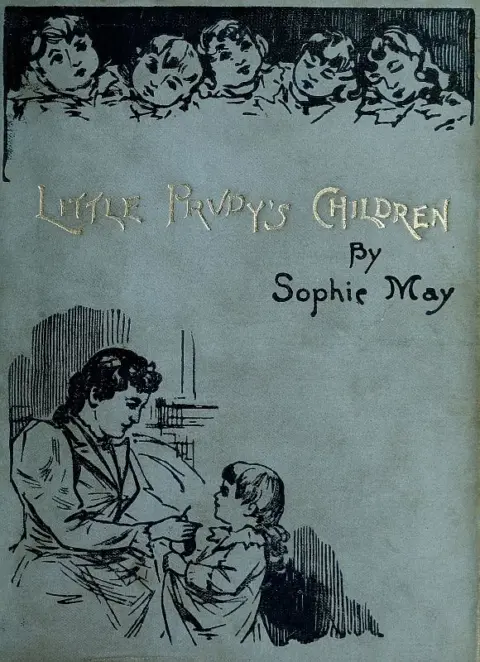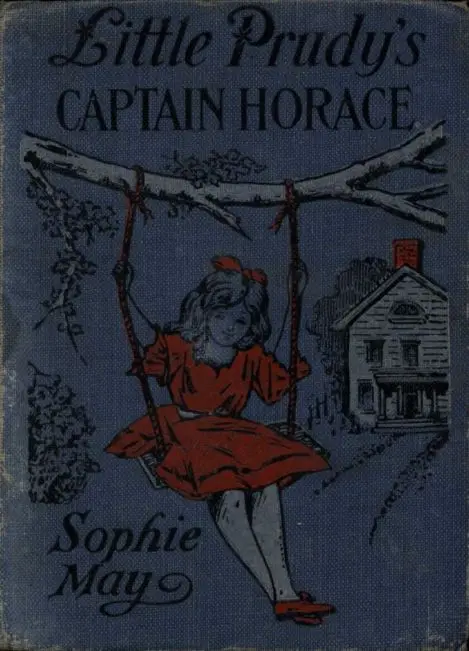
Little Prudy’s Captain Horace
Sophie May
THE CLASSIC COLLECTION · 1868
"Dotty Dimple At Home" by Sophie May is a children's novel written in the late 19th century. The story primarily revolves around the spirited character of Dotty Dimple, a young girl full of life and mischief, as she navigates her daily adventures and the challenges of growing up. The narrative captures her lively interactions with her family and the lessons she learns about temper and obedience. At the start of the book, we are introduced to Dotty Dimple, who wakes up feeling grumpy and reflects on her mixed nature, reminiscent of both a lion and a lamb. Her temper often causes chaos in her household, particularly affecting her sisters, Prudy and Susy. Dotty's mischievous personality leads her to concoct various games and imaginings, showcasing her creativity and impulsiveness. However, as the opening unfolds, Dotty grapples with the consequences of her behavior, particularly when she decides to be naughty and ignore the expectations of her mother, foreshadowing the adventures and misadventures that lie ahead in her journey toward understanding herself.
Introduction adapted from the source catalogue; source summaries may be automatically generated.
Free to read · English · 21,913 words · No account needed
MAKE TIME FOR A GOOD BOOK
On by default. Untick to stop anonymous reading totals. Each page counts after 10 seconds in view. How this works.
Anonymous counting is on unless you have switched it off.
"The baby was afraid of his little nurse; but he could not speak to tell how he was abused; all he could do was to cry when he was left with Harriet. But one day Mrs. Gray was obliged to go away to see her sick mother. She charged Harriet to take good care of little Freddy, and give him some baked apples and milk if he was hungry."
"With bread in?" suggested Dotty.
"Yes, I suppose so. Then she kissed her baby. He put his arms around her neck, and cried to go too; but she could not take him."
"I s'pose he cried 'cause he 'xpected that awful girl was a-going to shake him," said Dotty, indignantly.
"I cannot tell you precisely what Harriet did to him; but when the father and mother got home, that darling boy was moaning in great pain. They sent for the doctor, who said his spine was injured, and perhaps he would never walk again; and, indeed, he never did."
"O, mamma! mamma Parlin!"
"Yes, my child; and it is supposed that Harriet must have hurt him in
one of her fits of rage."
Dotty's face had grown very white.
"O, mamma, what did the folks do with Harriet?"
"They took her to court, and tried her for abusing the little boy. They could not prove that she was really guilty, though everybody believed she was."
"I know what 'guilty' means, mamma; it means hung."
"No, dear; if she hurt the baby she was guilty, whether she was punished
for it or not."
"Well, she did it, I just know she did it!" exclaimed Dotty, greatly excited. "That little tinty boy!"
"The judge pitied her for her youth and ignorance; so did the twelve men called the 'jury;' and she was allowed to go free."
"Then did she 'buse somebody's else's baby, mamma?"
"I hope not. The last I heard of her she was married to a negro
fiddler."
"Do you know why I have told you this sad story, my little daughter?"
"'Cause, 'cause--Harriet beat her head against the door, and hurt a baby, and--and--married black folks!"
Dotty was very pale, and there was a tear in her voice; still her mother could not be sure that her words had made much impression. She was afraid her long story had been "love's labor lost."
But I believe it had not been. Not entirely, at least. Dotty thought of Harriet all the afternoon, and walked about the house with a demureness quite unusual.
Your reading position is saved on this browser. Take it to another device with a library code. Reading pages adapt to text, rather than matching a printed edition.
BEHIND THE BOOK
This eBook is for the use of anyone anywhere in the United States and most other parts of the world at no cost and with almost no restrictions whatsoever. You may copy it, give it away or re-use it under the terms of the Project Gutenberg License included with this eBook or online at www.gutenberg.org. If you are not located in the United States, you will have to check the laws of the country where you are located before using this eBook. Read the source licence.
The original source file, including credits and licence, is retained by this library. Request an original-format copy at no charge. Please include the book title and Project Gutenberg identifier #25396.
KEEP YOUR CURIOSITY GOING
Coulson Kernahan

Maurice Baring
Frances Wright
Cécile Tormay

Frederic Jesup Stimson

W. H. P. (William Henry Pope) Jarvis