
Last letters from the living dead man
David Patterson (Spirit) Hatch

THE CLASSIC COLLECTION · 1923
"Dostoevsky" by André Gide is a work of literary criticism and biographical essays written in the early 20th century. It probes the life, thought, and artistry of Fyodor Dostoevsky, arguing for his primacy as a psychologist and moral visionary whose fiction wrestles with inner, spiritual conflicts rather than merely social ones. The focus is on how Dostoevsky’s characters embody living problems—religious, ethical, and existential—rendered with vivid humanity rather than abstract doctrine. The opening of this study presents Arnold Bennett’s introduction praising Gide’s insight and situating the book as a landmark in understanding Russian psychology, followed by a translator’s note explaining its origins as 1922 lectures and the sources quoted. Gide’s preface defends Dostoevsky against Western charges of irrationality, stressing his concern with the individual’s relation to self and God, the lifelike fluidity of his characters, and the uncompromising labor behind his art. In a long section drawn from correspondence, Gide sketches Dostoevsky’s aversion to letter-writing, lifelong poverty, humility in begging for help, ferocious work ethic and revisions, debilitating epilepsy, gambling and debts, intense family duties, and a worldview mixing Russian nationalism with a universal mission, Orthodoxy with a Christ-centered humanism, and individualism joined to self-sacrifice—all of which left him outside parties and programs. At the start of the addresses, Gide contrasts Rousseau’s self-conscious pose with Dostoevsky’s unposed humility, then recounts the youthful bohemian years, arrest in the Petrashevsky affair, mock execution, and Siberian exile, quoting letters that vividly depict the journey, brutal prison conditions, and the convict’s resilient hope and compassion he both received and offered.
Introduction adapted from the source catalogue; source summaries may be automatically generated.
Free to read · English · 53,689 words · No account needed
MAKE TIME FOR A GOOD BOOK
On by default. Untick to stop anonymous reading totals. Each page counts after 10 seconds in view. How this works.
Anonymous counting is on unless you have switched it off.
“‘Gracious benefactors, show kind charity to the girl christened Arina, and we will join with her to send our tears to the Heavenly Throne for you for ever, and congratulate you on your name day.
“‘Persons unknown to you.’
“Then Nikolay Semyonovitch, for whom I have such a respect, greatly disappointed me. He drew a very long face, and decided to send the child at once to the Foundling Home. I felt very sad. They lived frugally and had no children and Nikolay Semyonovitch was always glad of it. I carefully took the little Arina out of the basket and held her up under the arms. The basket had that sour, pungent odour characteristic of a small child which has not been washed for a long time. I opposed Nikolay Semyonovitch and suddenly announced that I would keep the child at my expense. In spite of his gentleness he protested with some severity, and, though he ended by joking, he adhered to his intention in regard to the foundling. I got my way, however. In the same block of buildings, but in a different wing, lived a very poor carpenter, an elderly man, given to drink, but his wife, a very healthy and still youngish woman, had only just lost a baby, and what is more, the only child she had had in eight years of marriage, also a girl, and by a strange piece of luck also called Arina. I call it good luck, because while we were arguing in the kitchen, the woman, hearing of what had happened, ran in to look at the child, and when she learned that it was called Arina, she was greatly touched. She still had milk, and unfastening her dress, she put the baby to her breast. I began persuading her to take the child home with her, saying I would pay for it every month. She was afraid her husband would not allow it, but she took it for the night. Next morning, her husband consented to her keeping it for eight roubles a month, and I immediately paid him for the first month in advance. He at once spent the money on drink. Nikolay Semyonovitch, still with a strange smile, agreed to guarantee that the money would be paid regularly every month. I would have given my sixty roubles into Nikolay Semyonovitch’s keeping as security, but he did not take it. He knew, however, that I had the money, and trusted me. Our momentary quarrel was smoothed over by this delicacy on his part. Marie Ivanovna said nothing, but wondered at my undertaking such a responsibility. I particularly appreciated their delicacy in refraining from the slightest jest at my expense, but on the contrary, taking the matter with proper seriousness. I used to run over to the carpenter’s wife three times a day, and at the end of the week I slipped an extra three roubles into her hand without her husband’s knowledge. For another three I bought a little quilt and swaddling clothes. But ten days later little Arina fell ill. I called in a doctor at once, he wrote a prescription, and we were up all night tormenting the mite with horrid medicine. Next day he declared that he had been sent for too late, and answered my entreaties--which I fancy were more like reproaches--by saying with majestic evasiveness: ‘I am not God.’ The baby’s little tongue and lips and whole mouth were covered with a minute white rash and towards evening she died, gazing at me with her big black eyes as though she understood already. I don’t know why I never thought to take a photograph of the dead baby. But will it be believed that I cried that evening, and, in fact, I howled as I had never let myself do before, and Marie Ivanovna had to try to comfort me, again without the least mockery either on her part or on Nikolay Semyonovitch’s. The carpenter made a little coffin, and Marie Ivanovna finished it with a frill and a pretty little pillow, while I bought flowers and strewed them on the baby. So they carried away my poor little blossom, whom it will hardly be believed I can’t forget even now. A little afterwards, however, this sudden adventure made me reflect seriously. Little Arina had not cost me much, of course, the coffin, the burial, the doctor, the flowers, and the payment of the carpenter’s wife came altogether to thirty roubles. As I was going to Petersburg I made up this sum from the forty roubles sent to me by Versilov for the journey and from the sale of various articles before my departure, so that my capital remained intact. But I thought: ‘If I am going to be turned aside like this, I shan’t get far.’ The affair with the student showed that the ‘idea’ might absorb me till it blurred my impressions and drew me away from the realities of life. The incident with little Arina proved, on the contrary, that no ‘idea’ was strong enough to absorb me, at least so completely that I should not stop short in the face of an overwhelming fact and sacrifice to it at once all that I had done for the ‘idea’ by years of labour. Both conclusions were nevertheless true.”[139]
Your reading position is saved on this browser. Take it to another device with a library code. Reading pages adapt to text, rather than matching a printed edition.
BEHIND THE BOOK
This eBook is for the use of anyone anywhere in the United States and most other parts of the world at no cost and with almost no restrictions whatsoever. You may copy it, give it away or re-use it under the terms of the Project Gutenberg License included with this eBook or online at www.gutenberg.org. If you are not located in the United States, you will have to check the laws of the country where you are located before using this eBook. Read the source licence.
The original source file, including credits and licence, is retained by this library. Request an original-format copy at no charge. Please include the book title and Project Gutenberg identifier #76944.
KEEP YOUR CURIOSITY GOING
David Patterson (Spirit) Hatch

David Patterson (Spirit) Hatch

David Patterson (Spirit) Hatch

Ralph Waldo Emerson

Maurice Baring
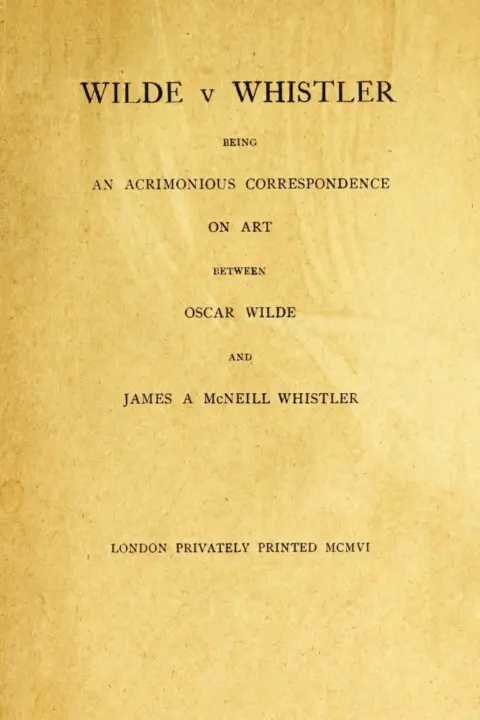
Oscar Wilde & James McNeill Whistler