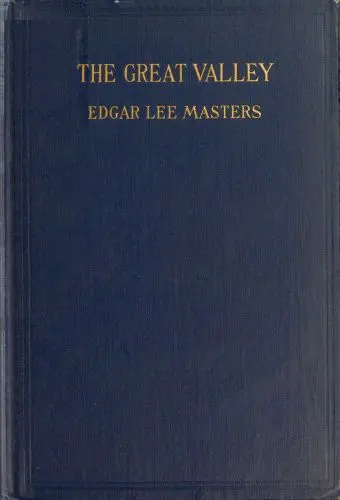
The Great Valley
Edgar Lee Masters
THE CLASSIC COLLECTION · 1920
"Domesday Book" by Edgar Lee Masters is a narrative poetry collection that appears to have been written in the early 20th century. The work seems to center around the life, death, and legacy of Elenor Murray, exploring the interconnectedness of human lives, particularly how one individual's fate can ripple through the lives of others, revealing an intricate tapestry of relationships and consequences. The opening of the narrative introduces Elenor Murray, whose tragic death sets off a chain of reflections about her life and the lives she touched. It begins by discussing the profound impact every life has on others, suggesting that the circles of influence are far-reaching and complex. As the story progresses, we learn about Elenor's early life, her aspirations, and the significant moments leading to her demise. The exploration is layered with the perspectives of various characters, like Coroner Merival and Elenor’s father, who provide insight into her character, family dynamics, and the societal pressures that shaped her life. The narrative foretells that the inquiry into her death will not only reveal the circumstances surrounding it but also offer a poignant commentary on broader human experiences and struggles.
Introduction adapted from the source catalogue; source summaries may be automatically generated.
Free to read · English · 86,048 words · No account needed
MAKE TIME FOR A GOOD BOOK
On by default. Untick to stop anonymous reading totals. Each page counts after 10 seconds in view. How this works.
Anonymous counting is on unless you have switched it off.
No,
Why should she? For I do not understand
Why in a case like this, a man who's worth,
Say fifty thousand dollars couldn't spare
Two hundred dollars by the year. Let's see:
He might have bought less corn or cattle, gambled
On lucky sales of cattle--there's a way
To do a big thing when you have the eyes
To see how big it is; and as for me,
If money must be lost, I'd rather lose it
On Elenor Murray than on cattle. In fact,
That's where the money went, as I have said.
And Elenor Murray went away and earned
Two terms at college, and this worthless son
Ate up and spent the money. All of them,
The son and Arthur Fouche and Elenor Murray
Are gone to dust, now, like the garden things
That sprout up, fall and rot.
At times it seems
All waste to me, no matter what you do
For self or others, unless you think of turnips
Which can't be much to turnips, but are good
For us who raise them. Here's my story then,
Good wishes to you, Coroner Merival.
Coroner Merival heard that Gottlieb Gerald
Knew Elenor Murray and her family life;
And knew her love for music, how she tried
To play on the piano. On an evening
He went with Winthrop Marion to the place,--
Llewellyn George dropped in to hear, as well--
Where Gottlieb Gerald sold pianos--dreamed,
Read Kant at times, a scholar, but a failure,
His life a waste in business. Gottlieb Gerald
Spoke to them in these words:--
I knew her, why of course. And you want me?
What can I say? I don't know how she died.
I know what people say. But if you want
To hear about her, as I knew the girl,
Sit down a minute. Wait, a customer!...
It was a fellow with a bill, these fellows
Who come for money make me smile. Good God!
Where shall I get the money, when pianos,
Such as I make, are devilish hard to sell?
Now listen to this tune! Dumm, dumm, dumm, dumm,
How's that for quality, sweet clear and pure?
Now listen to these chords I take from Bach!
Oh no, I never played much, just for self.
Well, you might say my passion for this work
Is due to this: I pick the wire strings,
The spruce boards and all that for instruments
That suit my ear at last. When I have built
A piano, then I sit and play upon it,
And find forgetfulness and rapture through it.
And well I need forgetfulness, for the bills
Are never paid, collectors always come.
I keep a little lawyer almost busy,
Lest some one get a judgment, levy a writ
Upon my prizes here, this one in chief.
Oh, well, I pay at last, I always pay,
But I must have my time. And in the days
When these collectors swarm too much I find
Oblivion in music, run my hands
Over the keys I've tuned. I wish I had
Some life of Cristofori, just to see
If he was dodging bills when tuning strings.
Perhaps that Silberman who made pianos
For Frederick the Great had money enough,
And needed no oblivion from bills.
You see I'm getting old now, sixty-eight;
And this I say, that life is far too short
For man to use his conquests and his wisdoms.
This spirit, mind, is a machine, piano,
And has its laws of harmony and use.
Well, it seems funny that a man just learns
The secrets of his being, how to love,
How to forget, what to select, what life
Is natural to him, and only living
According to one's nature is increase--
All else is waste--when wind blows on your back,
Just as I sit sometimes when these collectors
Come in on me--and so you find it's Death,
Who levies on your life; no little lawyer
Can keep him off with stays of execution,
Or supersedeas, I think it is.
Well, as I said, a man must live his nature,
And dump the rules; this Christianity
Makes people wear steel corsets to grow straight,
And they don't grow so, for they scarcely breathe,
They're laced so tight; and all their vital organs
Are piled up and repressed until they groan.
Then what? They lace up tighter, till the blood
Stops in the veins and numbness comes upon them.
Oblivion it may be--but give me music!
Your reading position is saved on this browser. Take it to another device with a library code. Reading pages adapt to text, rather than matching a printed edition.
Edgar Lee Masters

Edgar Lee Masters
Edgar Lee Masters
Edgar Lee Masters
BEHIND THE BOOK
This eBook is for the use of anyone anywhere in the United States and most other parts of the world at no cost and with almost no restrictions whatsoever. You may copy it, give it away or re-use it under the terms of the Project Gutenberg License included with this eBook or online at www.gutenberg.org. If you are not located in the United States, you will have to check the laws of the country where you are located before using this eBook. Read the source licence.
The original source file, including credits and licence, is retained by this library. Request an original-format copy at no charge. Please include the book title and Project Gutenberg identifier #35991.
KEEP YOUR CURIOSITY GOING
Coulson Kernahan

Maurice Baring
Frances Wright
Cécile Tormay

Frederic Jesup Stimson

W. H. P. (William Henry Pope) Jarvis