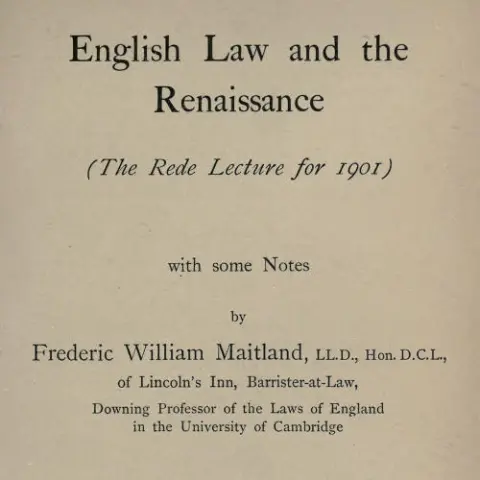
English Law and the Renaissance The Rede Lecture for 1901
Frederic William Maitland
THE CLASSIC COLLECTION · 1897
"Domesday Book and Beyond: Three Essays in the Early History of England" by Frederic William Maitland is a historical account written in the late 19th century. The work explores key themes and documents related to early English law and society, particularly focusing on the significance and implications of the Domesday Book—a comprehensive survey commissioned by William the Conqueror in 1085. The opening of the book presents a detailed introduction to the Domesday Book, describing its creation and its purpose as a tax record rather than a comprehensive legal document. Maitland discusses the methods used by royal commissioners to gather data regarding landholdings and the various classes of people that inhabited England during this period. He highlights the complexities of understanding the legal relationships and historical context of the land and its occupants, setting the stage for a deeper examination of feudalism and its societal ramifications in England.
Introduction adapted from the source catalogue; source summaries may be automatically generated.
Free to read · English · 233,138 words · No account needed
MAKE TIME FOR A GOOD BOOK
On by default. Untick to stop anonymous reading totals. Each page counts after 10 seconds in view. How this works.
Anonymous counting is on unless you have switched it off.
Amount of arable in England, 435. Decrease of arable, 436. The food problem, 436. What was the population? 436. What was the field-system? 437. What was the acre's yield? 437. Consumption of beer, 438. The Englishman's diet, 440. Is the arable superabundant? 441. Amount of pasturage, 441. Area of the villages, 443. Produce and value, 444. Varying size of acres, 445. The teamland in Cambridgeshire, 445.
The hides of Domesday, 446. Relation between hides and teamlands, 447. Unhidated estates, 448. Beneficial hidation, 448. Effect of privilege, 449. Divergence of hide from teamland, 450. Partition of the geld, 451. Distribution of hides among counties and hundreds, 451. The hidage of Worcestershire, 451. The County Hidage, 455. Its date, 456. The Northamptonshire Geld Roll, 457. Credibility of The County Hidage, 458. Reductions of hidage, 458. The county quotas, 459. The hundred and the hundred hides, 459. Comparison of Domesday hidage with Pipe Rolls, 460. Under-rated and over-rated counties, 461. Hidage and value, 462. One pound, one hide, 465. Equivalence of pound and hide, 465. Cases of under-taxation, 466. Kent, 466. Devon and Cornwall, 467. Cases of over-taxation, 468. Leicestershire, 468. Yorkshire, 469. Equity and hidage, 470. Distribution of hides and of teamlands, 471. Area and value as elements of geldability, 472. The equitable teamland, 473. Artificial valets, 473. The new assessments of Henry II., 473.
Acreage of the fiscal hide, 475. Equation between hide and acres, 475. The hide of 120 acres, 476. Evidence from Cambridgeshire, 476. Evidence from the Isle of Ely, 476. Evidence from Middlesex, 477. Meaning of the Middlesex entries, 478. Evidence in the Geld Inquests, 478. Result of the evidence, 480. Evidence from Essex, 480. Acreage of the fiscal carucate, 483. Acreage of the fiscal sulung, 484. Kemble's theory, 485. The ploughland and the plough, 486. The Yorkshire carucates, 487. Relation between teamlands and fiscal carucates, 487. The fiscal hide of 120 acres, 489. Antiquity of the large hide, 489.
§ 3. Beyond Domesday, pp, 490-520.
The hide beyond Domesday, 490. Arguments in favour of small hides, 490. Continuity of the hide in the land-books, 491. Examples from charters of Chertsey, 492. Examples from charters of Malmesbury, 492. Permanence of the hidation, 493. Gifts of villages, 494. Gifts of manses in villages, 495. The largest gifts, 496. The Winchester estate at Chilcombe, 496. The Winchester estates at Downton and Taunton, 498. Kemble and the Taunton estate, 499. Difficulty of identifying parcels, 500. The numerous hides in ancient documents, 501. The Burghal Hidage, 502. The Tribal Hidage, 506. Bede's hidage, 508. Bede and the land-books, 509. Gradual reduction of hidage, 510. Over-estimates of hidage, 510. Size of Bede's hide, 511. Evidence from Iona, 512. Evidence from Selsey, 513. Conclusion in favour of the large hide, 515. Continental analogies, 515. The German Hufe, 515. The Königshufe, 516. The large hide on the continent, 517. The large hide not too large, 518. The large hide and the manor, 519. Last words, 520.
[1] Siedelung und Agrarwesen der Westgermanen und Ostgermanen, der Kelten, Römer, Finnen und Slawen, von August Meitzen, Berlin, 1895.
Your reading position is saved on this browser. Take it to another device with a library code. Reading pages adapt to text, rather than matching a printed edition.
Frederic William Maitland
BEHIND THE BOOK
This eBook is for the use of anyone anywhere in the United States and most other parts of the world at no cost and with almost no restrictions whatsoever. You may copy it, give it away or re-use it under the terms of the Project Gutenberg License included with this eBook or online at www.gutenberg.org. If you are not located in the United States, you will have to check the laws of the country where you are located before using this eBook. Read the source licence.
The original source file, including credits and licence, is retained by this library. Request an original-format copy at no charge. Please include the book title and Project Gutenberg identifier #43255.
KEEP YOUR CURIOSITY GOING
Cécile Tormay

Moritz Busch
John L. Ransom
Frances Wright
Cécile Tormay

Mabel Potter Daggett