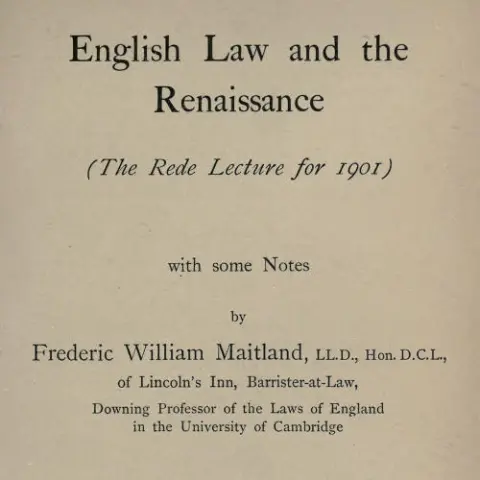
English Law and the Renaissance The Rede Lecture for 1901
Frederic William Maitland
THE CLASSIC COLLECTION · 1897
"Domesday Book and Beyond: Three Essays in the Early History of England" by Frederic William Maitland is a historical account written in the late 19th century. The work explores key themes and documents related to early English law and society, particularly focusing on the significance and implications of the Domesday Book—a comprehensive survey commissioned by William the Conqueror in 1085. The opening of the book presents a detailed introduction to the Domesday Book, describing its creation and its purpose as a tax record rather than a comprehensive legal document. Maitland discusses the methods used by royal commissioners to gather data regarding landholdings and the various classes of people that inhabited England during this period. He highlights the complexities of understanding the legal relationships and historical context of the land and its occupants, setting the stage for a deeper examination of feudalism and its societal ramifications in England.
Introduction adapted from the source catalogue; source summaries may be automatically generated.
Free to read · English · 233,138 words · No account needed
MAKE TIME FOR A GOOD BOOK
On by default. Untick to stop anonymous reading totals. Each page counts after 10 seconds in view. How this works.
Anonymous counting is on unless you have switched it off.
[1556] Downham, Witchford, Sutton, 'Helle,' Wilburton, Stretham,
Stuntney, Doddington.
[1557] Wichford, D. B. i. 192; iv. 507; Hamilton, 119.
[1558] Witcham, Whittlesey, Lindon, Wentworth, Chatteris, Wisbeach,
Littleport.
[1559] Wisbeach, 3-1/2 H. + 1 V. + 150 A. + 2-1/2 H. = 10 H.
[1560] In giving the sum of the particulars I add hides to hides, virgates to virgates, acres to acres, but I make no assumption as to the number of acres or virgates in the hide.
[1561] D. B. iv. 4, 9, 16.
[1562] D. B. iv. 22.
[1563] D. B. iv. 1, 6, 13.
[1564] D. B. iv. 3, 8, 15 (Melchesham).
[1565] D. B. iv. 3-4, 9, 15 (Chinbrige).
[1566] D. B. iv. 61-2-3.
[1567] D. B. iv. 23 (Hunesberge); see also Langeberge on the same
page.
[1568] Round in Domesday Studies, i. 212: 'I have worked through the Inquisitio Geldi with this special object, but found to my disappointment that the odd acres which paid geld on this occasion did not pay at a uniform rate, some paying twice as much as others.'
[1569] D. B. ii. 19: 'Ratendunam tenuit S. Adelred T. R. E. ... pro 20 hidis. Modo pro 16 hidis et dimidia.... Et 30 acras tenet Siward de S. Adelred. Modo tenet Ranulfus Piperellus de rege, set hundret testatur de abbatia. Et 3 hidas et 30 acras quas tenuit ecclesia et Leuesunus de ea T. R. E. modo tenet Eudo de abbate.' I think that this involves the statement:
[1570] D. B. ii. 3, 11, 33, 63 b, 78 b, and in many other places.
[1571] Ibid. 31.
[1572] Ibid. 6 b, 42 b.
[1573] Ibid. 46.
[1574] Ibid. 48.
[1575] Ibid. 6 b, 49, 60.
[1576] Ibid. 43.
[1577] Ibid. 74.
[1578] Ibid. 1 b.
[1579] Ibid. 11 b, 30 b, 31, 47 b.
[1580] Ibid. 72.
[1581] Ibid. 21 b.
[1582] Ibid. 16, 15.
[1583] D. B. ii. 79.
[1584] Some other fractions into which a hide would easily break by inheritance and partition can be expressed in various ways. Thus two-thirds of a hide can be expressed as 80 A. or as 'half a hide and 20 acres.' Three-quarters of a hide appears sometimes as 'half a hide and 30 A.,' sometimes as 'a hide less 30 A.' We might add to our other arguments derived from Essex that used by Morgan (op. cit., p. 31). It seems fairly clear that the holding of Roger 'God Bless the Dames', which is called 3 V. in one place is called 1/2 H. + 30 A. in another place (D. B. iv. 21 b, 96 b).
[1585] D. B. i. 141 b, Wallingtone.
[1586] D. B. i. 141, Stuterehele.
[1587] D. B. i. 165. There is here a transition from geldable area to real area. This land is rated at a hide, but when you come to plough it, you will find only 64 acres.
[1588] D. B. i. 93 b, Dudesham; iv. 396.
[1589] D. B. i. 79 b. Eyton, Dorset, 16, says that this is a clumsy way of describing 1 H. + 1 A. Round, Domesday Studies, i. 213, makes some just remarks on Eyton's treatment of this passage.
[1590] D. B. i. 95 b, Ecewiche; iv. 333.
Your reading position is saved on this browser. Take it to another device with a library code. Reading pages adapt to text, rather than matching a printed edition.
Frederic William Maitland
BEHIND THE BOOK
This eBook is for the use of anyone anywhere in the United States and most other parts of the world at no cost and with almost no restrictions whatsoever. You may copy it, give it away or re-use it under the terms of the Project Gutenberg License included with this eBook or online at www.gutenberg.org. If you are not located in the United States, you will have to check the laws of the country where you are located before using this eBook. Read the source licence.
The original source file, including credits and licence, is retained by this library. Request an original-format copy at no charge. Please include the book title and Project Gutenberg identifier #43255.
KEEP YOUR CURIOSITY GOING
Cécile Tormay

Moritz Busch
John L. Ransom
Frances Wright
Cécile Tormay

Mabel Potter Daggett