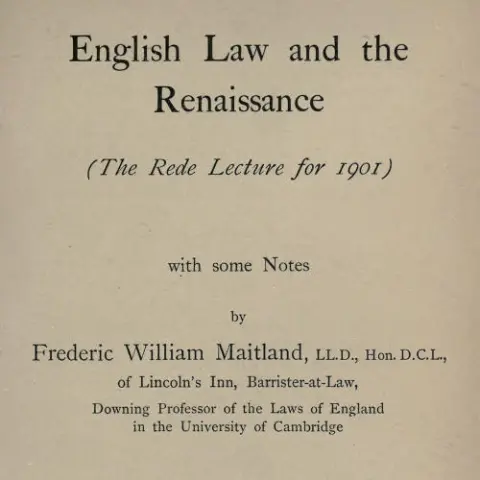
English Law and the Renaissance The Rede Lecture for 1901
Frederic William Maitland
THE CLASSIC COLLECTION · 1897
"Domesday Book and Beyond: Three Essays in the Early History of England" by Frederic William Maitland is a historical account written in the late 19th century. The work explores key themes and documents related to early English law and society, particularly focusing on the significance and implications of the Domesday Book—a comprehensive survey commissioned by William the Conqueror in 1085. The opening of the book presents a detailed introduction to the Domesday Book, describing its creation and its purpose as a tax record rather than a comprehensive legal document. Maitland discusses the methods used by royal commissioners to gather data regarding landholdings and the various classes of people that inhabited England during this period. He highlights the complexities of understanding the legal relationships and historical context of the land and its occupants, setting the stage for a deeper examination of feudalism and its societal ramifications in England.
Introduction adapted from the source catalogue; source summaries may be automatically generated.
Free to read · English · 233,138 words · No account needed
MAKE TIME FOR A GOOD BOOK
On by default. Untick to stop anonymous reading totals. Each page counts after 10 seconds in view. How this works.
Anonymous counting is on unless you have switched it off.
[1314] At the date of Domesday we are a long way from the first danegeld and a very long way from any settlement of Cambridgeshire; still if we analyze a symmetrical hundred, such as Armingford, we shall find that the average ten-hide vill is just about twice as rich as the average five-hide vill in men, in teams and in annual valet, though there will be some wide aberrations from this norm.
[1315] See above, p. 336, note 1160.
[1316] See above, p. 237.
[1317] This is proved by 'The Burghal Hidage' of which we spoke above, p. 187, and shall speak again hereafter.
[1318] See the Gerefa published by Dr Liebermann in Anglia, ix. 251. Andrews, Old English Manor, 246.
[1319] The manner in which the old hides have really fallen to pieces but are preserving a notional existence is well illustrated by Domesday of St. Paul's, 41-47. In one case a hide forms nine tenements containing respectively 30, 30, 15, 15, 5, 5, 7-1/2, 5, 7-1/2 acres. See Vinogradoff, Villainage, 249.
[1320] Vinogradoff, Villainage, 242; Maitland, History of an English Manor, Eng. Hist. Rev. ix. 418.
[1321] See Pell, in Domesday Studies, i. 357. Almost at one and the same moment, but in two different 'extents,' the same tenements are being described as containing 15 and as containing 18 acres. Domesday of St. Paul's, 69: 'In this manor the hide contains 120 acres; the old inquest said that it used not to contain more than 80; but afterwards the lands were sought out and measured (exquisitae sunt terrae et mensuratae).'
[1322] Cart. Rams. iii. 208. See also the table given by Seebohm,
op. cit. 37.
[1323] A 'double hide' of 240 acres plays a part in Mr Seebohm's speculations. His instances of it hardly bear examination. On p. 37 he produces from Rot. Hund. ii. 629 the equation 1 H.=6 V. of 40 A. apiece. This apparently refers to the Ramsey manor of Brington; but Cart. Rams. ii. 43 gives 1 H.=4 V. of 40 A., while Cart. Rams. iii. 209 gives 1 H.=4 V. of 34 A. Then Mr Seebohm, p. 51, cites from 'the documents of Battle Abbey given by Dugdale' the equation 1 H.=8 V.; but this seems to refer to the statement now printed in the Battle Cartulary (Camd. Soc.) p. xiii., where 1 H.=4 V. As to the supposed solanda of two hides, see Round, Feudal England, 103.
[1324] The virgates on the Gloucestershire manors of Gloucester Abbey contain the following numbers of acres: 36, 40, 36, 38, 48, 48, 48, 48, 50, 48, 40, 64, 64, 64, 48, 50, 60, 48, 48, 64, 18 (?), 44, 80, 48, 48, 72. See Gloucester Cartulary, vol. iii. Of the taxation and wealth of the various counties we shall speak hereafter.
[1325] Napier and Stevenson, Crawford Charters, p. 47: The O. E. sulh (plough) is 'cognate with Lat. sulcus.'
Your reading position is saved on this browser. Take it to another device with a library code. Reading pages adapt to text, rather than matching a printed edition.
Frederic William Maitland
BEHIND THE BOOK
This eBook is for the use of anyone anywhere in the United States and most other parts of the world at no cost and with almost no restrictions whatsoever. You may copy it, give it away or re-use it under the terms of the Project Gutenberg License included with this eBook or online at www.gutenberg.org. If you are not located in the United States, you will have to check the laws of the country where you are located before using this eBook. Read the source licence.
The original source file, including credits and licence, is retained by this library. Request an original-format copy at no charge. Please include the book title and Project Gutenberg identifier #43255.
KEEP YOUR CURIOSITY GOING
Cécile Tormay

Moritz Busch
John L. Ransom
Frances Wright
Cécile Tormay

Mabel Potter Daggett