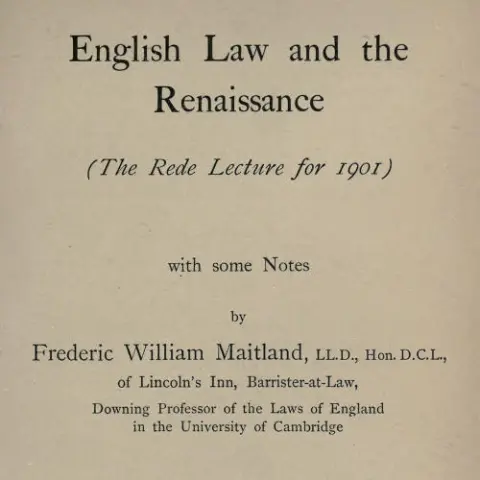
English Law and the Renaissance The Rede Lecture for 1901
Frederic William Maitland
THE CLASSIC COLLECTION · 1897
"Domesday Book and Beyond: Three Essays in the Early History of England" by Frederic William Maitland is a historical account written in the late 19th century. The work explores key themes and documents related to early English law and society, particularly focusing on the significance and implications of the Domesday Book—a comprehensive survey commissioned by William the Conqueror in 1085. The opening of the book presents a detailed introduction to the Domesday Book, describing its creation and its purpose as a tax record rather than a comprehensive legal document. Maitland discusses the methods used by royal commissioners to gather data regarding landholdings and the various classes of people that inhabited England during this period. He highlights the complexities of understanding the legal relationships and historical context of the land and its occupants, setting the stage for a deeper examination of feudalism and its societal ramifications in England.
Introduction adapted from the source catalogue; source summaries may be automatically generated.
Free to read · English · 233,138 words · No account needed
MAKE TIME FOR A GOOD BOOK
On by default. Untick to stop anonymous reading totals. Each page counts after 10 seconds in view. How this works.
Anonymous counting is on unless you have switched it off.
[1282] Thus e.g. Glastonbury Rentalia, 68: 'if he has eight oxen he shall plough every Thursday [during certain seasons] three roods [perticatas].'
[1283] Walter of Henley, 9.
[1284] Tour through the Southern Counties, ed. 3 (1772), pp.
298-301.
[1285] Tour through the Southern Counties, p. 127.
[1286] Walter of Henley, 9.
[1287] Young, View of Agriculture of Oxfordshire, p. 104. In Oxfordshire in the early years of this century many ploughs with four horses 'go out for 3 roods,' after all improvements in ploughs and in horses.
[1288] Meitzen, op. cit. 88. Dr Taylor in Domesday Studies, i. 61, gives a somewhat different explanation. The ploughman walked backwards in front of the beasts, and, when near the end of the furrow, used his right arm to pull them round.
[1289] Among the land-books those that most clearly indicate the intermixture of strips are K. 538 (iii. 19),--648 (iii. 210),--692 (iii. 290),--1158 (v. 310),--1169 (v. 326),--1234 (vi. 39),--1240 (vi. 51),--1276 (vi. 108),--1278 (vi. 111).
[1290] As to the names of culturæ the Ramsey Cartulary may be profitably consulted. Such names as Horsepelfurlange, Wodefurlonge, Benefurlange, Stapelfurlange (i. 307), Mikellefurlange (321), Stanweyfurlange, Longefurlange (331) are common. We meet also with -wong: Redewonge (321), Langiwange, Stoniwonge, Schortewonge, Semareswonge (341-2). Also with -leuge (apparently O. E. léah, gen. dat. léage): Wolnothesleuge, Edriches Leuge. Often the cultura is known as the Five (Ten, Twenty) Acres. Sometimes in Latin this sense of furlong is rendered by quarentina: 'unam rodam in quarentina de Newedich': Fines, ed. Hunter, i. 42.
[1291] Glastonbury Rentalia, 180, 195, 208.
[1292] Sixteen Old Maps: Oxford, Clarendon Press, 1888.
[1293] The rod, however, must have been very short; perhaps it had
as few as 12 feet.
[1294] For many reasons this must not be taken as a typical map. We refer to it merely as showing the relation of 'estimated' (that is of 'real') acres to an acre-measure.
[1295] Instructive evidence about this matter was given in a Chancery suit of James I.'s reign. The deponent speaking of the fen round Ely says 'it is the use and custom ... to measure the fen grounds by four poles in breadth for an acre, by a pole of 18 feet ... and in length for an acre of the said grounds as it happeneth, according to the length of the furlong of the same fens, which is sometimes shorter and sometimes longer.' Quoted by O. C. Pell in Domesday Studies, i. 296.
[1296] For an explanation of this mode of ploughing, see Meitzen,
op. cit. 84.
[1297] Meitzen gives 6 feet as a usual width for the beds in Germany. I think that in cent. xiii. our selions were usually wider than this.
Your reading position is saved on this browser. Take it to another device with a library code. Reading pages adapt to text, rather than matching a printed edition.
Frederic William Maitland
BEHIND THE BOOK
This eBook is for the use of anyone anywhere in the United States and most other parts of the world at no cost and with almost no restrictions whatsoever. You may copy it, give it away or re-use it under the terms of the Project Gutenberg License included with this eBook or online at www.gutenberg.org. If you are not located in the United States, you will have to check the laws of the country where you are located before using this eBook. Read the source licence.
The original source file, including credits and licence, is retained by this library. Request an original-format copy at no charge. Please include the book title and Project Gutenberg identifier #43255.
KEEP YOUR CURIOSITY GOING
Cécile Tormay

Moritz Busch
John L. Ransom
Frances Wright
Cécile Tormay

Mabel Potter Daggett