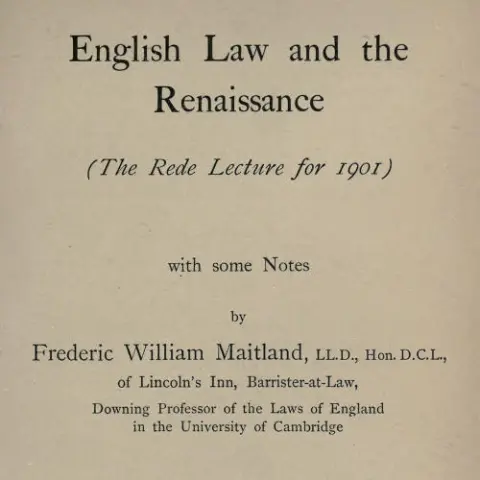
English Law and the Renaissance The Rede Lecture for 1901
Frederic William Maitland
THE CLASSIC COLLECTION · 1897
"Domesday Book and Beyond: Three Essays in the Early History of England" by Frederic William Maitland is a historical account written in the late 19th century. The work explores key themes and documents related to early English law and society, particularly focusing on the significance and implications of the Domesday Book—a comprehensive survey commissioned by William the Conqueror in 1085. The opening of the book presents a detailed introduction to the Domesday Book, describing its creation and its purpose as a tax record rather than a comprehensive legal document. Maitland discusses the methods used by royal commissioners to gather data regarding landholdings and the various classes of people that inhabited England during this period. He highlights the complexities of understanding the legal relationships and historical context of the land and its occupants, setting the stage for a deeper examination of feudalism and its societal ramifications in England.
Introduction adapted from the source catalogue; source summaries may be automatically generated.
Free to read · English · 233,138 words · No account needed
MAKE TIME FOR A GOOD BOOK
On by default. Untick to stop anonymous reading totals. Each page counts after 10 seconds in view. How this works.
Anonymous counting is on unless you have switched it off.
[1233] K. 241 (ii. 1), A.D. 839: Gift of 24 acres, 10 in one place, 14 in another.--K. 339 (ii. 149), A.D. 904: Gift of 60 acres of arable to the south and 60 to the north of a certain stream.--K. 586 (iii. 118): 'and 30 æcra on ðæm twæm feldan dallandes.'
[1234] See e.g. Glastonbury Rentalia (Somerset Record Soc.) pp. 14, 15, 55, 67, 89, 119, 128-9, 137-8, 155, 166, 192, 195, 208, 219. A system which leaves half the land idle in every year is of course quite compatible with the growth of both winter and spring corn. When, as is not uncommon, the villeins have to do between Michaelmas and Christmas twice as much ploughing as they will do between Christmas and Lady Day, this seems to point to a scheme which leaves one field idle and divides the other between winter and spring corn in the proportion of 2:1. Even in the fourteenth century a three-field system seems to have been regarded in some places as 'high farming.' Larking, Domesday of Kent, App. p. 23: Extent of Addington, A.D. 1361: 'Et sunt ibidem 60 acrae terrae arabilis, de quibus duae partes possunt seminari per annum, si bene coluntur.' For evidence of the three-field system, see Nasse, Agricultural Community, Engl. transl. 53.
[1235] Meitzen, op. cit. ii. 592.
[1236] Turton, Forest of Pickering (North Riding Record Society), 148 ff. Twenty years ago A. E. enclosed an acre; sown eight times with spring corn; value of a sown acre 1s., of an unsown, 4d. Twenty-two years ago E. C. enclosed a rood; sown seven times with oats, value 6d. a year; value, when unsown, 1d. a year. In the same book are many instances of a husbandry which alternates oats with hay.
[1237] Scrutton, Commons and Common Fields, 118, citing a Report to the Board of Agriculture.
[1238] Ine, 63-68, 70. See above, p. 238.
[1239] A very fine instance is found on the north coast of Norfolk:--Burnham Deepdale, B. Norton, B. Westgate, B. Sutton, B. Thorpe, B. Overy. As to this see Stevenson, E. H. R. xi. 304.
[1240] Index Map of Ordnance Survey of Norfolk. Six inch Map of Norfolk, LVI. Another instance occurs near Yarmouth along the banks of the Waveney. Even if the allotment was the result of modern schemes of drainage, it still might be a satisfaction of very ancient claims.
[1241] See above, p. 355.
[1242] Fines (ed. Hunter) i. 242: 'sex acras terrae mensuratas per legalem perticam eiusdem villae [de Haveresham].'
[1243] Acts of Parliament of Scotland, i. 309.
[1244] Schmid, Gesetze, App. XII.: 'three feet and three hand breadths and three barley corns.'
Your reading position is saved on this browser. Take it to another device with a library code. Reading pages adapt to text, rather than matching a printed edition.
Frederic William Maitland
BEHIND THE BOOK
This eBook is for the use of anyone anywhere in the United States and most other parts of the world at no cost and with almost no restrictions whatsoever. You may copy it, give it away or re-use it under the terms of the Project Gutenberg License included with this eBook or online at www.gutenberg.org. If you are not located in the United States, you will have to check the laws of the country where you are located before using this eBook. Read the source licence.
The original source file, including credits and licence, is retained by this library. Request an original-format copy at no charge. Please include the book title and Project Gutenberg identifier #43255.
KEEP YOUR CURIOSITY GOING
Cécile Tormay

Moritz Busch
John L. Ransom
Frances Wright
Cécile Tormay

Mabel Potter Daggett