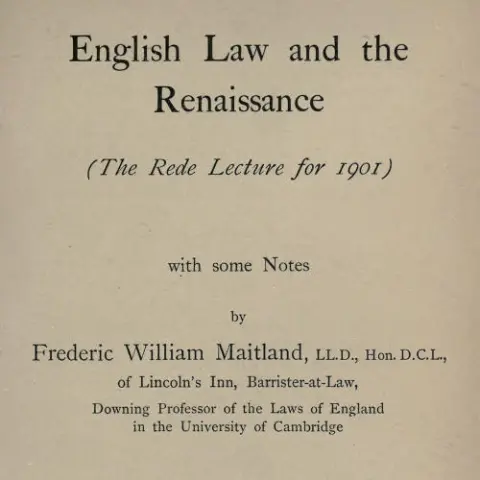
English Law and the Renaissance The Rede Lecture for 1901
Frederic William Maitland
THE CLASSIC COLLECTION · 1897
"Domesday Book and Beyond: Three Essays in the Early History of England" by Frederic William Maitland is a historical account written in the late 19th century. The work explores key themes and documents related to early English law and society, particularly focusing on the significance and implications of the Domesday Book—a comprehensive survey commissioned by William the Conqueror in 1085. The opening of the book presents a detailed introduction to the Domesday Book, describing its creation and its purpose as a tax record rather than a comprehensive legal document. Maitland discusses the methods used by royal commissioners to gather data regarding landholdings and the various classes of people that inhabited England during this period. He highlights the complexities of understanding the legal relationships and historical context of the land and its occupants, setting the stage for a deeper examination of feudalism and its societal ramifications in England.
Introduction adapted from the source catalogue; source summaries may be automatically generated.
Free to read · English · 233,138 words · No account needed
MAKE TIME FOR A GOOD BOOK
On by default. Untick to stop anonymous reading totals. Each page counts after 10 seconds in view. How this works.
Anonymous counting is on unless you have switched it off.
[970] A.D. 826, Egbert for Winchester, K. 1037 (v. 81): 'Volo etiam ut haec terra libera semper sit ... nullique serviat nisi soli episcopo Wentano.'
[971] K. 1346 (vi. 205). Compare Fustel de Coulanges, L'Immunité Mérovingienne, Revue historique, xxiii. 21.
[972] E.g. K. 1117 (v. 231): 'tribus semotis causis a quibus nullus nostrorum poterit expers fore'; K. v. pp. 259, 283, 334.
[973] To this class belong the foundation charter of Evesham mentioned above, p. 235, and Offa's charter for St. Albans, K. 161 (i. 195), which Haddan and Stubbs, iii. 469, are unwilling to decisively reject. Cenwulf's charter for Abingdon, K. 214 (i. 269), H. & S. iii. 556, sets a limit to the amount of military service that is to be demanded. Æthelstan's charter for Crediton, recently printed by Napier and Stevenson, Crawford Charters, p. 5, frees land from the trinoda necessitas.
[974] E.g. K. i. p. 274; ii. pp. 14, 15, 24, 26, 83; v. pp. 53, 62,
81.
[975] Observe how Bede describes a gift made by Oswy in the middle of the seventh century; Hist. Eccl. iii. 24 (ed. Plummer, i. 178): 'donatis insuper duodecim possessiunculis terrarum in quibus ablato studio militiae terrestris, ad exercendam militiam caelestem etc.'
[976] The passages in the dooms which mention it are collected in Schmid, Glossar, s. v. ángild. They are discussed by Maurer, Krit. Ueberschau, ii. 32.
[977] The clauses of immunity which mention the ángild will be collected in a note at the end of this section.
[978] K. 210 (i. 265); B. i. 497; H. & S. iii. 585. The clause in question is not found in every copy of the charter. If some monk is to be accused of tampering with the book, there seems just as much reason for charging him with having omitted a clause which limited, as for charging him with inserting a clause which recognized, the jurisdiction of the church.
[979] These clauses will be discussed in a note at the end of this
section.
[980] A.D. 841, K. 250 (ii. 14): 'Liberabo ab omnibus saecularibus servitutibus ... regis et principis vel iuniorum eorum, nisi in confinio reddant rationem contra alium.' Compare K. 117 (i. 144): 'nisi specialiter pretium pro pretio ad terminum.' Also Leg. Henr. 57 § 1: 'Si inter compares vicinos utrinque sint querelae, conveniant ad divisas.' Ibid. 57 § 8: 'aliquando in divisis vel in erthmiotis.' Ibid. 9 § 4: 'Et omnis causa terminetur, vel hundreto, vel comitatu, vel hallimoto soccam habentium, vel dominorum curiis, vel divisis parium.' See above, p. 97.
[981] A.D. 828, K. 223 (i. 287): 'cum furis comprehensione intus et foris'; A.D. 842, K. 253 (ii. 16) 'ut ... furis comprehensione ... terra secura et immunis ... permaneat'; A.D. 850, K. 1049 (v. 95) a similar form; A.D. 858, K. 281 (ii. 64), a similar form; A.D. 869, K. 300 (ii. 95), a similar form; A.D. 880, K. 312 (ii. 109): 'cum furis comprehensione.' See Kemble's remarks, C. D. vol. i. p. xlvi.
[982] Hist. Eng. Law, i. 565.
Your reading position is saved on this browser. Take it to another device with a library code. Reading pages adapt to text, rather than matching a printed edition.
Frederic William Maitland
BEHIND THE BOOK
This eBook is for the use of anyone anywhere in the United States and most other parts of the world at no cost and with almost no restrictions whatsoever. You may copy it, give it away or re-use it under the terms of the Project Gutenberg License included with this eBook or online at www.gutenberg.org. If you are not located in the United States, you will have to check the laws of the country where you are located before using this eBook. Read the source licence.
The original source file, including credits and licence, is retained by this library. Request an original-format copy at no charge. Please include the book title and Project Gutenberg identifier #43255.
KEEP YOUR CURIOSITY GOING
Cécile Tormay

Moritz Busch
John L. Ransom
Frances Wright
Cécile Tormay

Mabel Potter Daggett