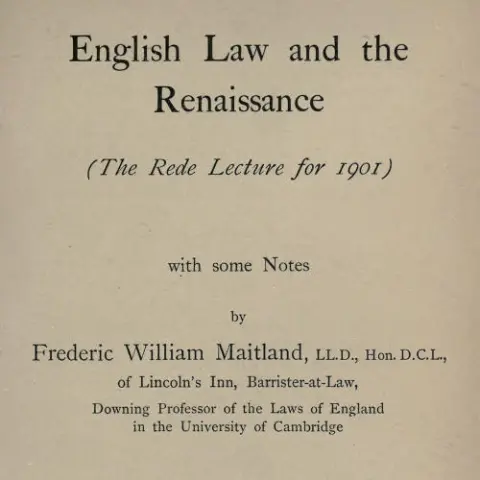
English Law and the Renaissance The Rede Lecture for 1901
Frederic William Maitland
THE CLASSIC COLLECTION · 1897
"Domesday Book and Beyond: Three Essays in the Early History of England" by Frederic William Maitland is a historical account written in the late 19th century. The work explores key themes and documents related to early English law and society, particularly focusing on the significance and implications of the Domesday Book—a comprehensive survey commissioned by William the Conqueror in 1085. The opening of the book presents a detailed introduction to the Domesday Book, describing its creation and its purpose as a tax record rather than a comprehensive legal document. Maitland discusses the methods used by royal commissioners to gather data regarding landholdings and the various classes of people that inhabited England during this period. He highlights the complexities of understanding the legal relationships and historical context of the land and its occupants, setting the stage for a deeper examination of feudalism and its societal ramifications in England.
Introduction adapted from the source catalogue; source summaries may be automatically generated.
Free to read · English · 233,138 words · No account needed
MAKE TIME FOR A GOOD BOOK
On by default. Untick to stop anonymous reading totals. Each page counts after 10 seconds in view. How this works.
Anonymous counting is on unless you have switched it off.
[Sidenote: The land-ríca as immunist.]
There is also a long series of dooms going back as far as Æthelstan's reign which give certain fines and forfeitures to one who is described as the land-hláford or the land-ríca. Remarkable they are, for they seem to assume that wherever a crime is committed there will be forthcoming some-one who will answer to the title 'the land-lord' or 'the territorial magnate.' In some sense or another they presuppose that there is Nulle terre sans seigneur. But who is this 'landlord'? According to our thinking, he is the lord of the hundred or else the lord who has a charter of immunity comprehending the land in question, and, if there be no person answering to this description, then he is the king. In the first place, in certain dooms relating to London we are told that, when a thief is caught and slain, his property is to be divided into two parts, of which his wife takes one, while the other is divided between the king and 'the association' (perhaps we may say 'the gild') which was engaged in the pursuit and capture; 'but if it be book-land or bishop's-land, the landlord takes half with the association in common[1007].' This seems to mean that there will be a lord to share in the proceeds of the forfeiture if, but only if, the scene of the capture be land that is within an immunity. It is assumed, not without warrant in the land-books, that the man who has book-land always, or almost always, enjoys an immunity, while as to the bishop's-land, whether the bishop be holding it in demesne or have granted it out to his thegns, that no doubt will be protected by an ample charter. So again, in another law 'the lord' receives the thief's wer 'if he [the lord] is worthy of his wite[1008]': that is to say, the lord receives it if he is in enjoyment of an immunity which confers upon him a right to 'wites.' Then again, in several cases we find that the land-lord or land-ríca shares the proceeds of a fine with the hundred or wapentake[1009]. This, as we think, points to the fact that the hundreds and wapentakes are passing into private hands. These laws are severe laws against criminals. They urge all men to the pursuit of the flying thief and they hold out a reward to those who are active in this duty. The men of the hundred are to have half the thief's property, while the lord (who in many cases will be the lord of the hundred) is to have the other half. He is to have no more, even though his charter may seem to give him more. So again, in certain cases an accused person must find security that he will stand a trial, and the gage is to be given 'half to the land-ríca, half to the wapentake[1010].' This land-ríca is the lord of the wapentake. In another instance the gage must be given half to the land-ríca and half to the king's port-reeve[1011]. Then there are cases in which the 'land-lord' is to take possession of cattle that have been irregularly acquired and are presumably stolen, and is to preserve them until their true owner shall make his appearance[1012]. These provisions, which seem the foundation of the 'franchise of waif and stray,' suggest that the 'land-lord' is the president of the court into which the owner must go when he wishes to prove his title; were this not so, the king's reeve would be the person who would have the custody of the unclaimed beasts. Certainly our explanation of these passages assumes that a hundred is often in private hands and it assumes that, when this is not the case, then the king is regarded as the lord of the hundred. But in so doing it merely assumes that the state of things revealed by Domesday Book is about a century old. When in that record we read that the soke of four and a half hundreds in Oxfordshire 'belongs to' the royal manor of Bensington, that the soke of two hundreds 'belongs to' the royal manor of Headington, that the soke of other two hundreds 'belongs to' the royal manor of Bampton, we see that the king is the lord, the proprietor, of those hundreds which have no other lord[1013]. From the laws now before us we infer that this is no very new arrangement. But of course it is possible that those laws have divers cases in view. It may be that within the hundred there is an immunity, a privileged township or manor, and that a thief is caught there. Who is to have the profits which arise from the crime and condemnation? The answer is: Half shall go to the hundred, half to the land-ríca, that is to say, half goes to the doomsmen, or perhaps to the lord, of the hundred court, half to the immunist. The lord under the general words of his charter might perchance claim the whole; but, in order that all the hundredors may have an interest in the pursuit of thieves, it is otherwise decreed. But where is justice to be done, in the hundred court or in the court of the immunist? That is a question of secondary importance to which our laws do not address themselves. Very probably justice will be done in the hundred court, or again it is not impossible that a mixed tribunal consisting partly of the men of 'the franchise,' partly of the men of 'the geldable' will meet upon the boundary of the immunist's land[1014]. Our main point must be that the land-lord or land-ríca of these laws is an immunist, or is the king, who, where there is no immunity, occupies the position of an immunist.
Your reading position is saved on this browser. Take it to another device with a library code. Reading pages adapt to text, rather than matching a printed edition.
Frederic William Maitland
BEHIND THE BOOK
This eBook is for the use of anyone anywhere in the United States and most other parts of the world at no cost and with almost no restrictions whatsoever. You may copy it, give it away or re-use it under the terms of the Project Gutenberg License included with this eBook or online at www.gutenberg.org. If you are not located in the United States, you will have to check the laws of the country where you are located before using this eBook. Read the source licence.
The original source file, including credits and licence, is retained by this library. Request an original-format copy at no charge. Please include the book title and Project Gutenberg identifier #43255.
KEEP YOUR CURIOSITY GOING
Cécile Tormay

Moritz Busch
John L. Ransom
Frances Wright
Cécile Tormay

Mabel Potter Daggett