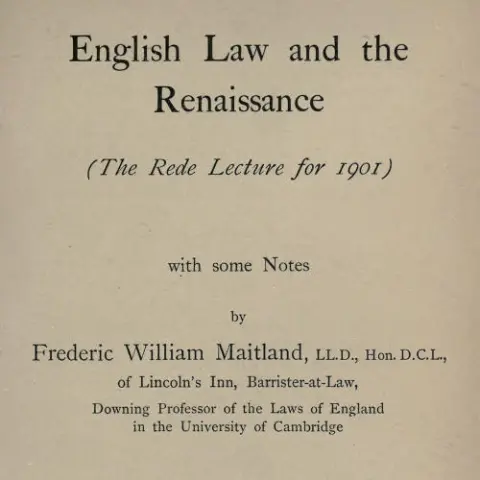
English Law and the Renaissance The Rede Lecture for 1901
Frederic William Maitland
THE CLASSIC COLLECTION · 1897
"Domesday Book and Beyond: Three Essays in the Early History of England" by Frederic William Maitland is a historical account written in the late 19th century. The work explores key themes and documents related to early English law and society, particularly focusing on the significance and implications of the Domesday Book—a comprehensive survey commissioned by William the Conqueror in 1085. The opening of the book presents a detailed introduction to the Domesday Book, describing its creation and its purpose as a tax record rather than a comprehensive legal document. Maitland discusses the methods used by royal commissioners to gather data regarding landholdings and the various classes of people that inhabited England during this period. He highlights the complexities of understanding the legal relationships and historical context of the land and its occupants, setting the stage for a deeper examination of feudalism and its societal ramifications in England.
Introduction adapted from the source catalogue; source summaries may be automatically generated.
Free to read · English · 233,138 words · No account needed
MAKE TIME FOR A GOOD BOOK
On by default. Untick to stop anonymous reading totals. Each page counts after 10 seconds in view. How this works.
Anonymous counting is on unless you have switched it off.
[The king's feorm.]
Then military service, along with the duty of repairing bridges and fastnesses, belongs to a genus of dues, of which unfortunately we get but a vague description. There are vectigalia publica, opera regia, onera saecularia, there is tributum, there is victus. How much of the information that we get about these matters from later days we may carry back with us to the earliest period it is difficult to say. Apparently the king, the under-king, even the ealdorman, has a certain right of living at the expense of his subjects, of making a progress through the villages and quartering himself, his courtiers, his huntsmen, his dogs and horses upon the folk of the townships, of exacting a 'one night's farm' from this village, a 'two nights' farm' from that. The men who have to bear these exactions may well be free men and free landowners; still over them the king has certain rights and rights that he can give away. According to our interpretation of the charters, it is often enough such rights as these that the king is giving when he says that he is giving terram iuris mei. He declares, it will be observed, that the land is to be free from vectigalia and opera to which it has heretofore been subject. But does he mean by this to benefit the occupiers of the soil? No, he has no care whatever to relieve them. Bent on saving his soul, his care is that the land shall be wholly devoted to the service of God. As we understand the matter, whatever vectigalia and opera the king has hitherto exacted from these men the church will now exact. The king has conveyed what he had to convey, a superiority over free landowners.
[Nature of the feorm.]
It is permissible to doubt whether modern historians have fully realized the extent of the rights which the king had over the land of free landowners. In the middle of Ine's laws, which follow each other in no rational order, we suddenly come upon an isolated text, which says this: 'For 10 hides "to foster" 10 vessels of honey, 300 loaves, 12 ambers of Welsh ale, 30 of clear [ale], 2 old [i.e. full grown] oxen or 10 wethers, 10 geese, 20 hens, 10 cheeses, an amber full of butter, 5 salmon, 20 poundsweight of fodder and a hundred eels[886].' The context throws no light upon the sentence; but in truth no sentence in Ine's laws has a context. What is its meaning? We can not but think that this foster is the king's victus[887]. Once a year from every ten hides he is entitled to this feorm. Perhaps it is a 'one night's feorm'; for it may be enough to support a king of the seventh century and a modest retinue during twenty-four hours. Still it will be no trifling burden upon the land, even if we suppose the hide to have 120 arable acres or thereabouts. Suppose that the king transfers his right over a single hide to some bishop or abbot, the donee will be entitled to receive from that hide a rent which can not be called insignificant. We dare not argue that this law is a general law for the whole of Wessex. It may refer only to some newly settled and allotted districts. There are other hints in these laws of Ine of some large land-settlement, an allotment of land among great men who have become bound to bring under cultivation a district theretofore waste[888]. But it is difficult to dissociate the foster of these laws from the victus of the charters, and, quite apart from this disputable passage, we have plenty of proof that the king's victus was an incumbrance which pressed heavily upon the lands of free landowners[889]. If in England the duty of feeding the king as he journeys through the country developed into a regular tax or rent this would not stand alone. That duty plays a considerable part in the Scandinavian law-books, and in the Denmark of the thirteenth century we may find arrangements which are very like that set forth in Ine's law. Every hundred (herad), taken as a whole, has to contribute something towards the king's support. Often it is a round sum of money; but often it will consist of provisions necessary to maintain the king's household during a night or two or three nights (servicium unius noctis, servicium duarum noctium). Then the 'service of two nights' is accurately defined. It consists of, among other things, 26 salted pigs, 14 live pigs, 16 salted oxen, 16 salted sheep, 360 fowls, 180 geese, 360 cheeses, corn, malt, fodder, butter, herrings, stock-fish, pepper and salt. This revenue stands apart from the revenue derived from the crown lands; it is regarded as a tax rather than a rent; but it is to this extent rooted in the soil, that the amount due from each hundred (herad) is fixed[890]. There is a great deal to make us think that at a quite early time in England such arrangements as this had been made. If we look at the charters we find that the king is always giving away manses in fives and tens, fifteens and twenties. This symmetry, this prevalence of a decimal system, we take to be artificial; already the manse, or hide, is a fiscal unit, a fraction of a district which has to supply the king with food or with money in lieu of food[891].
Your reading position is saved on this browser. Take it to another device with a library code. Reading pages adapt to text, rather than matching a printed edition.
Frederic William Maitland
BEHIND THE BOOK
This eBook is for the use of anyone anywhere in the United States and most other parts of the world at no cost and with almost no restrictions whatsoever. You may copy it, give it away or re-use it under the terms of the Project Gutenberg License included with this eBook or online at www.gutenberg.org. If you are not located in the United States, you will have to check the laws of the country where you are located before using this eBook. Read the source licence.
The original source file, including credits and licence, is retained by this library. Request an original-format copy at no charge. Please include the book title and Project Gutenberg identifier #43255.
KEEP YOUR CURIOSITY GOING
Cécile Tormay

Moritz Busch
John L. Ransom
Frances Wright
Cécile Tormay

Mabel Potter Daggett