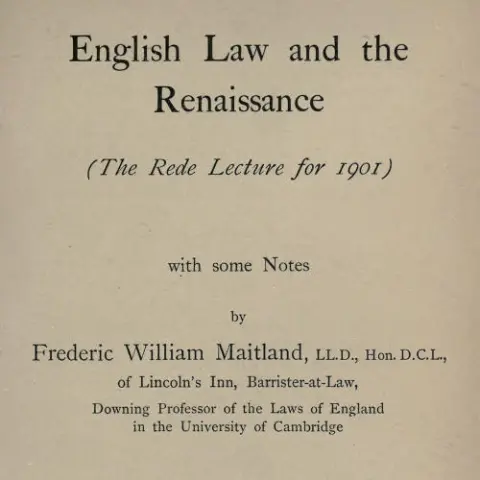
English Law and the Renaissance The Rede Lecture for 1901
Frederic William Maitland
THE CLASSIC COLLECTION · 1897
"Domesday Book and Beyond: Three Essays in the Early History of England" by Frederic William Maitland is a historical account written in the late 19th century. The work explores key themes and documents related to early English law and society, particularly focusing on the significance and implications of the Domesday Book—a comprehensive survey commissioned by William the Conqueror in 1085. The opening of the book presents a detailed introduction to the Domesday Book, describing its creation and its purpose as a tax record rather than a comprehensive legal document. Maitland discusses the methods used by royal commissioners to gather data regarding landholdings and the various classes of people that inhabited England during this period. He highlights the complexities of understanding the legal relationships and historical context of the land and its occupants, setting the stage for a deeper examination of feudalism and its societal ramifications in England.
Introduction adapted from the source catalogue; source summaries may be automatically generated.
Free to read · English · 233,138 words · No account needed
MAKE TIME FOR A GOOD BOOK
On by default. Untick to stop anonymous reading totals. Each page counts after 10 seconds in view. How this works.
Anonymous counting is on unless you have switched it off.
A manor is a house against which geld is charged. To the opinion that in some way or another the definition of a manor is intimately connected with the great tax we shall be brought by phrases such as the following: 'Richard holds Fivehide of the Earl which Brihtmær held in King Edward's time for forty acres and for a manor[512].'--'Two free men who were brothers, Bondi and Ælfric held it for two hides and for two manors[513].' When we say that a man holds land 'as' or 'for' (pro) forty acres, we mean that his holding, be its real size what it may, is rated to the geld at forty acres. If we add the words 'and as (or for) one manor,' surely we are still speaking of the geld. For one moment the thought may cross our minds that, besides a tax on land, there has been an additional tax on 'halls,' on houses of a certain size or value; but this we soon dismiss as most unlikely. To raise but one out of many objections: had there been such a house-tax, it would have left plain traces of itself in those 'Geld Inquests' of the south-western counties that have come down to us. Rather we regard the matter thus:--The geld is a land-tax, a tax of so much per hide or carucate. In all likelihood it has been assessed according to a method which we might call the method of subpartitioned provincial quotas. The assumption has been made that a shire or other large district contains a certain number of hides; this number has then been apportioned among the hundreds of that shire, and the number allotted to each hundred has been apportioned among the vills of that hundred. The common result is that some neat number of hides, five, ten or the like is attributed to the vill[514]. This again has been divided between the holdings in that vill. Ultimately it is settled that for fiscal purposes a given holding contains, or must be deemed to contain, this or that number of hides, virgates, or acres. Thus far the system makes no use of the manerium. But it now has to discover some house against which a demand may be made for every particular penny of geld. Despite the 'realism' of the system, it has to face the fact that, after all, taxes must be paid by men and not by land. Men live in houses. It seeks the tax-payer in his house. Now, were all the occupiers of land absolute owners of the land that they occupied, even were it true that every acre had some one person as its absolute owner, the task would be simple. A schedule of five columns, such we are familiar with, would set forth 'Owner's Name,' 'Place of Residence,' 'Description of Geldable Property,' 'Hidage,' 'Amount due.' But the occupier is not always the owner; what is more, there is no absolute ownership. Two, three, four persons will be interested in the land; the occupier will have a lord and that lord a lord; the occupier may be a serf, a villein, a sokeman; there is commendation to be considered and soke and all the infinite varieties of the power to 'withdraw' the land from the lord. Rude and hard and arbitrary lines must be drawn. Of course the state will endeavour to collect the geld in big sums. It will endeavour to make the great folk answer for the geld which lies on any land that is in any way subject to their power; thus the cost of collecting petty sums will be saved and the tax will be charged on men who are solvent. The central power may even hold out certain advantages to the lord who will become responsible for the geld of his tenants or justiciables or commended men. The hints that we get in divers counties that the lord's 'inland' has borne no geld seem to point in this direction, though the arrangements about this matter seem to have varied from shire to shire[515]. On the pipe rolls of a later day we see that the geld charged against the magnates is often 'pardoned.' For one reason the king can not easily tax the rich; for another he can not easily tax the poor; so he gets at the poor through the rich. The small folk will gladly accept any scheme that will keep the tax-collector from their doors, even though they purchase their relief by onerous promises of rents and services. The great men, again, may find advantage in such bargains; they want periodical rents and services, and in order to obtain them will accept a certain responsibility for occasional taxes. This process had gone very far on the eve of the Conquest. Moreover the great men had enjoyed a large liberty of paying their geld where they pleased, of making special compositions with the king, of turning some wide and discrete territory into a single geld-paying unit, of forming such 'manors' as Taunton or Berkeley or Leominster.
Your reading position is saved on this browser. Take it to another device with a library code. Reading pages adapt to text, rather than matching a printed edition.
Frederic William Maitland
BEHIND THE BOOK
This eBook is for the use of anyone anywhere in the United States and most other parts of the world at no cost and with almost no restrictions whatsoever. You may copy it, give it away or re-use it under the terms of the Project Gutenberg License included with this eBook or online at www.gutenberg.org. If you are not located in the United States, you will have to check the laws of the country where you are located before using this eBook. Read the source licence.
The original source file, including credits and licence, is retained by this library. Request an original-format copy at no charge. Please include the book title and Project Gutenberg identifier #43255.
KEEP YOUR CURIOSITY GOING
Cécile Tormay

Moritz Busch
John L. Ransom
Frances Wright
Cécile Tormay

Mabel Potter Daggett