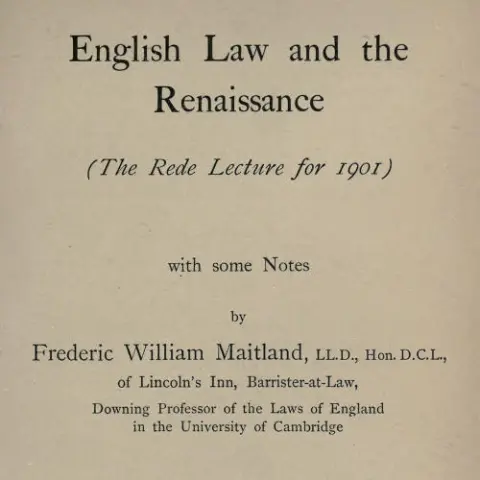
English Law and the Renaissance The Rede Lecture for 1901
Frederic William Maitland
THE CLASSIC COLLECTION · 1897
"Domesday Book and Beyond: Three Essays in the Early History of England" by Frederic William Maitland is a historical account written in the late 19th century. The work explores key themes and documents related to early English law and society, particularly focusing on the significance and implications of the Domesday Book—a comprehensive survey commissioned by William the Conqueror in 1085. The opening of the book presents a detailed introduction to the Domesday Book, describing its creation and its purpose as a tax record rather than a comprehensive legal document. Maitland discusses the methods used by royal commissioners to gather data regarding landholdings and the various classes of people that inhabited England during this period. He highlights the complexities of understanding the legal relationships and historical context of the land and its occupants, setting the stage for a deeper examination of feudalism and its societal ramifications in England.
Introduction adapted from the source catalogue; source summaries may be automatically generated.
Free to read · English · 233,138 words · No account needed
MAKE TIME FOR A GOOD BOOK
On by default. Untick to stop anonymous reading totals. Each page counts after 10 seconds in view. How this works.
Anonymous counting is on unless you have switched it off.
When Duke William became king of the English, he found (so he might well think) among the most valuable of his newly acquired regalia, a right to levy a land-tax under the name of geld or danegeld. A detailed history of that tax cannot be written. It is under the year 991 that our English chronicle first mentions a tribute paid to the Danes[8]; £10,000 was then paid to them. In 994 the yet larger sum of £16,000[9] was levied. In 1002 the tribute had risen to £24,000[10], in 1007 to £30,000[11], in 1009 East Kent paid £3,000[12]; £21,000 was raised in 1014[13]; in 1018 Cnut when newly crowned took £72,000 besides £11,000 paid by the Londoners[14]; in 1040 Harthacnut took £21,099 besides a sum of £11,048 that was paid for thirty-two ships[15]. With a Dane upon the throne, this tribute seems to have become an occasional war-tax. How often it was levied we cannot tell; but that it was levied more than once by the Confessor is not doubtful[16]. We are told that he abolished it in or about the year 1051, some eight or nine years after his accession, some fifteen before his death. No sooner was William crowned than 'he laid on men a geld exceeding stiff.' In the next year 'he set a mickle geld' on the people. In the winter of 1083-4 he raised a geld of 72 pence (6 Norman shillings) upon the hide. That this tax was enormously heavy is plain. Taking one case with another, it would seem that the hide was frequently supposed to be worth about £1 a year and there were many hides in England that were worth far less. But grievous as was the tax which immediately preceded the making of the survey, we are not entitled to infer that it was of unprecedented severity. It brought William but £415 or thereabouts from Dorset and £510 or thereabouts from Somerset[17]. Worcestershire was deemed to contain about 1200 hides and therefore, even if none of its hides had been exempted, it would have contributed but £360. If the huge sums mentioned by the chronicler had really been exacted, and that too within the memory of men who were yet living, William might well regard the right to levy a geld as the most precious jewel in his English crown. To secure a due and punctual payment of it was worth a gigantic effort, a survey such as had never been made and a record such as had never been penned since the grandest days of the old Roman Empire. But further, the assessment of the geld sadly needed reform. Owing to one cause and another, owing to privileges and immunities that had been capriciously granted, owing also, so we think, to a radically vicious method of computing the geldable areas of counties and hundreds, the old assessment was full of anomalies and iniquities. Some estates were over-rated, others were scandalously under-rated. That William intended to correct the old assessment, or rather to sweep it away and put a new assessment in its stead, seems highly probable, though it has not been proved that either he or his sons accomplished this feat[18]. For this purpose, however, materials were to be collected which would enable the royal officers to decide what changes were necessary in order that all England might be taxed in accordance with a just and uniform plan. Concerning each estate they were to know the number of geldable units ('hides' or 'carucates') for which it had answered in King Edward's day, they were to know the number of plough oxen that there were upon it, they were to know its true annual value, they were to know whether that value had been rising or falling during the past twenty years. Domesday Book has well been called a rate book, and the task of spelling out a land law from the particulars that it states is not unlike the task that would lie before any one who endeavoured to construct our modern law of real property out of rate books, income tax returns and similar materials. All the lands, all the land-holders of England may be brought before us, but we are told only of such facts, such rights, such legal relationships as bear on the actual or potential payment of geld. True, that some minor purposes may be achieved by the king's commissioners, though the quest for geld is their one main object. About the rents and renders due from his own demesne manors the king may thus obtain some valuable information. Also he may learn, as it were by the way, whether any of his barons or other men have presumed to occupy, to 'invade,' lands which he has reserved for himself. Again, if several persons are in dispute about a tract of ground, the contest may be appeased by the testimony of shire and hundred, or may be reserved for the king's audience; at any rate the existence of an outstanding claim may be recorded by the royal commissioners. Here and there the peculiar customs of a shire or a borough will be stated, and incidentally the services that certain tenants owe to their lords may be noticed. But all this is done sporadically and unsystematically. Our record is no register of title, it is no feodary, it is no custumal, it is no rent roll; it is a tax book, a geld book.
Your reading position is saved on this browser. Take it to another device with a library code. Reading pages adapt to text, rather than matching a printed edition.
Frederic William Maitland
BEHIND THE BOOK
This eBook is for the use of anyone anywhere in the United States and most other parts of the world at no cost and with almost no restrictions whatsoever. You may copy it, give it away or re-use it under the terms of the Project Gutenberg License included with this eBook or online at www.gutenberg.org. If you are not located in the United States, you will have to check the laws of the country where you are located before using this eBook. Read the source licence.
The original source file, including credits and licence, is retained by this library. Request an original-format copy at no charge. Please include the book title and Project Gutenberg identifier #43255.
KEEP YOUR CURIOSITY GOING
Cécile Tormay

Moritz Busch
John L. Ransom
Frances Wright
Cécile Tormay

Mabel Potter Daggett