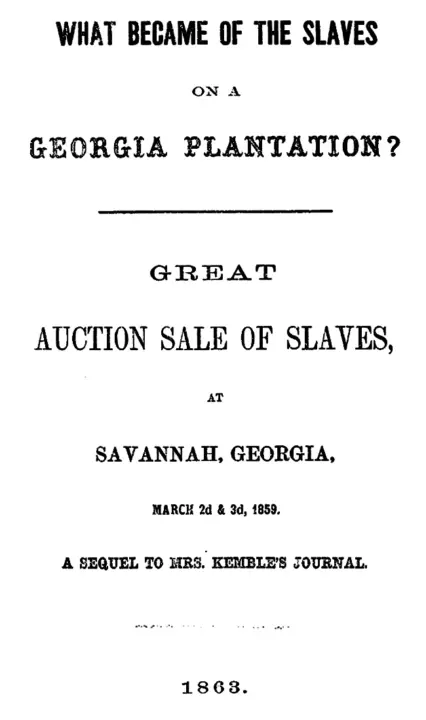
What Became of the Slaves on a Georgia Plantation? Great Auction Sale of Slaves, at Savannah, Georgia, March 2d & 3d, 1859
Q. K. Philander Doesticks
THE CLASSIC COLLECTION · 1854
"Doesticks: What He Says" by Q. K. Philander Doesticks is a humorous work likely written in the mid-19th century. This book appears to be a collection of satirical sketches, anecdotes, and whimsical observations narrated by its protagonist, Doesticks himself, as he embarks on various comedic adventures in and around New York City. The text suggests a playful tone, infused with a critique of societal norms and behaviors of the time. The opening of the work sets the stage for its eccentric style and candid humor. The narrator, Q. K. Philander Doesticks, acknowledges that this is not a typical literary effort but rather a hodgepodge of humorous sketches filled with absurdities and playful exaggerations. He details his inspirations and whims while hinting at his aspirations for literary fame, all the while sharing amusing anecdotes about urban experiences, such as visits to Niagara Falls and encounters with the vagaries of city life. The tone is irreverent and self-aware, inviting readers into a world where satire reigns, and the mundane becomes ridiculous through Doesticks' humorous lens.
Introduction adapted from the source catalogue; source summaries may be automatically generated.
Free to read · English · 57,900 words · No account needed
MAKE TIME FOR A GOOD BOOK
On by default. Untick to stop anonymous reading totals. Each page counts after 10 seconds in view. How this works.
Anonymous counting is on unless you have switched it off.
Assuming from the wonderful unanimity of the papers on this subject, that these amiable qualities constitute the fitness of the nominees for places of honor, trust, or profit, I have endeavored to analyze the gradations of criminal merit, and discover exactly how big a rascal a man must be to qualify himself for any given office. The result of my investigation is as follows:--
No one is eligible to the office of Mayor of the city, unless he has forged a draft, and got the money on it; and, on at least two separate occasions, set fire to his house, to get the insurance.
Candidates for Aldermen qualify themselves by carrying a revolver, getting beastly drunk, and stabbing a policeman or two before they can get sober.
A Common Councilman must drink with the Short Boys, give prizes to the Firemen's Target Excursion, carry a slung-shot in his pocket, and have a personal interest in a Peter Funk auction shop.
A police Justice must gamble a little, cheat a considerable, lie a good deal, and get drunk "clear through" every Saturday night; if he can read easy words, and write his name, it is generally no serious objection; but the Know Nothings will not permit even this accomplishment, on the plea that the science of letters is of foreign origin.
A man who can pick pockets scientifically, will make a good constable.
Aspirants to minor offices are classified according to desert, but no one who has not at least committed petit larceny, is allowed a place on any regular ticket.
As to offices of more importance, I should say from what I can now judge, that no man can ever be elected Governor of the State, unless he is guilty of a successful burglary, complicated with a midnight murder.
The rival candidates in this present crisis, had called each other all the names, and accused each other of all the crimes imaginable, for the preceding six weeks.
Boggs had been denounced as the plunderer of orphans, and seducer of innocent maidens, and the pilferer of hard-earned coppers from the poor.
Noggs, according to his charitable opponents, was a pickpocket, a sheepstealer, a Peter Funk, and an Irishman.
The candidate set up by the Know Nothings, to claim votes on the plea of his being an immaculate American, was proved to be the child of a French father, and a Prussian mother, and to have been born in Calcutta--it was asserted that he commenced his education in the northern part of Ethiopia, continued it in Dublin, and finally graduated at Botany Bay.
Your reading position is saved on this browser. Take it to another device with a library code. Reading pages adapt to text, rather than matching a printed edition.
Q. K. Philander Doesticks
Q. K. Philander Doesticks
Q. K. Philander Doesticks
BEHIND THE BOOK
This eBook is for the use of anyone anywhere in the United States and most other parts of the world at no cost and with almost no restrictions whatsoever. You may copy it, give it away or re-use it under the terms of the Project Gutenberg License included with this eBook or online at www.gutenberg.org. If you are not located in the United States, you will have to check the laws of the country where you are located before using this eBook. Read the source licence.
The original source file, including credits and licence, is retained by this library. Request an original-format copy at no charge. Please include the book title and Project Gutenberg identifier #39114.
KEEP YOUR CURIOSITY GOING

Charles G. (Charles Griffith) Ross
Hannah Webster Foster

Emily Lawless
Edwin Hamlin Carr

Charles De Lano Hine
Andrew Ure