THE CLASSIC COLLECTION✦Lincoln’s Inaugurals, Addresses and Letters (Selections)CLASSIC FREE BOOKS
Lincoln’s Inaugurals, Addresses and Letters (Selections)
Abraham Lincoln
THE CLASSIC COLLECTION · 1915
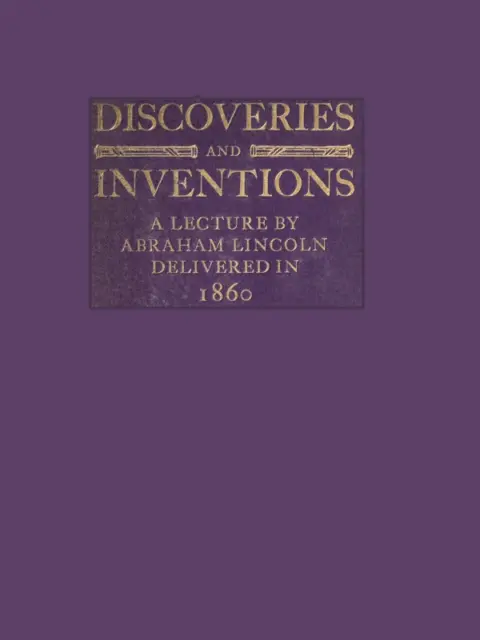
"Discoveries and Inventions: A lecture by Abraham Lincoln delivered in 1860" is a historical account in the form of a lecture by the 16th President of the United States, Abraham Lincoln. The material reflects Lincoln's intellectual engagement and perspectives on humanity's advancements through discoveries and inventions, illustrating his knowledgeable viewpoint influenced by both personal insights and biblical references. This work is rooted in the time period of the mid-19th century, during a time of significant social and technological change in America, just before Lincoln's election to the presidency. In this lecture, Lincoln explores the evolution of human progress through various inventions, emphasizing the unique capacity of man to innovate compared to other creatures. He discusses early discoveries, such as clothing and tools, and links these developments to historical and biblical narratives, reinforcing their significance in human society. He transitions into more complex inventions, including transportation methods, agriculture, and the utilization of natural forces like wind and steam. Throughout, Lincoln showcases an appreciation for human ingenuity as a defining characteristic of our species and encourages a continued pursuit of knowledge and improvement.
Introduction adapted from the source catalogue; source summaries may be automatically generated.
Free to read · English · 3,206 words · No account needed
MAKE TIME FOR A GOOD BOOK
On by default. Untick to stop anonymous reading totals. Each page counts after 10 seconds in view. How this works.
Anonymous counting is on unless you have switched it off.
[Illustration (Title Page)]
The Lecture--“Discoveries and Inventions”--by our greatest American, presents a phase of Lincoln’s activity about which little is generally known. It shows as clearly as any of his other writings how great was Lincoln’s knowledge of the progress of mankind, particularly as related in the Bible, and it reveals also his debt to that Book of Books for inspiration and illustration, as well as his masterly use of pure English, largely gained through that study.
In the fateful year of 1860, the year of his election to the presidency, Lincoln took up, in the pause of his affairs after the long debate with Douglas, the custom of lyceum lecturing, then in great vogue. This lecture on “Discoveries and Inventions” was delivered in towns near his home, Springfield, Illinois, and in Springfield itself on Washington’s birthday. Five days later Lincoln made his great speech at Cooper Union in New York.
The lecture is not included with any collection of Lincoln’s addresses. It appeared in print for the first time in Sunset Magazine in 1909--the centennial of Lincoln’s birth.
The original manuscript, from which this edition, the first in book form, is made, was a cherished possession of the late Dr. Samuel Houston Melvin, of Oakland, California, formerly a resident of Springfield, Illinois, and a friend of Mr. Lincoln. Just prior to Dr. Melvin’s death, in 1898, he made an affidavit setting forth the history of the manuscript; that statement is as follows:
In the month of February, 1861, being at that time a resident of Springfield, Illinois, I called one evening at the residence of my friend, Dr. John Todd. The doctor was an uncle of Mrs. Abraham Lincoln. While there Mr. Lincoln came in, bringing with him a well-filled satchel, remarking as he set it down that it contained his literary bureau. Mr. Lincoln remained some fifteen or twenty minutes, conversing mainly about the details of his prospective trip to Washington the following week, and told us of the arrangements agreed upon for the family to follow him a few days later. When about to leave he handed the grip above referred to to Mrs. Grimsley, the only daughter of Dr. Todd, who was then a widow but who subsequently became the wife of Rev. Dr. John H. Brown, a Presbyterian minister located in Springfield, remarking as he did so that he would leave the bureau in her charge; that if he ever returned to Springfield he would claim it, but if not she might make such disposition of its contents as she deemed proper. A tone of indescribable sadness was noted in the latter part of the sentence. Lincoln had shown me quite a number of letters a few days before, threatening his life, some predicting that he never would be inaugurated, and it was apparent to me that they were making an impression upon his mind, although he tried to laugh the matter off. About five years later the Nation was startled by the announcement of Lincoln’s assassination. The corporation of Springfield selected twelve of its citizens to proceed at once to Washington and accompany the remains of the dead President back to his old home. I was one of that number, and shall never forget the indescribable sadness manifested by millions of mourners along the route of travel of the funeral cortège as it wended its way westward over two thousand miles. A few evenings after his body was laid to rest, I again called upon my neighbors, the family of Dr. Todd. Scenes and incidents connected with the assassination and funeral of the dead President were discussed, and the remark made by Lincoln on his last visit to the house was referred to as indicating a presentiment that he would not return alive. This recalled the fact of his having left his so-called literary bureau, and his injunction as to its disposition. Mrs. Grimsley brought the grip from the place where it had been stored, and opened it with a view to examining its contents. Among them was found this manuscript, and attached to it by means of a piece of red tape was another of like character. They proved to be manuscripts of two lectures which he had prepared and delivered within a year prior to his election to the presidency--one at Jacksonville, Illinois, and a few days later at Decatur, Illinois; the other a little later at Cook’s Hall, Springfield, Illinois, at which I was present. Mrs. Grimsley told me to select from the contents of the bureau any one of the manuscripts it contained; and supposing at that time that the two manuscripts belonged to the same lecture, I selected them. On subsequent examination I discovered that while they both treated upon the same subject (Inventions and Discoveries) they were separate lectures. Twenty-five years later I disposed of one of the manuscripts to Mr. Gunther[A] of Chicago. The other it is my hope and desire shall remain in possession of my family and its descendants.
Your reading position is saved on this browser. Take it to another device with a library code. Reading pages adapt to text, rather than matching a printed edition.
Abraham Lincoln
Abraham Lincoln
Abraham Lincoln
Abraham Lincoln
BEHIND THE BOOK
This eBook is for the use of anyone anywhere in the United States and most other parts of the world at no cost and with almost no restrictions whatsoever. You may copy it, give it away or re-use it under the terms of the Project Gutenberg License included with this eBook or online at www.gutenberg.org. If you are not located in the United States, you will have to check the laws of the country where you are located before using this eBook. Read the source licence.
The original source file, including credits and licence, is retained by this library. Request an original-format copy at no charge. Please include the book title and Project Gutenberg identifier #52007.
KEEP YOUR CURIOSITY GOING

David Patterson (Spirit) Hatch

David Patterson (Spirit) Hatch

David Patterson (Spirit) Hatch
Cécile Tormay

Moritz Busch
John L. Ransom