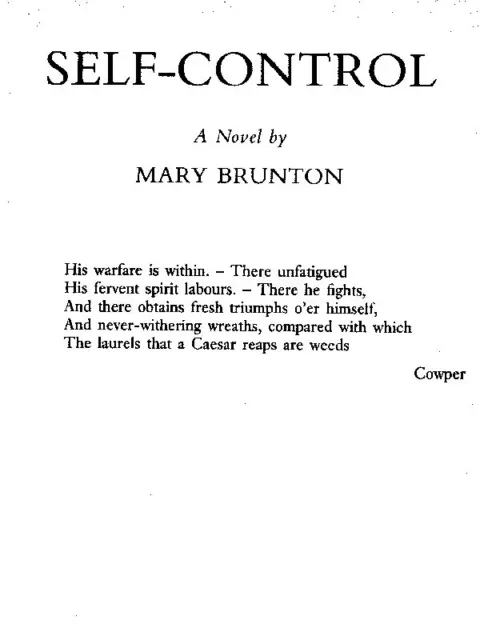
Self-control: A Novel
Mary Brunton
THE CLASSIC COLLECTION · 1814
"Discipline" by Mary Brunton is a novel written in the early 19th century. It chronicles the life of Ellen Percy, a wealthy and headstrong young woman, as she navigates the complexities of adolescence and society, grappling with her own pride and the lessons of humility and self-awareness. At the start of the novel, readers are introduced to Ellen as she reflects on her childhood, the consequences of her spoiled upbringing, and the tender yet enabling relationship she had with her mother. The opening chapter sets the stage for her struggles with self-importance and rebellion, highlighting her conflicts with authority figures, particularly her father and later, her schoolmates. As Ellen's character begins to evolve through her interactions at school and the revelations of her mother’s influence, it becomes clear that the path to personal growth will be laden with challenges requiring discipline and introspection.
Introduction adapted from the source catalogue; source summaries may be automatically generated.
Free to read · English · 156,975 words · No account needed
MAKE TIME FOR A GOOD BOOK
On by default. Untick to stop anonymous reading totals. Each page counts after 10 seconds in view. How this works.
Anonymous counting is on unless you have switched it off.
'And now I think I see you raise your indignant head; and, with the lofty scorn of baseness which I have so often seen expressed in your countenance and mien, I hear you exclaim, "Shall I desert my earliest friend!--repay with cold ingratitude her long-tried, ardent attachment?" Your indignation, Ellen, is virtuous, but mistaken. If Miss Arnold's attachment be real, she has a claim to your gratitude, indeed; but not to your intimacy, your confidence, your imitation. These are due to far other qualifications. But are you sure, Ellen, that the warm return you make to Miss Arnold's supposed affection is itself entirely real? Are you sure, that it is not rather the form under which you choose to conceal from yourself, that her adulation is become necessary to you? Before you indignantly repel this charge, ask your own heart, whether you are, in every instance, thus grateful for disinterested love? Is there not a friend of whose love you are regardless?--whose counsels you neglect?--whose presence you shun?--from whom you withhold your trust, though the highest confidence were here the highest wisdom?--whom you refuse to imitate, though here the most imperfect imitation were glorious? You exchange your affection, and all the influence which your affection bestows, for a mere shadow of good-will. The very dog that fawns upon you, is caressed with childish fondness. Oh, Ellen, does it never strike you with strong amazement to reflect, that you are sensible to every love but that which is boundless? grateful for every kindness but that which is wholly undeserved--wholly beyond return? Is nothing due to an unwearied friend? Is it fitting, that one who lives, who enjoys so much to sweeten life, by the providence, the bounty, the forbearance of a benefactor, should live to herself alone? Yet ask your own conscience, what part of your plan of life, or rather, since I believe your life is without a plan, which of your habits is inspired by gratitude. Dare to be candid with yourself, and though the odious word will grate upon your ear, enquire whether selfishness be not rather your chosen guide;--whether you be not selfish in your pursuit of pleasure;--selfish in your fondness for the flatterer who soothes your vanity,--selfish in the profuse liberality with which you vainly hope to purchase an affection which it is not in her nature to bestow,--selfish even in the relief which you indiscriminately lavish on every complainer whose cry disturbs you on your bed of roses. Is this the temper of a Christian--of one "who is not her own, but is bought with a price?" Consider this awful price, and how will your own conduct change in your estimation? How will you start as from a fearful dream, when you remember, that of this mighty debt you have hitherto lived regardless? How will you then abhor that pursuit of selfish pleasure which has hitherto alienated your mind from all that best deserves your care,--blasted the very sense by which you should have perceived the excellence of your benefactor,--diverted your regards from the deeper and deeper death which is palsying your soul; and closed your ear against the renovating voice which calls you to arise and live? This voice, once heard, would exalt your confiding temper to the elevations of faith,--ennoble your careless generosity to the self-devotion of saints and martyrs,--your warmth of affection, now squandered on the meanest of objects, to the love of God. The true religion once received, would change the whole current of your hopes and fears;--would ennoble your desires, subdue passion, humble the proud heart, overcome the world. But you will not give her whereon to plant her foot; for where, amidst the multitude of your toys, shall religion find a place? Oh, why should we, by continual sacrifice, confirm our natural idolatry of created things? Why fill, with the veriest baubles of this unsubstantial scene, hearts already too much inclined to exclude their rightful possessor? The pursuit of selfish pleasure is indeed natural, for self is the idol of fallen man; but the great end of his present state of being is to prostrate that idol before the Supreme. The stony Dagon bows unwillingly, but bow he must. Our heavenly Father, though a merciful, is not a fond or partial parent; and the same lot is more or less the portion of us all. He has freely given. He has done more; he has warned us of the real uses of his gifts. Perverse by nature, we abuse his bounty. Again, he exhorts us by the ministry of his servants; and often graciously sweetens his warnings, by conveying them in the voice of partial friendship, or parental love. We reject counsel; and the father unwillingly chastises. He withdraws the gifts which we have perverted, or suffers them to become themselves the punishment of their own abuse. If kindness cannot touch, nor exhortation move, nor warning alarm, nor chastisement reclaim, what other means can be employed with a moral being: What remains but the fearful sentence, "He is joined to his idols; let him alone." Oh, Ellen, my blood freezes at the thought that such a sentence may ever go forth against you. Rouse you, dear child of my love,--rouse you from your ill-boding security. Tremble, lest you already approach that state where mercy itself assumes the form of punishment. You have hitherto lived to yourself alone. Now venture to examine this god of your idolatry;--for the being whose pleasure and whose honour you seek, is your god, call it by what name you will. See if it be worthy to divide even your least service with Him who, infinite in goodness, accepts the imperfect,--showers his bounty on the unprofitable,--and opens, even to the rebel, the arms of a father!--who meets your offences with undesired pardon, and anticipates your wants with offers of himself! Think you that this generous love could lay on you a galling yoke? I know that, though you should distrust my judgment, you will credit my testimony; and I solemnly protest to you, that I have found his service to be "perfect freedom." He exalts my joys as gifts of his bounty; He blesses my sorrows as tokens of his love; He lightens my duties by honouring them, poor as they are, with his acceptance; and even the pang with which I feel and own myself a lost sinner is sweetened by remembrance of that mercy which came to seek and to save me, because I was lost. These are my pleasures; and I know that they can counterbalance poverty, and loneliness, and pain. Your pleasures too I have tried; and I know them to be cold, fleeting, and unsubstantial, as the glories of a winter sky. Oh for the eloquence of angels, that I might persuade you to exchange them for the real treasure! Yet vain were the eloquence of angels, if the "still small voice" be wanting, which alone can speak to the heart. I may plead, and testify, and entreat; but is aught else within my power?--Yes,--I will go and pray for you.
Your reading position is saved on this browser. Take it to another device with a library code. Reading pages adapt to text, rather than matching a printed edition.
Mary Brunton
BEHIND THE BOOK
This eBook is for the use of anyone anywhere in the United States and most other parts of the world at no cost and with almost no restrictions whatsoever. You may copy it, give it away or re-use it under the terms of the Project Gutenberg License included with this eBook or online at www.gutenberg.org. If you are not located in the United States, you will have to check the laws of the country where you are located before using this eBook. Read the source licence.
The original source file, including credits and licence, is retained by this library. Request an original-format copy at no charge. Please include the book title and Project Gutenberg identifier #38510.
KEEP YOUR CURIOSITY GOING
Coulson Kernahan

Maurice Baring
Frances Wright
Cécile Tormay

Frederic Jesup Stimson

W. H. P. (William Henry Pope) Jarvis