THE CLASSIC COLLECTION✦An outlaw’s diary: the CommuneCLASSIC FREE BOOKS
An outlaw’s diary: the Commune
Cécile Tormay
THE CLASSIC COLLECTION · 1919
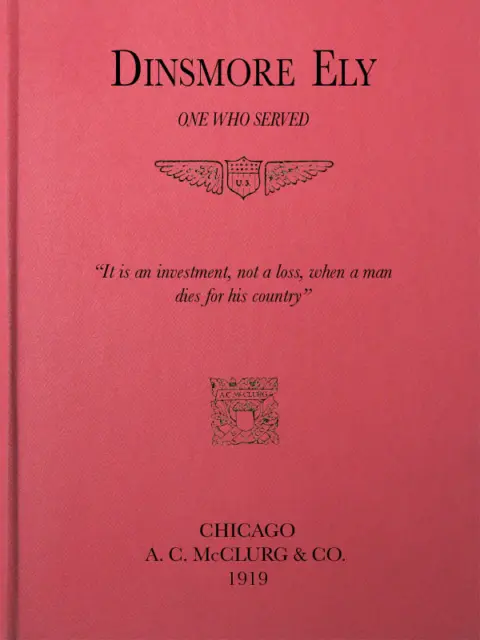
"One Who Served" by Dinsmore Ely is an autobiographical account written in the early 20th century. The book recounts the experiences of Dinsmore Ely, a young American aviator who volunteered to serve during World War I. Through his letters home, Ely shares his journey from arriving in France to training as a pilot, highlighting his adventures, reflections on life, and the complexities of war. At the start of the narrative, Ely expresses his enthusiasm and excitement about sailing to France, capturing the vibrant atmosphere of his departure and the camaraderie among men on the ship. As he recounts his early days in France, he reflects on his training in aviation and the friendships he forms along the way. The opening portion establishes Ely's sense of purpose and determination to serve his country, while also offering glimpses of the profound experiences that will shape his identity as a soldier and human being throughout the war. Ely's narrative is marked by youthful optimism, curiosity about the world, and an awareness of the sacrifices that come with devotion to duty.
Introduction adapted from the source catalogue; source summaries may be automatically generated.
Free to read · English · 46,673 words · No account needed
MAKE TIME FOR A GOOD BOOK
On by default. Untick to stop anonymous reading totals. Each page counts after 10 seconds in view. How this works.
Anonymous counting is on unless you have switched it off.
Soon a motor car drove up, and out stepped a young French chap. He asked if I was the guy and I says “Yes,” and he “’lowed” that he was just back from Verdun for his permission and asked if I would come out and have supper and stay overnight, so we got in the car and went out to a beautiful château. I met the family and apologized for my clothes, which they said were fine for war times. Then the children came in and played until supper.
They were all charming—no formality or constraint. They all spoke English, more or less, and the dinner was jolly, with difficulties of understanding. The eldest son of the family had lost his life when a bombing plane burned over Verdun last year. That gave them and me a special bond of sympathy. The other son, of about twenty-two, is a sergeant in the First Dragoons. The eldest daughter, of about twenty-eight, mother of all the little children, sat beside me. Her husband is a captain in the First Dragoons. She was very entertaining and spoke English quite well. The other member was the little daughter, about fifteen. Later I learned that M. Duval is a viscount, of the old blood of France.
After dinner we went into the petit salon. They entertained me by showing me innumerable photographs. M. Duval is a camera enthusiast, and does all his own developing and printing. He takes these double pictures on plates, and you look at them through a stereoscope. They have traveled very extensively. They have hunted big game and small game in mountain, forest, and plain, and the pictures tell the story like an Elmendorf lecture. Meanwhile, they all contributed interesting remarks in broken English, and so we got better acquainted. Mme. Duval showed me her postcard collection of French châteaux. The Duvals owned more than twenty through Touraine and Normandy, they and their direct relatives by marriage. We all went up the old stairway together and bid each other good night in the upper hall. They asked what I wanted for my breakfast in bed, but I came down bright and early and joined them at a seven o’clock breakfast. We looked at some more pictures and then went rabbit hunting in the drizzling rain. They gave me an American repeating gun. M. Duval assigned us to our positions, not far from the château, and we waited. Three or four men set about to drive the rabbits. Off among the trees I saw the strangest looking rabbit. I pulled up, about the fire, when it struck me there was something wrong, so I looked again. There were two of the creatures gliding around from one rabbit hole to another. Their color was cream yellow. After a little guessing, I concluded they must be ferrets, so I let them live. Suddenly a man called “Oh-ee,” and a rabbit humped past right by my feet. I took a pot shot, but it had me scared and I almost hit my foot, it was so close. Two more went by and didn’t mind my shooting at them. They were so close it seemed a pity to shoot them, yet that didn’t quite explain my missing. Well, you know what an old hand I am at rabbit shooting. I was just a little out of practice, having fired a shotgun, once when I was twelve years old. The blessing was that no one was there to see. Then I got one at a good distance, and found that it was much easier to hit them at a hundred feet than twenty-five. My average began to go up, and the first fifteen shots I had three rabbits. Then we changed positions, and I found that the son had eleven. I don’t think he had fired more than ten shots. At thirty shots I had twelve rabbits, and I felt a little more respectable. It was a pipe after you got used to it. Then we took a walk about the place and went in to lunch. All the food they had was from their own place: meat, wild and tame; fish from the river near by; and chestnuts, mashed like potatoes and baked. These latter are called les marrons. There were also sweet cakes, salads, mixed and dressed by M. Duval, and—wonder of wonders—American apple pie! I ate three pieces, and they had it for every meal while I was there. I understand why menus are written in French and old novels rave on French cuisines. Never did I eat such delicious food. Every dish is served separately as a work of art. The service was fine old china, with cracks all through it. The knives, forks, and spoons were gold plated, and the daughter would get up from the table and serve the bread if the maid didn’t happen to be in the room. Everyone eats the food as he gets it hot, and one person may be a course behind the others without causing inconvenience.
Your reading position is saved on this browser. Take it to another device with a library code. Reading pages adapt to text, rather than matching a printed edition.
BEHIND THE BOOK
This eBook is for the use of anyone anywhere in the United States and most other parts of the world at no cost and with almost no restrictions whatsoever. You may copy it, give it away or re-use it under the terms of the Project Gutenberg License included with this eBook or online at www.gutenberg.org. If you are not located in the United States, you will have to check the laws of the country where you are located before using this eBook. Read the source licence.
The original source file, including credits and licence, is retained by this library. Request an original-format copy at no charge. Please include the book title and Project Gutenberg identifier #51720.
KEEP YOUR CURIOSITY GOING
Cécile Tormay

Moritz Busch
John L. Ransom
Frances Wright
Cécile Tormay

Mabel Potter Daggett