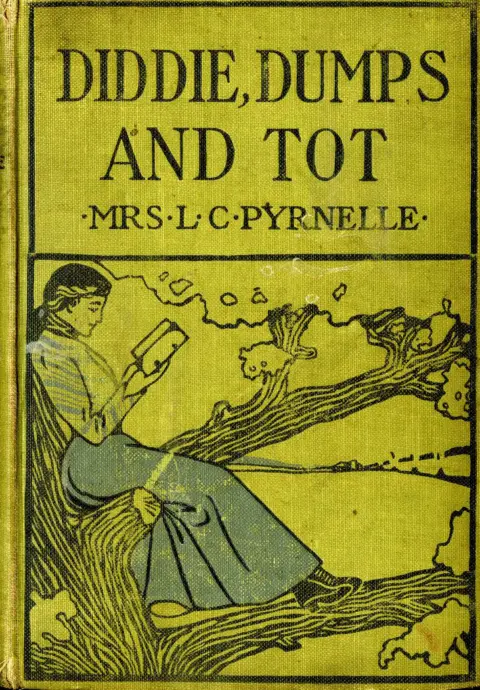
Diddie, Dumps, and Tot; Or, Plantation Child-Life
Louise Clarke Pyrnelle
THE CLASSIC COLLECTION · 1882
"Diddie, Dumps & Tot; or, Plantation Child-Life" by Louise Clarke Pyrnelle is a fictional narrative that captures the childhood experiences of three little girls on a Southern plantation in the mid-19th century. The story unfolds through the adventures of Diddie, Dumps, and Tot, who interact affectionately with the enslaved individuals on their plantation, showcasing the complexities of their relationships in a historical context. The narrative aims to preserve the folk stories, games, and traditions of Southern slaves, reflecting a formative period that the author sought to immortalize. The opening of the book introduces Diddie, Dumps, and Tot, the daughters of Major Waldron, who live in a big house surrounded by both beautiful gardens and their enslaved caregivers, including the nurturing 'Mammy' and various other figures who help raise them. The description paints a vivid picture of plantation life and the closeness between the children and their caregivers. As the story progresses, we learn about their playful interactions, festive celebrations, and the lessons they receive from the adults around them. The text establishes a nostalgic tone as it explores the contrasts and connections between the lives of the white children and the enslaved individuals, illustrating a world soon to change.
Introduction adapted from the source catalogue; source summaries may be automatically generated.
Free to read · English · 43,376 words · No account needed
MAKE TIME FOR A GOOD BOOK
On by default. Untick to stop anonymous reading totals. Each page counts after 10 seconds in view. How this works.
Anonymous counting is on unless you have switched it off.
"Little missy," he said, piteously, "I'se er starvin' ter def. I ain't had er mouf'l ter eat in fo' days."
"What's the reason?" asked Dumps. "Are you a runaway nigger?"
"Yes, honey; I 'longs ter ole Tight-fis' Smith; an' he wanted ter whup me fur not gittin' out ter de fiel' in time, an' I tuck'n runned erway fum 'im, an' now I'm skyeert ter go back, an' ter go anywhar; an' I can't fin' nuf'n t' eat, an' I'se er starvin' ter def."
"Well, you wait," said Dumps, "an' I'll go bring yer the picnic."
"Don't tell nobody 'boutn my bein' hyear, honey."
"No, I won't," said Dumps, "only Diddie; she's good, an' she won't tell nobody; an' she can read an' write, an' she'll know what to do better'n me, because I'm all the time such a little goose. But I'll bring yer sump'n t' eat; you jes wait er little minute; an' don't yer starve ter def till I come back."
Dumps ran back to the ditch where the children were, and, taking Diddie aside in a very mysterious manner, she told her about the poor man who was hiding in the gin-house, and about his being so hungry.
"An' I tol' 'im I'd bring 'im the picnic," concluded Dumps; and Diddie, being the gentlest and kindest-hearted little girl imaginable, at once consented to that plan; and, leaving Tot with the little negroes in the woods, the two children took their baskets, and went higher up the ditch, on pretence of finding a good place to set the table; but, as soon as they were out of sight, they cut across the grove, and were soon at the gin-house. They entered the pick-room cautiously, and closed the door behind them, The man came out from his hiding-place, and the little girls emptied their baskets in his hands.
He ate ravenously, and Diddie and Dumps saw with pleasure how much he enjoyed the nice tarts and sandwiches and cakes that Mammy had provided for the picnic.
"Do you sleep here at night?" asked Diddie.
"Yes, honey, I'se skyeert ter go out anywhar; I'se so skyeert uv
Tight-fis' Smith."
"He's awful mean, ain't he?" asked Dumps.
"Dat he is, chile," replied the man; "he's cruel an' bad."
"Then don't you ever go back to him," said Dumps. "You stay right here an' me'n Diddie'll bring you ev'y-thing ter eat, an' have you fur our nigger."
Your reading position is saved on this browser. Take it to another device with a library code. Reading pages adapt to text, rather than matching a printed edition.
Louise Clarke Pyrnelle
BEHIND THE BOOK
This eBook is for the use of anyone anywhere in the United States and most other parts of the world at no cost and with almost no restrictions whatsoever. You may copy it, give it away or re-use it under the terms of the Project Gutenberg License included with this eBook or online at www.gutenberg.org. If you are not located in the United States, you will have to check the laws of the country where you are located before using this eBook. Read the source licence.
The original source file, including credits and licence, is retained by this library. Request an original-format copy at no charge. Please include the book title and Project Gutenberg identifier #17146.
KEEP YOUR CURIOSITY GOING
Cécile Tormay

Moritz Busch
Coulson Kernahan
John L. Ransom

Maurice Baring
Frances Wright