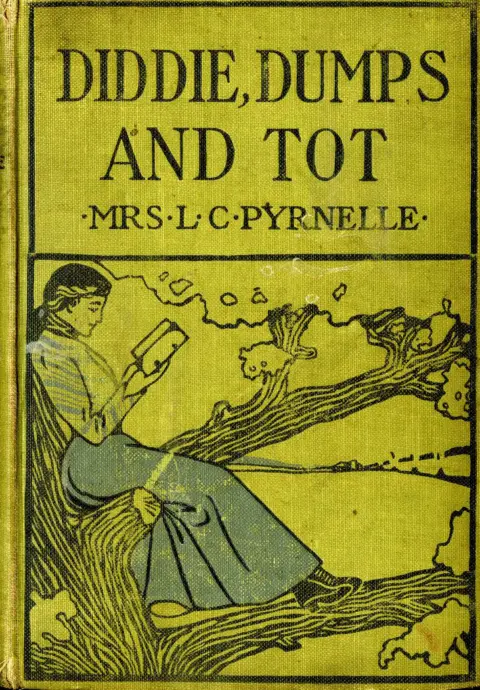
Diddie, Dumps, and Tot; Or, Plantation Child-Life
Louise Clarke Pyrnelle
THE CLASSIC COLLECTION · 1882
"Diddie, Dumps & Tot; or, Plantation Child-Life" by Louise Clarke Pyrnelle is a fictional narrative that captures the childhood experiences of three little girls on a Southern plantation in the mid-19th century. The story unfolds through the adventures of Diddie, Dumps, and Tot, who interact affectionately with the enslaved individuals on their plantation, showcasing the complexities of their relationships in a historical context. The narrative aims to preserve the folk stories, games, and traditions of Southern slaves, reflecting a formative period that the author sought to immortalize. The opening of the book introduces Diddie, Dumps, and Tot, the daughters of Major Waldron, who live in a big house surrounded by both beautiful gardens and their enslaved caregivers, including the nurturing 'Mammy' and various other figures who help raise them. The description paints a vivid picture of plantation life and the closeness between the children and their caregivers. As the story progresses, we learn about their playful interactions, festive celebrations, and the lessons they receive from the adults around them. The text establishes a nostalgic tone as it explores the contrasts and connections between the lives of the white children and the enslaved individuals, illustrating a world soon to change.
Introduction adapted from the source catalogue; source summaries may be automatically generated.
Free to read · English · 43,376 words · No account needed
MAKE TIME FOR A GOOD BOOK
On by default. Untick to stop anonymous reading totals. Each page counts after 10 seconds in view. How this works.
Anonymous counting is on unless you have switched it off.
An' de frog, he turnt roun', he did, an' he wave his han' roun' his
head, an' he holler back,
"'Pig-un-a-wa-ya, Pig-un-a-wa-ya, hooo-hooo!'
"Atter Nancy Jane O got erhead er de birds, den de hardes' flyin' wuz thu wid; so she jes went 'long, an' went 'long, kin' er easy like, tell she got ter de stone; an' she lit on er' simmon-bush close ter de crick, an' Pigunawaya he slipt off, he did, an' he hist up his feet, an' he gin er jump, kerchug he went down inter de water; an' by'mby hyear he come wid de stone in his mouf. Den he mount on Nancy Jane O, he did; an', mun, she wuz so proud, she an' de frog bof, tell dey flew all roun' an' roun', an' Nancy Jane O, she 'gun ter sing,
"' Who on-tied, who on-tied Po' Nancy Jane O?'
An' de frog he ans'er back,
"'Pig-un-a-wa-ya, Pig-un-a-wa-ya, hooo-hooo!'
"An' wile dey wuz er singin' an' er j'yin' uv deyselves, hyear come de birds; an' de frog he felt so big, caze he'd got de stone, tell he stood up on Nancy Jane O's back, he did, an' he tuck'n shuck de stone at de birds, an' he holler at 'em
"'O Pig-un-a-wa-ya, Pig-un-a-wa-ya, hooo-hooo!'
An' jes ez he said dat, he felt hisse'f slippin', an' dat made him clutch on ter Po' Nancy Jane O, an' down dey bof' went tergedder kersplash, right inter de crick.
"De frog he fell slap on ter er big rock, an' bust his head all ter pieces; an' Po' Nancy Jane O sunk down in de water an' got drownded; an' dat's de een'."
"Did the king get the stone, Aunt Edy?" asked Dumps.
"Wy no, chile; don't yer know de mole he's blin' tell yit? ef'n he could er got dat stone, he could er seen out'n his eyes befo' now. But I ain't got no time ter fool 'long er you chil'en. I mus' git marster's shuts done, I mus'."
And Aunt Edy turned to her ironing-table, as if she didn't care for company; and Dumps and Tot, seeing that she was tired of them, went back to the house, Tot singing,
"Who on-tied, who on-tied Po' Nanty Dane O?"
and Dumps answering back,
"Pig-un-a-wa-ya, Pig-un-a-wa-ya, hooo-hooo!"
Your reading position is saved on this browser. Take it to another device with a library code. Reading pages adapt to text, rather than matching a printed edition.
Louise Clarke Pyrnelle
BEHIND THE BOOK
This eBook is for the use of anyone anywhere in the United States and most other parts of the world at no cost and with almost no restrictions whatsoever. You may copy it, give it away or re-use it under the terms of the Project Gutenberg License included with this eBook or online at www.gutenberg.org. If you are not located in the United States, you will have to check the laws of the country where you are located before using this eBook. Read the source licence.
The original source file, including credits and licence, is retained by this library. Request an original-format copy at no charge. Please include the book title and Project Gutenberg identifier #17146.
KEEP YOUR CURIOSITY GOING
Cécile Tormay

Moritz Busch
Coulson Kernahan
John L. Ransom

Maurice Baring
Frances Wright