THE CLASSIC COLLECTION✦Frank Merriwell’s dangerCLASSIC FREE BOOKS
Frank Merriwell’s danger
Burt L. Standish
THE CLASSIC COLLECTION · 1901
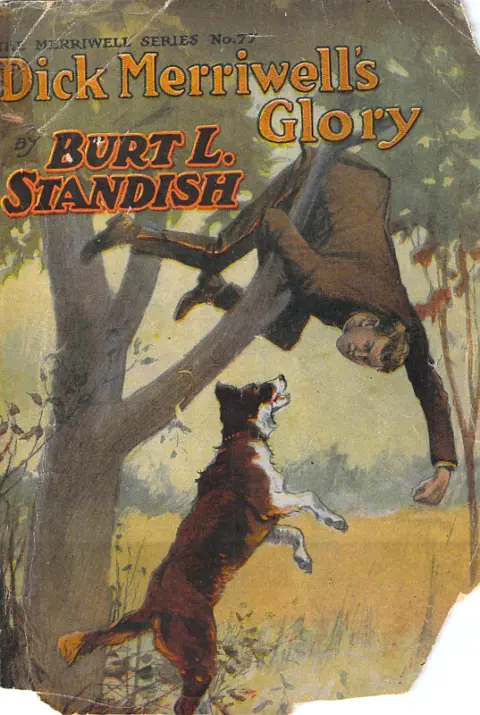
"Dick Merriwell's Glory; Or, Friends and Foes" by Burt L. Standish is a novel written in the late 19th century. The story centers around Dick Merriwell, a cadet at Fardale Military School, who becomes a local hero after achieving remarkable success in a football game against White Academy. The book unfolds themes of friendship, rivalry, and personal growth as Dick navigates the challenges posed by jealous classmates and his own expectations while training under the guidance of his older brother, Frank. The opening of "Dick Merriwell's Glory" introduces readers to Dick Merriwell's rise to fame at Fardale Military School following an impressive football performance. As Dick is celebrated by his peers, he simultaneously faces jealousy and hostility from classmates who feel overshadowed. Chief among his adversaries is Jabez Lynch, who attempts to undermine him through treacherous means. Meanwhile, Frank Merriwell takes on the role of mentor, striving to mold his brother into a well-rounded athlete mentally and physically. As the first chapter establishes the competitive atmosphere at the school, it sets the stage for Dick's journey toward greatness, friendship, and the inevitable conflicts with those envious of his success.
Introduction adapted from the source catalogue; source summaries may be automatically generated.
Free to read · English · 68,695 words · No account needed
MAKE TIME FOR A GOOD BOOK
On by default. Untick to stop anonymous reading totals. Each page counts after 10 seconds in view. How this works.
Anonymous counting is on unless you have switched it off.
"Oh, I don’t like to think that any Fardale fellow really wants to see us beaten!" exclaimed Steve Nunn.
"I don’t like to think so," said Dick; "but I know it."
"But they wouldn’t do anything to help down us?"
"Wouldn’t they?"
"An onery Piute who would do anything of the sort ought to be lynched like a horse-thief!" exploded the Texan Maverick, in his forceful way.
"I have reasons to believe," said Dick quietly, "that there is at least one fellow at Fardale who has opened communication with a member of the Viewland team, with the intention of putting Viewland onto our style of playing and our signals."
"Say, Dick," called Buckhart, "just name the varmint, and we’ll give him a coat of tar and feathers! That’s the sort of medicine that will do him good."
"As I have no absolute proof against him, I’ll not name him now," said Dick, remembering how his charge against Uric Scudder had fallen flat through Jack Glennon’s denial that he knew Scudder.
"I think it will not be easy for Viewland to get hold of our signals," said Frank Merriwell, "as the series signals, which will be adopted in the next game, will make it hard for them to tell what we’re going to do. But every man here must be sure he has those signals by heart, so he will make no blunders in the plays. I want to see if everybody here is up on signals, so I’ll just give a few and call on different ones to tell what they mean. I’ll take simple signals first, and then follow with series signals. Ready now. The one I call will answer."
They sat quiet and gave him attention. The darkness was gathering more rapidly in the corners now, the red and gold of the sunset dying out of the autumn sky.
"21—37—70—Z—43," called Frank. "Gordan."
"Drop-kick by full-back," answered Gordan promptly.
"Right," nodded Merry. "7—70—Y—16—200—10. Shannock."
"Left half round right end," answered Shannock, with equal promptness.
"Right again," said Frank. "2—7—22—18—Y—40. Blair."
"Left half through center," spoke Blair, without hesitation.
"Correct. 26—28—B—100—4. Merriwell."
"Tackles back; right tackle through center," answered Dick Merriwell.
"27—29—F—100—7. Burrows."
"Tackles back; left tackle round right end," said Burrows.
"21—Z—83—2—1—62. Douglass."
"Drop-kick by full-back," said Douglass slowly.
"Have to think quick in a game, you know," said Frank.
"I never could think any too quick," confessed Hugh Douglass, his face
flushing somewhat.
Your reading position is saved on this browser. Take it to another device with a library code. Reading pages adapt to text, rather than matching a printed edition.
Burt L. Standish
Burt L. Standish
Burt L. Standish
Burt L. Standish
BEHIND THE BOOK
This eBook is for the use of anyone anywhere in the United States and most other parts of the world at no cost and with almost no restrictions whatsoever. You may copy it, give it away or re-use it under the terms of the Project Gutenberg License included with this eBook or online at www.gutenberg.org. If you are not located in the United States, you will have to check the laws of the country where you are located before using this eBook. Read the source licence.
The original source file, including credits and licence, is retained by this library. Request an original-format copy at no charge. Please include the book title and Project Gutenberg identifier #62411.
KEEP YOUR CURIOSITY GOING
Coulson Kernahan

Maurice Baring
Frances Wright
Cécile Tormay

Frederic Jesup Stimson

W. H. P. (William Henry Pope) Jarvis