THE CLASSIC COLLECTION✦Frank Merriwell’s dangerCLASSIC FREE BOOKS
Frank Merriwell’s danger
Burt L. Standish
THE CLASSIC COLLECTION · 1910
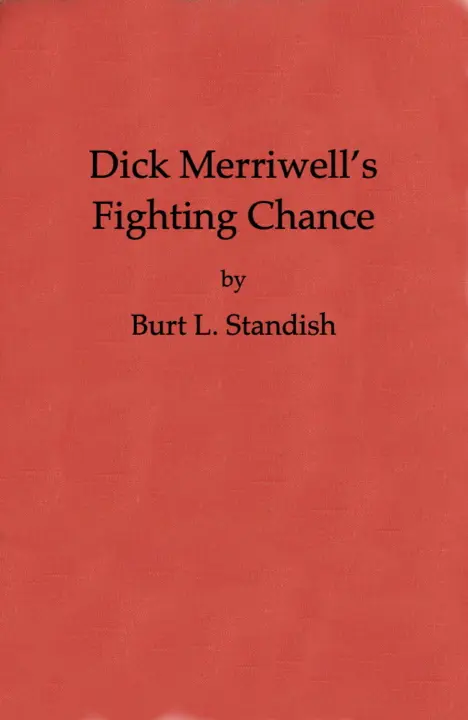
"Dick Merriwell's Fighting Chance; Or, The Split in the Varsity" by Burt L. Standish is a novel written in the early 20th century. The story revolves around Dick Merriwell, an amiable and talented college athlete, and his friend Bob Hollister, who is struggling to balance academic responsibilities with his passion for football. The narrative emphasizes themes of loyalty, integrity, and the challenges of college life as it showcases the friendships and athletic pursuits of the Merriwell brothers and their companions. The opening of the book focuses on a gathering in Durfee Hall where Dick Merriwell and his friends are engaged in lighthearted banter and discussions about their lives and studies. Through their conversations, it becomes clear that Bob Hollister is facing academic difficulties due to his preoccupation with football. With the looming possibility of being dropped from college due to poor grades, he confides in Dick about his struggles. The story sets the stage for the tension between athletics and academics, foreshadowing the challenges Bob will face as he attempts to reconcile his love for football with the need to focus on his studies.
Introduction adapted from the source catalogue; source summaries may be automatically generated.
Free to read · English · 82,393 words · No account needed
MAKE TIME FOR A GOOD BOOK
On by default. Untick to stop anonymous reading totals. Each page counts after 10 seconds in view. How this works.
Anonymous counting is on unless you have switched it off.
“I know that,” Elwell returned composedly, “but neither can any one else while I’m here.”
Fitz instantly took up the gantlet.
“Talk about hogs!” he exclaimed, springing from his seat on the table. “And here I am fairly bursting with a perfectly punk song I just learned this afternoon. Avaunt, creature!”
He made a dive at Elwell, and, before the stalwart Hoosier realized what was happening, the piano stool was deftly upset and he sprawled on the floor. By the time he had scrambled to his feet, the slim chap was seated calmly at the keyboard and had struck an opening chord.
“Come into the garden, Maud,” he began dramatically. He got no farther. A united yell of protest arose which effectually drowned him out.
“Oh, what a chestnut!”
“Noah sang that to the animals in the ark!”
“Give us something that’s not more than two thousand years old!”
Fitz turned slowly around, a look of pained surprise on his freckled
face.
“Peace, prithee—peace!” he chided. “I assure you that the song is quite new, save the first line, which may be a little reminiscent. Kindly refrain from any more rude, vulgar interruptions.”
Before the others could recover their breath he struck the chords and began to sing again, this time rather hurriedly:
“Come into the garden, Maud”;
But Maud was much too wise.
‘Oh, no,’ said she, ‘the corn has ears
And the potatoes eyes.’
His voice, dwelling lingeringly and fondly on the last note, was drowned
in a shout of laughter.
“Great!” choked Buckhart. “Maud was a wise child, all right.”
“Give us another verse, old fellow,” chuckled Elwell.
“I’m afraid I’m not in very good voice to-night,” simpered Fitz, looking coyly down at the keys. “Such a critical audience always makes me so nervous. However——”
He lifted his voice again in the same serious chant.
“The rain it falls upon the just, And also on the unjust fellers; But chiefly on the just, because The unjust have the justs’ umbrellers.”
This verse was received with equal applause, and Fitz was entreated to
give them another.
“Sing another song,” urged Rose. “You must know a pile of them.”
“Well, I’ll give you a very short one,” the slim chap returned with much apparent reluctance. “It’s a little old, but you mustn’t mind a thing like that.”
Striking a single chord, he began the first line.
“Mary had a little——”
He paused, and, clearing his throat, glanced around at his audience, plainly surprised that there had been no interruption. Having been caught once, however, the fellows were not going to repeat the performance, and remained expectantly silent.
Your reading position is saved on this browser. Take it to another device with a library code. Reading pages adapt to text, rather than matching a printed edition.
Burt L. Standish
Burt L. Standish
Burt L. Standish
Burt L. Standish
BEHIND THE BOOK
This eBook is for the use of anyone anywhere in the United States and most other parts of the world at no cost and with almost no restrictions whatsoever. You may copy it, give it away or re-use it under the terms of the Project Gutenberg License included with this eBook or online at www.gutenberg.org. If you are not located in the United States, you will have to check the laws of the country where you are located before using this eBook. Read the source licence.
The original source file, including credits and licence, is retained by this library. Request an original-format copy at no charge. Please include the book title and Project Gutenberg identifier #63024.
KEEP YOUR CURIOSITY GOING
Coulson Kernahan

Maurice Baring
Frances Wright
Cécile Tormay

Frederic Jesup Stimson

W. H. P. (William Henry Pope) Jarvis