THE CLASSIC COLLECTION✦Frank Merriwell’s dangerCLASSIC FREE BOOKS
Frank Merriwell’s danger
Burt L. Standish
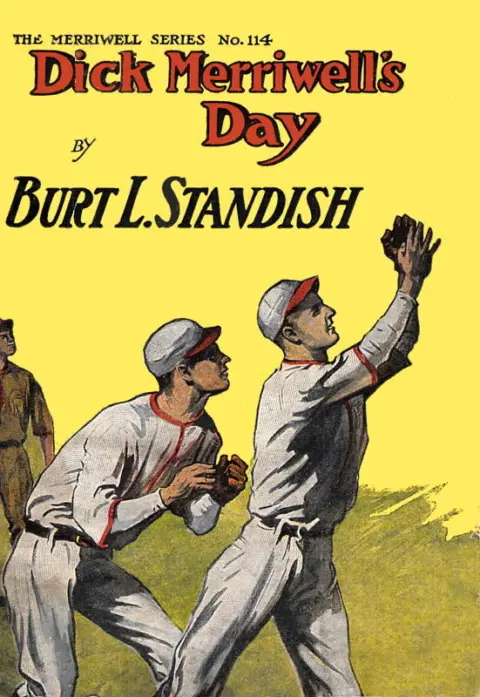
THE CLASSIC COLLECTION · 1904
"Dick Merriwell's Day; Or, Iron Nerve" by Burt L. Standish is a sports novel written in the early 20th century. The story centers around the titular character, Dick Merriwell, who is the captain of the Fairhaven baseball team as they battle for championship glory in a competitive league. The narrative emphasizes themes of sportsmanship, determination, and camaraderie while showcasing the excitement of athletic contests. The beginning of the novel sets the stage for a tight race for the pennant, with the Fairhaven team facing a crucial game against the Rockford team. Following a tense match that ended in defeat for Fairhaven, Dick Merriwell and his teammates prepare for the next game, eager to secure their place in the standings. However, as Dick's friend and catcher, Buckhart, begins to feel unwell for unusual reasons, the atmosphere becomes increasingly fraught with tension. Suspense builds as it is revealed that the opposition is attempting to sabotage Fairhaven, introducing conflict that will play out as the story unfolds. The opening chapters effectively establish a sense of urgency and anticipation for the upcoming game while highlighting the integrity and challenges faced by the characters.
Introduction adapted from the source catalogue; source summaries may be automatically generated.
Free to read · English · 77,733 words · No account needed
MAKE TIME FOR A GOOD BOOK
On by default. Untick to stop anonymous reading totals. Each page counts after 10 seconds in view. How this works.
Anonymous counting is on unless you have switched it off.
They entered the hotel and Chip glanced around in apprehension, as they ascended the stairs, fearing they would be observed. To his relief no one paid any attention to them. Jolliby led the way to the door of a room on which he knocked.
“Come in,” called a voice.
“Jingoes!” exclaimed Chip. “Didn’t know there was anybub-bub-bub-body in there! Jest thought I’d knock and fuf-fuf-fuf-find out!”
He opened the door and stepped in, followed by Blackington, whose curiosity was greatly aroused by this time.
It was Merriwell’s room they entered, and they found Dick and Ray Garrett still pondering over the figures representing the standing of the teams in the league.
“Is it you, Chip?” said Dick. “Why didn’t you come in without stopping to knock? You don’t have to knock on my door. Oh, hello! I see you have some one with you. How do you do, Mr. Blackington?”
Dick rose quickly and stepped forward to meet the president of the league, who shook hands with him cordially.
“Ain’t gug-gug-gug-got no time to chin,” said Jolliby, in a mysterious manner, holding up the key Buckhart had given him. “I want you fuf-fuf-folks to keep mighty still. Where’s that dud-dud-door lead to, Dick?”
As he asked the question he pointed to a door at one side of the room.
“That leads into the next room,” said Dick. “It’s locked.”
“Well, I think we’ll tut-tut-try this key on it,” whispered Jolliby, as he hurried toward the door.
His manner was so unusual that his companions watched him wonderingly. The key unlocked the door and Chip opened it a fraction, peering into the next room.
“All right,” he said, with satisfaction, as he pulled the door softly to, but did not close it entirely.
“Tut-tut-turn out that light, Dick. Come over here, everybody. Get close to this door and kuk-kuk-kuk-keep all-fired still. You’re gug-gug-going to hear something that’ll interest you.”
He checked their questions, and a few minutes later the quartette stood close by the door, silently waiting and listening.
Within three minutes some one entered the adjoining room. This person began to whistle, and Dick knew it was Brad Buckhart.
Less than three minutes after Brad entered that room, there came a knock on his door. On being invited to enter, the person who knocked cautiously opened the door and looked in.
It was Tom Fernald.
“Walk right in, Mr. Fernald,” invited the Texan. “You see I’m all alone here. I’m waiting for you. Thought you might wish to talk to me up here where there’s less danger of being observed or overheard.”
Your reading position is saved on this browser. Take it to another device with a library code. Reading pages adapt to text, rather than matching a printed edition.
Burt L. Standish
Burt L. Standish
Burt L. Standish
Burt L. Standish
BEHIND THE BOOK
This eBook is for the use of anyone anywhere in the United States and most other parts of the world at no cost and with almost no restrictions whatsoever. You may copy it, give it away or re-use it under the terms of the Project Gutenberg License included with this eBook or online at www.gutenberg.org. If you are not located in the United States, you will have to check the laws of the country where you are located before using this eBook. Read the source licence.
The original source file, including credits and licence, is retained by this library. Request an original-format copy at no charge. Please include the book title and Project Gutenberg identifier #61174.
KEEP YOUR CURIOSITY GOING
Coulson Kernahan

Maurice Baring
Frances Wright
Cécile Tormay

Frederic Jesup Stimson

W. H. P. (William Henry Pope) Jarvis