THE CLASSIC COLLECTION✦Frank Merriwell’s dangerCLASSIC FREE BOOKS
Frank Merriwell’s danger
Burt L. Standish
THE CLASSIC COLLECTION · 1910
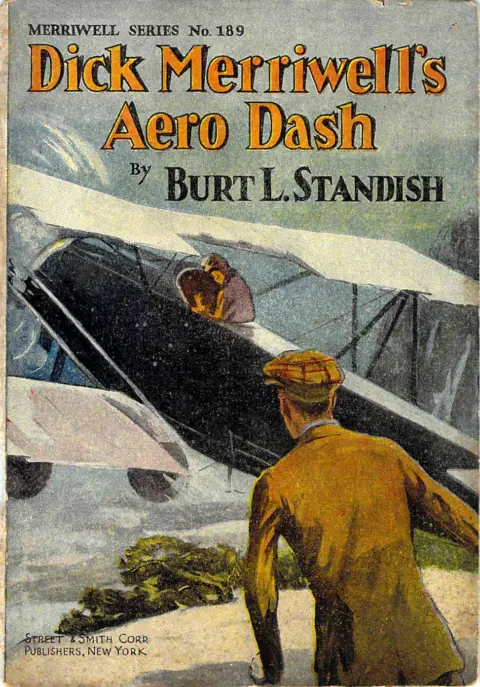
"Dick Merriwell's Aëro Dash; Or, Winning Above the Clouds" by Burt L. Standish is a novel written in the early 20th century. The story revolves around Dick Merriwell and his friends, who are faced with the aftermath of a tragic accident involving a little girl. As the narrative unfolds, themes of responsibility, courage, and the quest for justice take center stage, focusing particularly on Merriwell as he strives to uncover the truth behind the child's injuries. The opening of the book introduces a chaotic scene where a reckless driver, Brose Stovebridge, speeds along a road and tragically hits a young girl who is left injured on the roadside. Instead of helping her, he panics and flees the scene. In stark contrast, Dick Merriwell and his companions come across the injured child soon after, and Merriwell takes charge by carrying her to safety and seeking medical assistance. This encounter sets the stage for the ensuing conflict as Merriwell becomes determined to find out who was responsible for the accident, leading to a tense exploration of guilt, deception, and moral cowardice. With a backdrop of racing and competition, the plot promises to escalate as Merriwell seeks to bring the truth to light.
Introduction adapted from the source catalogue; source summaries may be automatically generated.
Free to read · English · 90,454 words · No account needed
MAKE TIME FOR A GOOD BOOK
On by default. Untick to stop anonymous reading totals. Each page counts after 10 seconds in view. How this works.
Anonymous counting is on unless you have switched it off.
He was altogether too anxious to hit, and somehow, McDonough seemed to divine this, for the miner pulled him with the first two balls handed up, neither of which Stan touched.
“You’ve got him, Bill,” chirped Orren Fairchilds, who stood a little to one side of the plate. “Keep it up.”
“Look out for those wide ones, Stan,” cautioned Gardiner.
Garrick knew he had been fooled into striking at what must have been balls, and he resolved to use better judgment. It seemed likely that, having deceived him in such a manner, McDonough would still seek to lure him into biting at the bad ones, and he resolved not to repeat the error.
The burly Mispah pitcher took his time. Dick was standing beside the mine owner, for it was his turn next at the bat, and suddenly he caught the flash of McDonough’s eye as it was turned in his direction.
It was the briefest possible glance, for the next instant the miner whipped one over the inside corner of the plate with all the speed he could command.
Too late Garrick saw that the ball might be good. He could not get his bat around to meet it, and therefore let it pass, hoping the umpire would call it a ball.
“You’re out!” came sharply from the umpire.
Garrick stepped back and tossed his bat on the ground.
“Too bad, Stan,” Dick said, as he came forward to take his place.
“Take it easy, Merriwell,” Gardiner advised, in a low tone. “It’s better to let him fan you than to strain your arm.”
Dick nodded comprehendingly. All the same he did not intend to strike
out if he could help it.
He squared himself at the plate and faced the pitcher. McDonough turned the ball in his hands, and once more the Yale man caught that brief, almost imperceptible flash of the miner’s eyes toward the right.
Then he toed the plate and sent in a swift one with a sharp outcurve.
Merriwell did not move his bat.
“Ball one!” cried the umpire.
Again McDonough tried a coaxer, but the Yale man refused to bite, nor did he budge when the ball came whistling over the plate a little too high and cut the pan almost on a level with Dick’s neck.
“You’ve got him in a hole,” laughed Gardiner. “He’s going to make you a present of the base.”
McDonough grinned sourly and then put one straight over the centre of
the plate.
Dick played the game and let it pass.
“Strike one!” declared the umpire.
Your reading position is saved on this browser. Take it to another device with a library code. Reading pages adapt to text, rather than matching a printed edition.
Burt L. Standish
Burt L. Standish

Burt L. Standish

Burt L. Standish
BEHIND THE BOOK
This eBook is for the use of anyone anywhere in the United States and most other parts of the world at no cost and with almost no restrictions whatsoever. You may copy it, give it away or re-use it under the terms of the Project Gutenberg License included with this eBook or online at www.gutenberg.org. If you are not located in the United States, you will have to check the laws of the country where you are located before using this eBook. Read the source licence.
The original source file, including credits and licence, is retained by this library. Request an original-format copy at no charge. Please include the book title and Project Gutenberg identifier #64407.
KEEP YOUR CURIOSITY GOING
Coulson Kernahan

Maurice Baring
Frances Wright
Cécile Tormay

Frederic Jesup Stimson

W. H. P. (William Henry Pope) Jarvis