THE CLASSIC COLLECTION✦Frank Merriwell’s dangerCLASSIC FREE BOOKS
Frank Merriwell’s danger
Burt L. Standish
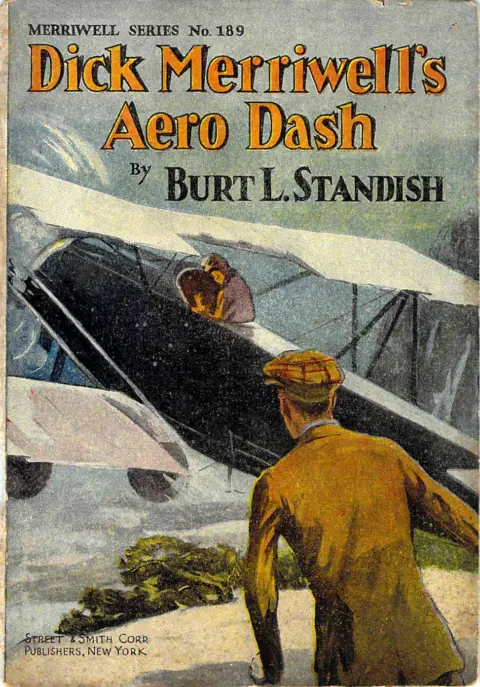
THE CLASSIC COLLECTION · 1910
"Dick Merriwell's Aëro Dash; Or, Winning Above the Clouds" by Burt L. Standish is a novel written in the early 20th century. The story revolves around Dick Merriwell and his friends, who are faced with the aftermath of a tragic accident involving a little girl. As the narrative unfolds, themes of responsibility, courage, and the quest for justice take center stage, focusing particularly on Merriwell as he strives to uncover the truth behind the child's injuries. The opening of the book introduces a chaotic scene where a reckless driver, Brose Stovebridge, speeds along a road and tragically hits a young girl who is left injured on the roadside. Instead of helping her, he panics and flees the scene. In stark contrast, Dick Merriwell and his companions come across the injured child soon after, and Merriwell takes charge by carrying her to safety and seeking medical assistance. This encounter sets the stage for the ensuing conflict as Merriwell becomes determined to find out who was responsible for the accident, leading to a tense exploration of guilt, deception, and moral cowardice. With a backdrop of racing and competition, the plot promises to escalate as Merriwell seeks to bring the truth to light.
Introduction adapted from the source catalogue; source summaries may be automatically generated.
Free to read · English · 90,454 words · No account needed
MAKE TIME FOR A GOOD BOOK
On by default. Untick to stop anonymous reading totals. Each page counts after 10 seconds in view. How this works.
Anonymous counting is on unless you have switched it off.
“That’s some pitching,” he said. “I haven’t had that happen to me in many moons. Now, Edgar, suppose you see what you can do.”
But Morrison was walking rapidly toward him from the pitcher’s box, his hands clenched and his face dark.
“You can’t make a monkey out of me,” he snarled. “I’m through.”
Gardiner looked at him in amazement.
“Do you mean you won’t pitch to-morrow?” he asked.
“Neither to-morrow nor any other day,” snapped Morrison. “Nothing would hire me to pitch on this team after the dirty trick you’ve played bringing a fellow in to make a show of me. Think I’m a fool?”
Gardiner flushed hotly.
“Nobody could make a fool of you,” he said, with sarcastic emphasis. “You seem to have been born that way.”
The angry man disdained any reply.
“Any of my friends will have to choose now between Gardiner and me,” he went on furiously. “If they prefer playing on his team, well and good; but at that moment they cease to be my friends. Understand?”
He cast a significant glance at George Burgess, and, turning on his heel, walked rapidly toward the clubhouse.
Burgess hesitated for an instant and, with a shrug of his shoulders, slowly unbuckled his chest protector and threw it on the ground, together with his mask and mitt. Then he followed Morrison.
The flush had died out of Gardiner’s face, leaving it a little pale. His eyes traveled slowly over the faces of the remaining men.
“Well,” he said quietly, “any more?”
Unconsciously, perhaps, he looked at Roland Hewett, the centre fielder, a slim, fastidious fellow with thin, blond hair and pale blue eyes, whom he knew was another friend of the deserting pitcher. There was a worried, undecided look on his weak face.
“I don’t know----” he stammered. “I--I believe I’ll go and see if he really meant what he said.”
Then he, too, left the group on the diamond and presently disappeared
into the clubhouse.
For a moment no one spoke. Then Reddy Maxwell broke the silence.
“Well, fellows,” he said, with forced cheerfulness, “I should say that the team is better off without a bunch that will desert it at a time like this.”
“But how the deuce are we going to fill their places?” Irving Renworth, the right fielder, asked apprehensively.
“By Jove, fellows. I’m sorry!” Gardiner broke in contritely. “It’s all my fault. I shouldn’t have talked that way to Morrison, knowing how touchy he is.”
Your reading position is saved on this browser. Take it to another device with a library code. Reading pages adapt to text, rather than matching a printed edition.
Burt L. Standish
Burt L. Standish
Burt L. Standish
Burt L. Standish
BEHIND THE BOOK
This eBook is for the use of anyone anywhere in the United States and most other parts of the world at no cost and with almost no restrictions whatsoever. You may copy it, give it away or re-use it under the terms of the Project Gutenberg License included with this eBook or online at www.gutenberg.org. If you are not located in the United States, you will have to check the laws of the country where you are located before using this eBook. Read the source licence.
The original source file, including credits and licence, is retained by this library. Request an original-format copy at no charge. Please include the book title and Project Gutenberg identifier #64407.
KEEP YOUR CURIOSITY GOING
Coulson Kernahan

Maurice Baring
Frances Wright
Cécile Tormay

Frederic Jesup Stimson

W. H. P. (William Henry Pope) Jarvis